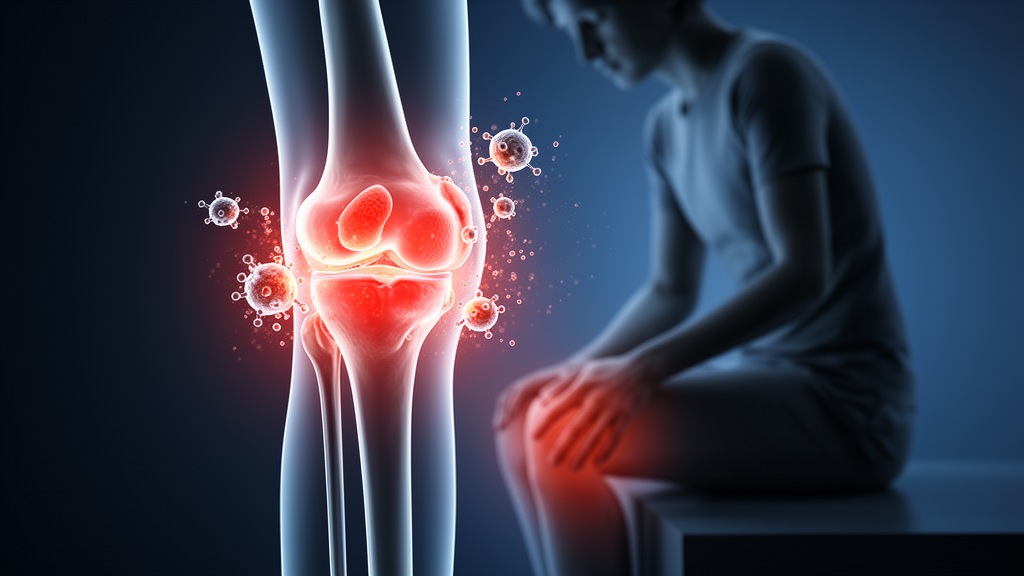
For decades, rheumatologists have documented a frustrating pattern: patients with rheumatoid arthritis whose disease seemed well controlled suddenly experience painful flares after periods of intense psychological stress. The clinical association between stress and worsening arthritis has been so consistent that it appears in patient surveys and clinical observations worldwide, yet the biological mechanism connecting an emotional state to inflammation inside the joint has remained one of the most stubborn mysteries in autoimmune research. Now, a team of researchers in Japan has traced that connection step by step, revealing a signaling chain that runs from the brain through body fat and into the joint lining, where it reignites inflammation even after the disease has slipped into remission.
The study, conducted at Chiba University in collaboration with Asahi General Hospital and International University of Health and Welfare Narita Hospital, was led by Assistant Professor Shigeru Tanaka and Professor Hiroshi Nakajima of the Graduate School of Medicine at Chiba University. Their findings, published in the journal Science Advances on October 16, 2026, identify a stress-responsive pathway that depends on the inflammatory signaling protein interleukin-6, or IL-6. The work provides what the researchers describe as a biological explanation for how psychological stress can reactivate joint inflammation independently of the lymphocytes traditionally blamed for autoimmune disease.
To capture the phenomenon of stress-induced flares, the team used a mouse model of autoimmune arthritis in which the disease was first allowed to enter a remission-like state. The animals were then exposed to restraint stress, a standard laboratory method for inducing psychological stress in rodents. Following the stress exposure, the researchers observed that inflammation flared back to life in joints that had previously quieted down. This experimental design was critical, because it separated the question of how stress initiates arthritis from the arguably more puzzling question of how stress resurrects inflammation in tissue that appeared to have healed.
Using tissue analysis, immune-cell profiling, and molecular measurements, the researchers traced the inflammatory signals activated by stress. The experiments revealed that psychological stress switches on the sympathetic nervous system, the branch of the nervous system responsible for the fight-or-flight response. This activation targets brown adipose tissue, a specialized form of body fat best known for generating heat. When stimulated by stress-related neural signals, the brown fat releases IL-6 into the circulation, turning a fat depot into an unexpected source of inflammatory signaling. The observation suggests that the effects of stress on arthritis extend well beyond the immune cells conventionally associated with autoimmunity.
The next question was which cells inside the joint respond to this circulating IL-6. The answer pointed to fibroblast-like synoviocytes, specialized cells embedded in the synovial tissue that lines and lubricates the joints. IL-6 stimulates these cells to produce CXCL1, a chemokine that functions as a biological beacon for neutrophils, the white blood cells that act as early responders in inflammatory reactions. Attracted by CXCL1, neutrophils flood into the joint, and their accumulation drives the reactivation of inflammation. When the researchers blocked the CXCR2 receptor, which responds to CXCL1, stress-triggered arthritis in the mouse model was significantly reduced.
The team then tested the pathway at multiple points by blocking key receptors and monitoring inflammatory markers, joint swelling, and immune-cell accumulation. When mice were treated with a β3-adrenergic receptor antagonist, a compound that interferes with the stress-related neural signal reaching brown adipose tissue, the researchers observed a coordinated decline across the entire pathway: plasma IL-6 levels dropped, joint swelling diminished, CXCL1 expression fell, and neutrophil accumulation in the joints decreased. The results establish the sequence as a coherent causal chain rather than a loose collection of correlations.
The implications reach beyond laboratory mice. The researchers examined whether this stress-related pathway leaves traces in people with rheumatoid arthritis by analyzing a specific variant of the ADRB3 gene, which encodes the β3-adrenergic receptor. Patients carrying the Trp64Arg variant, which makes cells less responsive to stress-related hormones, showed a weaker link between perceived stress and arthritis activity compared with patients without the variant. The researchers caution that this analysis was observational, so it does not prove that stress directly caused changes in disease activity, but the genetic association offers suggestive human evidence that the pathway identified in mice may be relevant to patients.
One of the most conceptually important findings is the idea that arthritic joints may retain a form of tissue inflammatory memory. According to this view, the joint tissue itself preserves a capacity for inflammation that persists after the visible disease has remitted, and this memory can be reactivated by stress through a pathway that operates independently of lymphocytes. The concept reframes remission not as a complete return to health but as a dormant state in which the joint remains primed for reactivation, with fibroblast-like synoviocytes serving as the tissue-resident switch that stress can flip.
The therapeutic possibilities emerging from this work are notable precisely because the pathway offers a way to intervene without broadly suppressing the immune system. Current rheumatoid arthritis treatments rely heavily on immunosuppression, which leaves patients vulnerable to infections. Targeting the stress-responsive arm of this pathway, for example by modulating β3-adrenergic signaling, IL-6 release, or the CXCL1-CXCR2 axis, could in principle calm stress-triggered flares while leaving the rest of the immune defenses intact. The mouse experiments, in which receptor blockade reduced inflammatory markers and joint swelling, provide early proof that such an approach is feasible.
For the millions of people living with rheumatoid arthritis, the study transforms an old piece of folk wisdom into a concrete molecular map. The journey from a stressful experience to a swollen, painful joint now has identifiable stations: sympathetic nervous system activation, IL-6 release from brown adipose tissue, CXCL1 production by synovial fibroblasts, and neutrophil recruitment through CXCR2. A better understanding of this pathway could guide the development of strategies to anticipate and prevent stress-induced flares, improving disease management and the quality of life of people living with RA. The research also raises broader questions about whether other stress-sensitive inflammatory conditions operate through similar tissue memory mechanisms, a possibility that could reshape how medicine thinks about the body-mind connection in chronic disease.
Subject of Research: Psychological stress reactivates rheumatoid arthritis through an IL-6-dependent pathway linking brown adipose tissue, synovial fibroblasts, and neutrophil recruitment.
Article Title: How psychological stress triggers arthritis flares via an IL-6-dependent pathway
Article References: How psychological stress triggers arthritis flares via an IL-6-dependent pathway. Original publication (Bibliographic details unavailable.)
Image Credits: AI Generated
DOI: Not provided
Keywords: rheumatoid arthritis, psychological stress, interleukin-6, brown adipose tissue, synovial fibroblasts, neutrophils, CXCL1, autoimmunity, psychological, stress, triggers, arthritis
News Source: Ophelia Keating. (October 19, 2026). Psychological Stress Triggers Arthritis Flares Through an IL-6-Dependent Pathway. Scienmag.