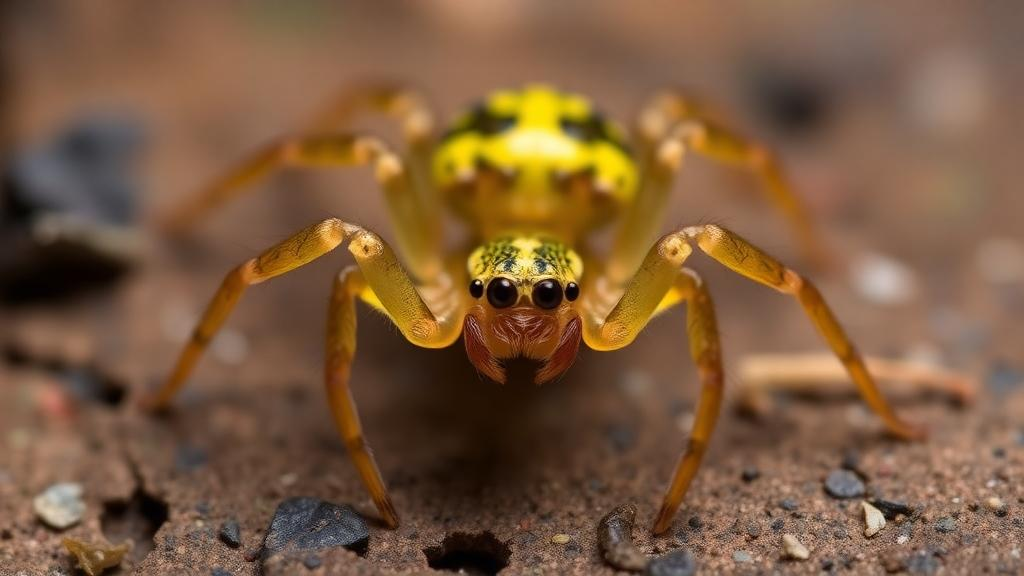
Deep in the limestone caves and shaded rock overhangs of China’s Yunnan–Guizhou Plateau, some of the world’s smallest predators have been quietly diversifying for millions of years. A new study published in Zoosystematics and Evolution has now formally described four previously unknown species of these minute spiders, all belonging to the genus Crassignatha, while simultaneously settling a decades-long debate about where this enigmatic lineage truly belongs on the spider tree of life. Each of the newly named spiders measures less than a millimeter long, small enough to balance comfortably on the tip of a pencil eraser.
The symphytognathid spiders, the family to which Crassignatha belongs, are among the most miniaturized animals on Earth. Adults typically reach about one millimeter in body length, and the family holds the record for the smallest described adult spider: Patu digua, at roughly 0.33 millimeters. Despite occurring on every continent except Antarctica, these spiders remain poorly studied because their cryptic microhabitats—forest leaf litter, soil crevices, and debris piles near cave entrances—make them extraordinarily difficult to find and collect. Only ten living genera and 108 described species are currently known, with no fossil record whatsoever.
Crassignatha itself has had a turbulent taxonomic history since its establishment in 1995 as a genus containing just one species. It was initially shuffled among several spider families: first placed in the subfamily Synaphrinae within a broadly defined Anapidae, then suggested to belong with Symphytognathidae, later catalogued under Mysmenidae, and only definitively confirmed within Symphytognathidae by a phylogenetic study in 2015. The new research provides independent molecular confirmation of that placement, resolving a long-standing uncertainty and aligning with recent phylogenomic findings based on ultraconserved element data.
The research team, collecting during field surveys of karst cave systems on the Yunnan–Guizhou Plateau, gathered numerous micro-spider specimens preserved in 95 percent ethanol. Voucher material is deposited at the Natural History Museum of Sichuan University in Chengdu. The morphological work demanded extraordinary precision: male palps and female epigynes were carefully dissected, female vulval structures were cleared in lactic acid and mounted in Hoyer’s medium on ultra-thin slides for bilateral examination, and images were stacked using Helicon Focus software to achieve full depth of field on structures measured in tenths of a millimeter.
To test the genus’s monophyly—the question of whether all Crassignatha species share a single common ancestor exclusive of other lineages—the researchers sequenced five genetic markers: the mitochondrial 16S rRNA and COI genes, plus the nuclear 18S rRNA, 28S rRNA, and histone H3 genes. Their dataset comprised 21 Crassignatha species as the ingroup, alongside outgroup species from the related genera Kirinua and Patu. Phylogenetic analyses used both maximum likelihood inference with 2,000 ultrafast bootstrap replicates in IQ-TREE and Bayesian inference in MrBayes, running 50 million generations of Markov chain Monte Carlo across two independent runs.
The results were unambiguous. Both analytical frameworks produced fully concordant topologies, recovering Crassignatha as a maximally supported monophyletic group, with 100 percent bootstrap support and a posterior probability of 1.0. Every terminal clade received strong support, and the genus emerged as sister to the Kirinua–Patu outgroup. The analyses also validated the distinctness of all 21 included species, confirming that even in a genus of nearly invisible spiders, species boundaries drawn from reproductive morphology correspond closely to evolutionary reality measured in DNA.
The four new species each carry distinctive genital equipment that separates them from close relatives. Crassignatha hekou, from a cave entrance in Yunnan’s Xundian County, males bear three clasping spurs on the second leg, compared with two in C. yinzhi and one in C. ertou. Crassignatha liangdu, named for Liupanshui City’s reputation as China’s Cool Capital, possesses a long coiled embolus with a distinct basal process and an unusually broad embolic membrane. Crassignatha panlong, from Kunming’s Panlong District, shows a linearly spiraled embolus suspended above the bulb, while Crassignatha qingxu, named after the enormous local Qingxu Cave, stands apart with a long horn-like median apophysis and a forked embolus unlike any other congener.
Beyond the new species, the team documented the first occurrence of the previously known C. shunani outside its type locality, extending its range from Sichuan into Guizhou Province. With 32 described species, Crassignatha now surpasses both Symphytognatha and Patu in species richness, making it the second-largest genus in Symphytognathidae, exceeded only by Anapistula with 34 species—and the most species-rich symphytognathid genus known from China.
Perhaps the most striking insight comes from mapping the phylogeny onto geography. The researchers found that early-diverging lineages occupy the periphery of the genus’s range, a pattern consistent with relictual distributions following early dispersal. Intermediate lineages concentrate in the karst core of the Yunnan–Guizhou Plateau, suggesting gradual expansion from this center, while the most recently diverged species show cross-regional and even disjunct distributions; C. shiluensis occurs in both Yunnan and Hainan, implying transmarine dispersal or an ancient land-bridge connection. The overlapping ranges of the youngest species with transitional lineages may reflect microhabitat partitioning that reduces competition between close relatives.
This diversification appears inseparable from the region’s extraordinary geology. The phased uplift of the plateau and the evolution of major river systems such as the Pearl River likely acted as alternating barriers and corridors, promoting eastward expansion alongside vicariance and allopatric speciation. Fragmented limestone bedrock and cave networks created persistent dispersal barriers that restrict gene flow, while karst topography offered a network of microrefugia during Pleistocene climatic swings. Although not obligate cave-dwellers, these spiders show a pronounced preference for mesic, dark microhabitats, meaning the availability of suitable limestone substrates fundamentally constrains where they can live and reinforces regional endemism. The authors caution that sampling gaps in Guizhou and adjacent karst regions likely mean species richness remains underestimated, and that scarce specimens still leave some species delimited by morphology alone. As systematic cave surveys continue, the world’s smallest spiders may yield many more species—and with them, a sharper picture of how one of Asia’s great biodiversity hotspots was assembled.
Subject of Research: Phylogenetics and taxonomy of the miniature spider genus Crassignatha in China's karst caves
Article Title: Phylogenetic classification of poorly known Crassignatha spiders ( Araneae , Symphytognathidae ), with descriptions of four new species
Article References: Wu, H., & Lin, Y. (2026). Phylogenetic classification of poorly known Crassignatha spiders (Araneae, Symphytognathidae), with descriptions of four new species. Zoosystematics and Evolution, 102(1), 159-179. https://doi.org/10.3897/zse.102.165834
Image Credits: AI Generated
Keywords: Crassignatha, Symphytognathidae, spider taxonomy, karst caves, Yunnan–Guizhou Plateau, molecular phylogenetics, new species, China, biogeography, miniaturized spiders, COI barcoding, allopatric speciation
News Source: Margaret Porter. (October 19, 2026). Four Tiny New Spider Species Emerge from China’s Karst Caves, Resolving a Taxonomic Puzzle. Scienmag.