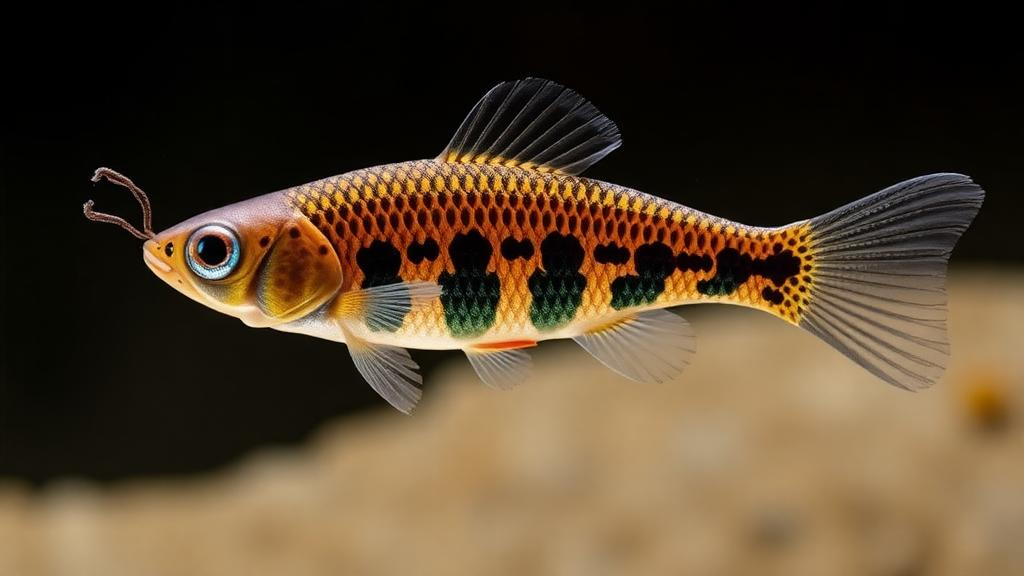
Deep in the seasonal pools of the East African inland plateau, a group of small, brilliantly coloured killifish has been quietly conducting a long-term experiment in genome evolution. A new study published in Comparative Cytogenetics has now charted the chromosomes of twelve members of the Nothobranchius ugandensis species group, revealing a striking pattern: while the overall chromosome count has remained stubbornly stable across millions of years, the internal architecture of those chromosomes has shifted dramatically. The finding offers a rare window into how genomes diversify in small, isolated populations living at the mercy of monsoon rains and desiccating dry seasons.
Annual killifishes of the genus Nothobranchius are among the most extreme life-history specialists in the vertebrate world. All 96 valid species live in ephemeral freshwater pools that appear during seasonal rainfall across north-eastern, eastern and south-eastern Africa, then vanish entirely during the dry season. Their eggs survive buried in dried mud, hatching only when the rains return, producing non-overlapping generations in small, biogeographically isolated populations. This lifestyle, combined with limited dispersal ability, generates strong spatial genetic structure and makes genetic drift, bottlenecks and founder effects powerful forces shaping genome evolution. The genus also includes Nothobranchius furzeri, the vertebrate with the shortest recorded captive lifespan, less than 12 weeks, which has become a model organism for ageing research.
The N. ugandensis species group belongs to the subgenus Zononothobranchius and comprises twelve species distributed from southern Sudan and south-western Ethiopia in the north, through Uganda and Kenya, to central and south-western Tanzania. Each species is tied to a specific drainage system, from the Lake Albert basin and Albert Nile drainage of north-western Uganda to the Katuma system of south-western Tanzania. Males display species-specific colour patterns that serve as important diagnostic characters, ranging from the red and blue-yellow phenotypes of N. ugandensis in southeastern Uganda to the distinctive hues of N. attenboroughi in northern Tanzania, a species named in honour of the renowned naturalist.
In the new investigation, researchers analysed thirty-three individuals belonging to seven species using conventional cytogenetic protocols, describing the karyotypes of these seven species for the first time. Chromosome preparations from adult fish and one- to two-week-old larvae were obtained following established techniques, with larvae held in a dilute colchicine solution before their abdominal organs were dissected, incubated in hypotonic potassium chloride, fixed in methanol-acetic acid, and dropped onto heated slides. Giemsa-stained spreads were examined under an Axioplan 2 imaging microscope, with at least ten complete metaphases analysed per individual. Karyotypes were arranged according to centromere position following the nomenclature of Levan and colleagues, classifying chromosomes as metacentric, submetacentric, or subtelocentric/acrocentric.
The results reveal a remarkable cytogenetic signature. All twelve species share an identical diploid chromosome number of 2n = 36, along with the largest pair of metacentric chromosomes. Yet the number of chromosomal arms, the nombre fondamental or NF, varied widely, ranging from 46 to 64 across the group. Within the seven newly analysed species, NF ranged from 54 in N. moameensis, which had the lowest number of biarmed chromosomes at 18, to 64 in N. derhami, which had the highest at 28. Every species exhibited a different karyotype structure except N. attenboroughi and N. ugandensis, two species that are widely separated geographically and belong to different clades in the molecular phylogeny.
This pattern contrasts sharply with karyotype evolution in many other Nothobranchius species. Across the genus, cytogenetic data for 73 chromosomally characterised representatives indicate chromosome counts ranging from 16 to 50, with N. rachovii exhibiting the lowest diploid number among karyotyped fishes. Many other Nothobranchius species diversified their karyotypes mainly through chromosome fusions and fissions, interchromosomal rearrangements that alter the total chromosome count. The N. ugandensis species group, by comparison, maintains a stable 2n and appears constrained to intrachromosomal structural changes that shift centromere positions without changing chromosome number.
The most probable mechanisms behind these centromeric shifts are pericentric inversions, two-break rearrangements in which the segment between the breaks, containing the centromere, is inverted by 180 degrees and re-inserted into the chromosome. Centromere repositioning, the replacement of an old centromere by a new one located elsewhere on the chromosome, may also contribute, and the researchers cannot exclude reciprocal and non-reciprocal translocations. Notably, no chromosome polymorphism was detected within the sampling, and no heteromorphic sex chromosomes or multiple sex chromosome systems were observed, despite such systems being documented in other Nothobranchius species scattered across the phylogeny.
When the cytogenetic characteristics were superimposed onto a phylogenetic tree based on two mitochondrial genes, Cytochrome oxidase subunit I and NADH dehydrogenase 2, no correlation emerged between karyotype variation and phylogenetic relationships, nor with biogeographic distribution. The phylogeny recovered well-defined clades with strong branch support: N. nubaensis from Sudan and Ethiopia grouped with N. albertinensis and N. ugandensis from Uganda; N. attenboroughi, N. derhami, N. moameensis and N. venustus clustered from systems associated with the Lake Victoria basin; N. hoermanni, N. torgashevi and N. streltsovi formed a central Tanzanian clade; and N. itigiensis and N. kardashevi grouped from central and south-western Tanzania. The absence of correspondence suggests independent parallel processes of karyotype differentiation within the group.
Chromosome inversions are known to suppress recombination in the rearranged region, but only in the heterozygous constitution. While inversion heterozygotes might represent a transient populational polymorphism, they can also be maintained by balancing selection, as inversions lock together sets of adjacent alleles that may confer selective advantages for local adaptation. Such cases have been reported in an increasing number of teleost species. However, neither this study nor previous work detected individuals polymorphic for cytologically detectable inversions, leading the researchers to conclude that inversions were fixed mainly by neutral processes rather than natural selection. Given the structuring into small, isolated populations, the most reasonable explanation for the fixation of these rearrangements is random genetic drift, including bottlenecks and founder effects, consistent with the ability of killifishes to colonise new sites during major floods in the rainy season.
The N. ugandensis species group forms part of the Inland Clade and diverged approximately four million years ago, according to previous molecular dating. The biogeographic relationships among members in central Tanzania can be explained by Palaeo-Lake Manonga, a shallow lake basin formed when rifting at the end of the Miocene ponded east-west rivers in northern Tanzania, providing connections with the Malagarasi system in western Tanzania. The presence of N. ugandensis in Uganda, with N. nubaensis in a basal phylogenetic position, suggests an ancestral dispersal northward through Uganda and along the Nile drainage. Nothobranchius genomes harbour a high amount of repetitive DNA, roughly 60 to 80 percent, capable of facilitating chromosome rearrangements, and a hypothesis worth testing is whether species from the N. ugandensis group exhibit a low proportion of clustered repeats in their genomes, corresponding to the limited rate of interchromosomal karyotype dynamics. Future studies are needed to assess the impact of predicted multiple inversions on genome evolution and species diversification within this remarkable lineage of seasonal fishes.
Subject of Research: Karyotype differentiation and centromeric shifts in the Nothobranchius ugandensis species group of East African annual killifishes
Article Title: Karyotype differentiation in the Nothobranchius ugandensis species group ( Teleostei , Cyprinodontiformes ), seasonal fishes from the east African inland plateau, in the context of phylogeny and biogeography
Article References: Krysanov, E. Y., Nagy, B., Watters, B. R., Sember, A., & Simanovsky, S. A. (2023). Karyotype differentiation in the Nothobranchius ugandensis species group (Teleostei, Cyprinodontiformes), seasonal fishes from the east African inland plateau, in the context of phylogeny and biogeography. Comparative Cytogenetics, 17(1), 13-29. https://doi.org/10.3897/compcytogen.v7.i1.97165
Image Credits: AI Generated
DOI: 10.3897/compcytogen.v7.i1.97165
Keywords: Nothobranchius, annual killifish, karyotype evolution, pericentric inversion, centromere repositioning, genetic drift, East Africa, Comparative Cytogenetics, seasonal wetlands, phylogeny, biogeography, chromosome arms
News Source: Gavin Prescott. (October 19, 2026). Stable chromosomes, shifting centromeres: how East African killifish rewrite karyotype evolution. Scienmag.