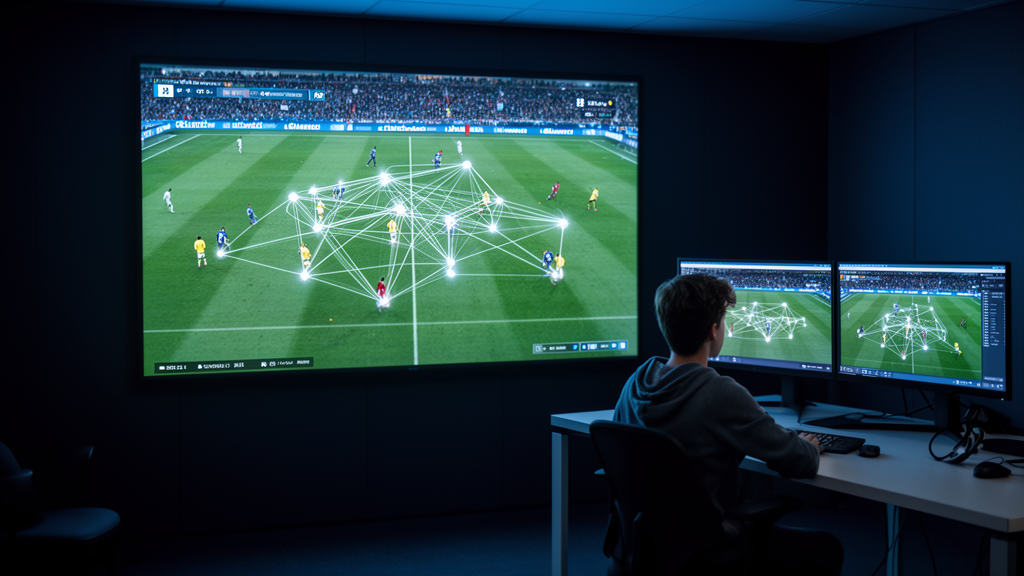
A football match is, at its core, a constantly shifting network. Twenty-three moving entities—twenty-two players and a ball—interact through passes, marks, runs, and blocks, and the meaning of any single moment depends on how all of those relationships evolve together. A new study published in Discover Artificial Intelligence argues that this relational structure is precisely what artificial intelligence should be modeling directly, rather than forcing video pixels through generic pattern recognizers. The proposed system, a Spatio Temporal Graph Network (STGN), turns broadcast footage into a living graph and uses it to detect key events and decode tactical patterns with accuracy and speed that outperform established deep learning baselines.
The challenge the study addresses is deceptively hard. Sports videos feature fast interactions between players and the ball, frequent occlusions, sudden viewpoint changes, and outcomes shaped by tactical intentions that are never explicitly visible on screen. Conventional approaches have struggled to capture this. Three-dimensional convolutional networks can learn spatio-temporal features from raw pixels, but they typically slice long videos into independent short segments, destroying the global temporal context in which events unfold. Long short-term memory networks model temporal dependencies, yet they compress video into one-dimensional feature sequences and discard the spatial interactions between players that are the most discriminative signals in a match. Even Transformers, with their long-range attention, suffer from quadratic growth in computation as frame counts increase and carry no built-in bias toward entity relationships.
The core insight behind STGN is borrowed from other domains where interacting entities evolve over time: traffic flow prediction, molecular dynamics simulation, and social network analysis. In those fields, research has repeatedly shown that when a system consists of multiple interacting entities whose evolution depends on both local spatial neighborhoods and long-range temporal dependencies, deeply integrating graph neural networks with sequence models significantly outperforms architectures that process space and time separately. The study applies that lesson to sport by treating players and the ball as heterogeneous nodes in a dynamic graph, connecting them with semantically meaningful edges, and encoding the whole sequence jointly.
The pipeline begins with perception. A quantized and pruned YOLOv8 detector locates players in each broadcast frame, while a lightweight classification branch distinguishes teammates, opponents, and referees using color histograms, texture features, and temporal position consistency. The ball, notoriously small and fast-moving, is handled by a cascaded scheme: optical flow first isolates motion-salient candidate regions, and a small convolutional network then evaluates each candidate for ball presence and precise location. Kalman filters model the motion state of every target so that positions can be predicted through occlusions, and Hungarian matching associates detections with existing tracks using a weighted combination of Mahalanobis motion cost and ResNet-18 appearance features. The result is a structured stream of positions, velocities, roles, and possession flags for every entity on the pitch.
Those outputs are then organized into a dynamic heterogeneous graph for every frame. Player-player edges are weighted by a Gaussian radial basis function of Euclidean distance, preserving continuous differences in proximity rather than applying a hard threshold. A special fixed-weight possession edge links the ball to whichever eligible player is nearest within a defined control threshold, while distance-weighted player-ball edges extend the ball’s influence to everyone else on the field. Because players enter and leave the camera’s view, node counts fluctuate from frame to frame; the framework handles this with an identity-based alignment strategy in which a binary mask indicates each node’s presence, and missing frames simply carry the previous hidden state forward, maintaining temporal continuity.
Encoding proceeds in two coupled stages. A heterogeneous graph convolution layer aggregates messages separately for each edge type, using type-aware projection matrices and attention-style aggregation coefficients, with residual connections and layer normalization stabilizing learning. Player and ball node features are first mapped into a common space through type-aware linear projections. The spatially enhanced node features then flow into gated recurrent units that model each entity’s evolution across the clip, while average pooling over all nodes and frames produces a global clip-level representation. Two prediction heads operate on top: a feedforward network that classifies key events from the global representation, and a tactical branch that recognizes both clip-level tactical patterns and node-level player roles from the fine-grained temporal states.
Crucially, the framework does not treat event detection and tactical analysis as separate chores. They share the same spatio-temporal encoder and are optimized through a joint weighted loss, allowing tactical labels to act as contextual priors for event recognition and event labels to sharpen features for tactical understanding. Experiments on the SoccerNet v3 benchmark—830 full matches with annotations for seventeen event types, supplemented by analyst-labeled tactical patterns and player roles—show the payoff. STGN reaches a mean average precision of 79.5 percent for key event detection, a macro-average F1 of 80.7 percent for tactical pattern recognition, and a silhouette coefficient of 0.62 for player role clustering, all while running at 52.8 frames per second on Tesla V100 GPUs with a moderate 31.2 million parameters. Statistical tests, including paired t-tests and Wilcoxon signed-rank comparisons against SlowFast, VideoMAE, ST-GCN, HIGRID+TCN, and MT-Net, confirm the gains are not random variation.
The interpretability results may be the most striking part. Attention weight visualizations show a ball-carrying player node assigning its highest aggregation weight of 0.92 to the ball itself, followed by 0.85 to the nearest defending player and 0.78 to a forward-running teammate—distant opponents and the goalkeeper receive weights as low as 0.29 and 0.20. The distribution matches exactly what a coach would describe as tactically important. A t-SNE analysis of learned player features reveals six well-separated role clusters, with defensive roles grouped distinctly from attacking ones and even full backs and wingers, whose field positions overlap, remaining moderately separated. A variant lacking the graph structure achieved a silhouette coefficient of only 0.34 with heavy cluster overlap, underscoring how much the relational modeling contributes. Temporal localization is similarly precise: goal-event predictions land within a mean absolute error of 0.28 seconds of ground truth, without any post-hoc alignment module.
Ablation experiments isolate each component’s contribution. Removing the graph structure entirely causes the largest collapse, dropping event mAP to 62.3 percent and tactical F1 to 63.5 percent, while replacing heterogeneous convolution with homogeneous aggregation, deleting spatial edges, disabling the temporal GRU, or training without multi-task supervision each produce significant degradation. Clip length analysis shows performance rising from 71.2 percent at 32 frames to a peak of 79.5 percent at 64 frames before declining slightly with longer windows, indicating that the model exploits genuine temporal context rather than simply accumulating noise.
The author notes limitations, particularly the fragility of detection and tracking when the ball is severely occluded or speeds out of view, and points toward future work with temporal graph networks whose edge weights evolve across frames to capture marking switches and formation contractions. Even so, the framework offers something the field has lacked: a single, real-time-capable system that sees a match the way analysts do—not as pixels, but as a web of relationships under continuous negotiation. For intelligent refereeing, tactical training support, and automated content understanding, that structural lens may prove to be the difference between recognizing that something happened and understanding why.
Subject of Research: Spatio-temporal graph networks for key event detection and tactical analysis in sports videos
Article Title: Research on key event detection and tactical analysis in sports videos via spatio temporal graph network
Article References: Hei, W. (2026). Research on key event detection and tactical analysis in sports videos via spatio temporal graph network. Discover Artificial Intelligence, 6(1), Article 1235. https://doi.org/10.1007/s44163-026-02271-3
Image Credits: AI Generated
DOI: 10.1007/s44163-026-02271-3
Keywords: spatio-temporal graph network, sports video analysis, key event detection, tactical analysis, graph neural networks, SoccerNet v3, multi-object tracking, heterogeneous graph convolution, multitask learning, player role classification, computer vision, deep learning
News Source: Blake Davidson. (October 18, 2026). Graph Networks Learn to Read the Hidden Tactics Inside Sports Videos. Scienmag.