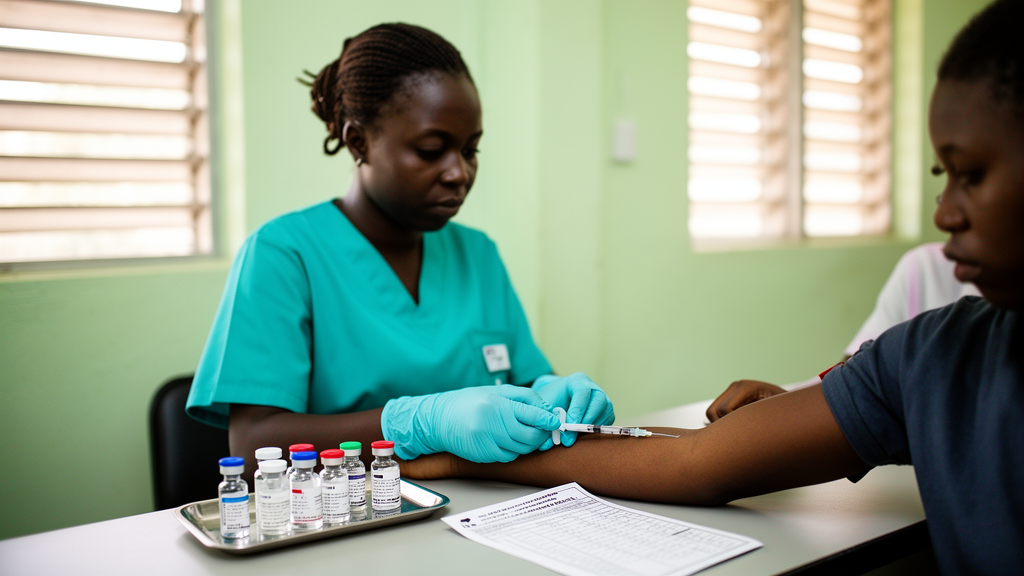
A cross-sectional study of 625 healthcare workers in Kumasi, Ghana, has exposed a troubling gap between the protection that exists on paper and the protection that actually reaches the people who handle needles for a living. Published in BMC Health Services Research, the survey found that while roughly six in ten workers had completed the recommended three-dose hepatitis B vaccine series, only about one in seven of those fully vaccinated had ever undergone the post-vaccination antibody test that confirms the shots actually worked. At the same time, more than a third of all participants reported a needlestick injury, the single most direct route by which the virus passes from patient to clinician. The result is a workforce that is simultaneously exposed to frequent sharps injuries and largely unaware whether its immunization has taken.
The biology behind the concern is straightforward. Hepatitis B virus is far more infectious than HIV, surviving outside the body for up to seven days and requiring a much smaller inoculum to establish infection. A hollow-bore needle contaminated with infected blood can deliver enough virus to seed an infection in a matter of seconds, which is why occupational health guidelines worldwide treat healthcare workers as a priority group for vaccination. But vaccination is a two-step proposition. The three-dose series provokes an antibody response in the vast majority of recipients, yet a meaningful minority — often estimated at five to ten percent of healthy adults — fail to develop protective levels of anti-hepatitis B surface antibodies after the standard schedule. Without post-vaccination testing, those non-responders walk the same hospital corridors as everyone else, carrying a certificate of immunity that may be worthless.
The Kumasi survey, conducted across four hospitals between November and December 2023, quantified just how rarely that second step happens. Of the 625 workers enrolled, 61.6 percent had received at least three vaccine doses. Among those fully vaccinated, a mere 15.2 percent had undergone post-vaccination testing. Awareness was even thinner: only 25.4 percent of all participants knew that post-vaccination testing existed as a guideline at all. In practical terms, the study suggests that most vaccinated staff in these hospitals have never verified that their immunization protected them, and most of their colleagues have never heard that such verification is possible.
The needlestick findings compound the risk. 34.9 percent of participants reported having sustained a needlestick injury, and the statistical analysis identified two groups at sharply elevated odds: clinicians, whose adjusted odds of injury were nearly nine times those of other roles, and permanent staff, whose odds were roughly double those of temporary or contract workers. The clinician figure makes intuitive sense — physicians and clinical officers perform injections, suturing, and procedures at the highest rate — but the permanent-staff association is more revealing. It suggests that cumulative exposure over years of employment, rather than inexperience, drives injury risk, and that the people most likely to stay in the system long enough to benefit from vaccination are also the people most likely to need it.
When the researchers modeled who actually completed vaccination, a consistent social gradient emerged. Workers aged 31 to 40 were more than three times as likely to be fully vaccinated as the youngest cohort, and married participants more than twice as likely as unmarried ones. Occupational category mattered even more: laboratory scientists showed fourfold higher odds of full vaccination and nurses and midwives roughly threefold, compared with other roles. Permanent staff were about twice as likely as non-permanent staff to have completed the series. The pattern points to a structural explanation rather than a motivational one — workers with stable contracts, longer institutional tenure, and clearer occupational identity are more likely to have been offered, reminded about, and able to finish a three-dose schedule that spans six months.
Employment status echoed through every stage of the compliance chain. Permanent staff not only vaccinated more often; they were also more than twice as likely to know about post-vaccination testing and more than four times as likely to have actually undergone it. In a health system where a large share of frontline workers are employed on temporary or informal arrangements, the study implies that the very design of the workforce funnels preventive care toward the permanently employed and away from everyone else. A contract nurse who rotates between facilities may never encounter the occupational health office that would schedule her antibody check, even if she completes her vaccine series on her own initiative.
The authors used purposive sampling and investigator-administered questionnaires, analyzing the data with chi-square tests and multivariable logistic regression in SPSS and GraphPad Prism. That design carries the usual caveats of cross-sectional research: it captures a snapshot rather than a trajectory, cannot establish that any factor causes the outcomes, and — because participants were recruited purposively rather than randomly — the prevalence estimates may not generalize precisely to the Ashanti Region’s healthcare workforce as a whole. Self-reported vaccination and injury histories also depend on memory and record-keeping. None of these limitations, however, plausibly explains away the central imbalance: a workforce with high injury exposure and near-universal failure to verify immunity.
The stakes extend beyond the individual clinician. An unvaccinated or non-immune healthcare worker who contracts hepatitis B may transmit it to patients through occupational exposure, and chronic infection acquired in adulthood carries a significant lifetime risk of cirrhosis and liver cancer. Ghana’s national immunization program has vaccinated infants against hepatitis B since 2002, which protects the next generation but leaves today’s adult workforce — born before the program existed — dependent on occupational vaccination. The Kumasi data suggest that dependency is not being met, and that the gap is invisible precisely because everyone assumes the vaccine worked.
The study’s recommendations are correspondingly concrete. The authors call for regular training on hepatitis B infection prevention, free vaccination for healthcare workers, active follow-up by facility managers to ensure all three doses are completed, and routine arrangement of post-vaccination testing once the series is finished. The cost argument is difficult to dispute: a complete vaccine series and a single antibody test cost a fraction of the lifetime treatment of one chronic infection, and the intervention targets a workforce that is already assembled, already scheduled, and already exposed. What the study documents is not a knowledge deficit about hepatitis B itself — most healthcare workers understand the disease — but a systems failure in the unglamorous machinery of follow-up, reminder, and verification.
For occupational health planners well beyond Ghana, the findings read as a warning about the quiet collapse of the last mile of immunization programs. Getting a healthcare worker to accept a first dose is the easy part; ensuring dose two arrives on schedule, dose three six months later, and an antibody check after that requires institutional persistence that temporary staffing, high turnover, and underfunded occupational health services erode. The Kumasi survey measured that erosion precisely: 61.6 percent vaccinated, 15.2 percent tested, 25.4 percent aware the test exists, and one in three already stuck by a contaminated needle. Until the follow-through matches the exposure, the region’s hospitals will keep employing workers whose protection against one of medicine’s most preventable occupational infections is, in the most literal sense, unverified.
Subject of Research: Hepatitis B vaccination compliance and needlestick injury risk among healthcare workers in Ghana
Article Title: Low compliance rate to hepatitis B vaccination and post-vaccination guidelines amidst high incidence of needlestick injuries among healthcare workers in Ashanti region, Ghana: a cross-sectional study
Article References: Obeng, M. A., Okwan, D. K., Boateng, C. O., Takyi, P., Scott, G. Y., Antwi, P. B., Atisu, P. D., Abrampah, A. A., Ahadzie, S. Y. N., Boakye, F. K., & Boateng, D.-G. K. O. (2026). Low compliance rate to hepatitis B vaccination and post-vaccination guidelines amidst high incidence of needlestick injuries among healthcare workers in Ashanti region, Ghana: a cross-sectional study. BMC Health Services Research. https://doi.org/10.1186/s12913-026-15678-6
Image Credits: AI Generated
DOI: 10.1186/s12913-026-15678-6
Keywords: hepatitis B, healthcare workers, needlestick injuries, post-vaccination testing, Ghana, occupational health, vaccination compliance, cross-sectional study, Kumasi, BMC Health Services Research, infection prevention, immunization
News Source: Kristina Jarvis. (October 18, 2026). Ghana’s Nurses Face Hepatitis B Risk as Vaccination Follow-Through Collapses. Scienmag.