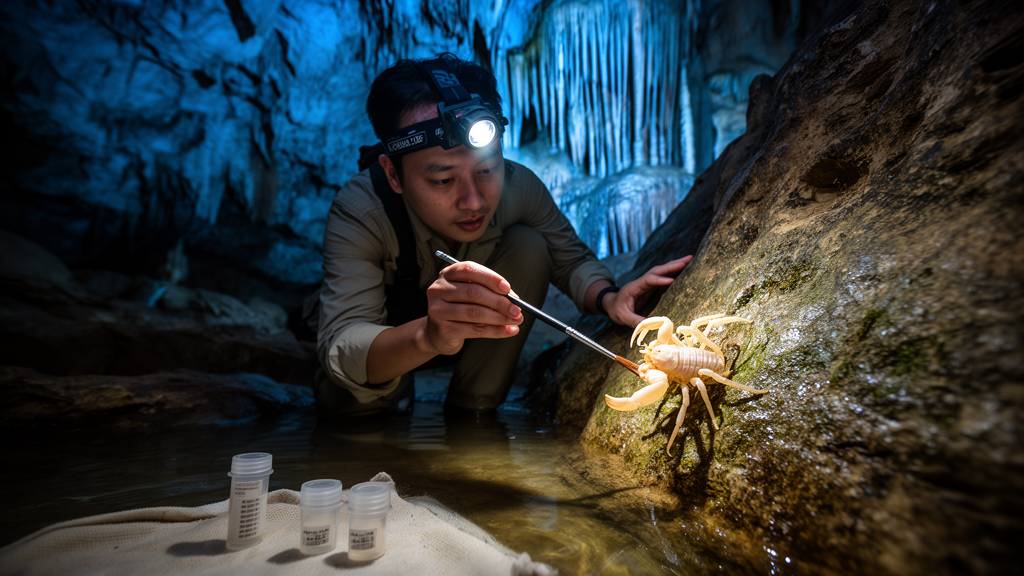
Researchers have formally described three new species of cave-dwelling pseudoscorpions from the Guangxi Zhuang Autonomous Region in southern China, significantly expanding the known diversity of the genus Tyrannochthonius in the area. These tiny arachnids, belonging to the family Chthoniidae, were collected from hypogean habitats and represent a notable addition to the subterranean fauna of the Southwest China Karst region. The discovery highlights the ongoing trend of explosive growth in the number of described cave-dwelling pseudoscorpion species in China, a region that has become a focal point for subterranean biology research in recent years.
The three newly identified species are Tyrannochthonius rudongyanensis, Tyrannochthonius tiani, and Tyrannochthonius yanwuensis. Prior to this study, only one species of this genus, Tyrannochthonius chixingi, was known from Guangxi. The new findings bring the total count of hypogean Tyrannochthonius species in the province to four, underscoring the high level of endemism and biodiversity hidden within the limestone caves of the region. These organisms are part of a broader group of 42 Tyrannochthonius species recorded in China, the majority of which are adapted to life in the dark, stable environments of the karst landscape.
Tyrannochthonius rudongyanensis was named after its type locality, Rudongyan Cave, located in Xingan County, Guilin City. The holotype is a male specimen, with paratypes including both males and females collected from the same cave at different elevations. The species is characterized by its moderately sized troglomorphic body, featuring elongated appendages and a carapace completely lacking eyes or eyespots. This absence of visual organs is a classic adaptation to permanent darkness, where energy is redirected from maintaining complex sensory structures to other physiological functions essential for survival in the cave ecosystem.
The diagnosis of T. rudongyanensis reveals specific morphological traits that distinguish it from similar species such as T. multidentatus and T. antridraconis. Notably, it possesses both chelal fingers with intercalary teeth, a feature shared with its relatives but differentiated by the specific arrangement and length of the pedipalpal segments. The femur of the pedipalp is significantly shorter in T. rudongyanensis compared to these similar species, measuring approximately 0.88 to 0.93 mm in length. Additionally, the teeth on the chelal fingers are short and upright, contrasting with the longer, retrorse teeth found in related taxa, which likely reflects differences in prey capture strategies or environmental adaptations.
The second new species, Tyrannochthonius tiani, was named in honor of Prof. Mingyi Tian, who participated in the fieldwork and collected the holotype specimen. This species was discovered in Ganxiao Cave within the Mulun National Nature Reserve in Huanjiang County, Hechi City. The holotype is a female, and the species is distinguished by its exceptionally slender pedipalps. The femur of the pedipalp is 9.43 times longer than it is broad, a ratio that is notably higher than that of its closest relative, T. nanxingensis. This extreme elongation is another troglomorphic trait, potentially enhancing the animal’s ability to navigate narrow crevices or detect prey in the confined spaces of the cave.
T. tiani differs from T. nanxingensis in several key characters, including the thickness of the chela and the shape of the chela teeth. In T. tiani, the chela is thinner, with a length-to-breadth ratio of 9.42, whereas in T. nanxingensis, this ratio is 7.12. Furthermore, the movable chelal finger of T. tiani features macrodenticles, which are larger, more pronounced teeth compared to the smaller teeth found in T. nanxingensis. These subtle morphological differences are critical for taxonomic identification and suggest that these species have diverged sufficiently to warrant separate classification, likely driven by isolation in different cave systems over evolutionary time.
The third species, Tyrannochthonius yanwuensis, was named after Yanwu Cave in Leye County, Baise City. The holotype is a male specimen, and the species is characterized by the presence of intercalary teeth on both chelal fingers, a trait it shares with T. akaelus. However, T. yanwuensis is distinguished by the number of setae on its tergites, specifically on tergites III and IV, where it has two setae on each, compared to three and four, respectively, in T. akaelus. This difference in chaetotaxy, or the arrangement of sensory hairs, is a reliable diagnostic feature used by arachnologists to differentiate between closely related species in the genus.
All three new species exhibit pale yellow coloration with slightly darker black chelicerae, carapaces, pedipalps, and tergites, while their soft parts remain pale. This lack of pigmentation is another hallmark of troglomorphs, as the production of melanin and other pigments is energetically costly and offers no selective advantage in the absence of light. The specimens were collected from under clods and rocks inside the caves, indicating a preference for sheltered microhabitats that provide humidity and protection from disturbances. The distribution map provided in the study shows the specific locations of these four species in Guangxi, highlighting the geographic separation that may have contributed to their speciation.
The Southwest China Karst region, which spans eight provinces and is centered around the Yunnan-Guizhou Plateau, is recognized as a hotspot for pseudoscorpion diversity. The first cave-dwelling pseudoscorpion in China was described in 1995, but interest in this group has surged in recent years, with numerous new species being reported from Guizhou and other neighboring provinces. The current study adds to this growing body of knowledge, demonstrating that even in well-studied areas, new species continue to be discovered. The detailed illustrations and measurements provided in the paper, including the specific ratios of body parts and the arrangement of trichobothria, offer a comprehensive baseline for future comparative studies.
These findings contribute to our understanding of subterranean evolution and the mechanisms driving speciation in isolated cave environments. The presence of multiple distinct species in a relatively small geographic area suggests that the karst landscape, with its network of disconnected caves, acts as a series of natural laboratories for evolution. As research continues, it is likely that further surveys of the caves in Guangxi and the broader Southwest China Karst region will reveal additional new species, further enriching the global inventory of pseudoscorpion diversity and providing new insights into the biology of life in the dark.
Subject of Research: Discovery of three new cave-dwelling pseudoscorpion species in Guangxi, China
Article Title: Three new cave-dwelling species of Tyrannochthonius Chamberlin, 1929 ( Pseudoscorpiones , Chthoniidae ) from Guangxi, China
Article References: Sun, J., Guo, X., & Zhang, F. (2025). Three new cave-dwelling species of Tyrannochthonius Chamberlin, 1929 (Pseudoscorpiones, Chthoniidae) from Guangxi, China. Subterranean Biology, 51, 115-133. https://doi.org/10.3897/subtbiol.51.146465
Image Credits: AI Generated
DOI: 10.3897/subtbiol.51.146465
Keywords: pseudoscorpions, cave biology, Guangxi, Tyrannochthonius, new species, subterranean fauna, karst region, arachnology, troglomorphs, biodiversity, Three, cave-dwelling
News Source: Drew Townsend. (October 18, 2026). Three New Cave Pseudoscorpion Species Found in Guangxi. Scienmag.