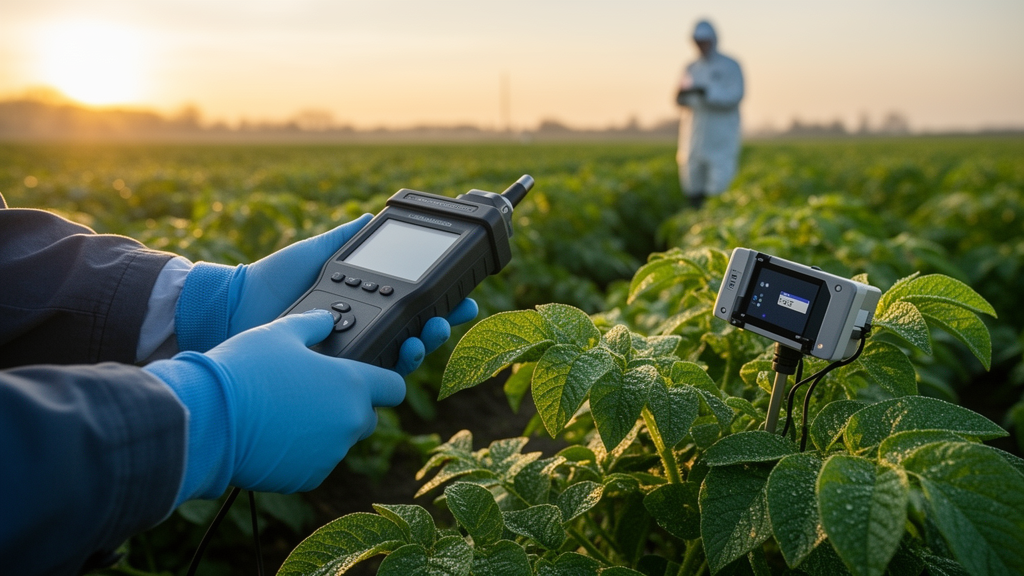
Potato late blight, caused by the oomycete Phytophthora infestans, remains one of the most destructive threats to global potato cultivation, capable of wiping out entire harvests under favorable environmental conditions. Traditional detection methods often rely on visual inspection or molecular assays that require tissue sampling, meaning farmers typically identify the disease only after significant damage has occurred. A new study published in Results in Optics demonstrates that combining two non-invasive spectroscopic techniques can detect the pathogen in potato leaves before any visible symptoms manifest, offering a potential breakthrough for precision agriculture and early intervention strategies.
The research, led by scientists from Sapienza University of Rome and other European institutions, utilized Fiber Optic Reflectance Spectroscopy (FORS) and Terahertz Time-Domain Spectroscopy (THz-TDS) to analyze intact potato leaves of the Agata cultivar. By measuring spectral signatures at specific points on the leaves, the team was able to distinguish between healthy tissue, early-stage infection at two days post-inoculation, and advanced necrosis at four days post-inoculation. The key finding is that both techniques reveal physiological and structural changes in the leaf tissue that precede the visible appearance of chlorotic or brown lesions, which typically emerge around the fourth day after infection.
Fiber Optic Reflectance Spectroscopy operates in the visible to near-infrared range, capturing how light reflects off the leaf surface. This method is highly sensitive to the concentration of photosynthetic pigments such as chlorophyll and carotenoids, as well as the internal cellular structure of the leaf. In healthy leaves, the reflectance spectrum shows a characteristic “red edge,” a sharp transition from low reflectance in the red region to high reflectance in the near-infrared. The study found that this red edge position shifts to lower wavelengths as the infection progresses, indicating a decline in chlorophyll content and photosynthetic efficiency. Even at the pre-symptomatic stage of two days post-inoculation, the red edge position shifted significantly compared to healthy controls, providing an early optical marker of stress.
Terahertz Time-Domain Spectroscopy probes the leaf in a different frequency range, from 0.1 to 6 terahertz, which is sensitive to low-frequency molecular vibrations and intermolecular interactions, particularly those involving water. Since liquid water strongly absorbs terahertz radiation, this technique is often used to assess hydration status in plant tissues. The researchers observed that healthy potato leaves exhibit a linear increase in absorbance with frequency, driven primarily by their high water content. However, in leaves infected with P. infestans, the terahertz absorbance profile changed dramatically. At two days post-inoculation, the absorbance at 1.0 terahertz decreased significantly compared to healthy tissue, a change that was statistically distinct despite the lack of visible symptoms. This suggests that the pathogen induces early perturbations in water distribution or cellular integrity that are detectable through terahertz sensing.
As the infection advanced to the necrotic stage at four days post-inoculation, the terahertz spectra revealed even more profound alterations. The absorbance curves for necrotic tissue crossed those of healthy tissue, with higher absorbance at lower frequencies and lower absorbance at higher frequencies. Additionally, a broad absorption band centered around 0.66 terahertz emerged in the necrotic samples, with an amplitude an order of magnitude larger than in healthy leaves. The researchers hypothesize that this band may be associated with the accumulation of flavonoids, such as anthocyanins, which are stress-response pigments produced by the plant during infection. While the exact molecular origin of this band requires further biochemical validation, its presence provides a distinct spectral fingerprint for advanced tissue degradation.
The study highlights the complementary nature of these two spectroscopic methods. FORS provides insights into the biochemical and physiological status of the leaf, such as pigment degradation and photosynthetic stress, while THz-TDS offers information on structural changes and water dynamics. By combining data from both techniques, the researchers were able to create a multiscale assessment of the plant’s health. A principal component analysis of the full spectral datasets confirmed that the three conditions—healthy, early infected, and necrotic—occupy distinct regions in the spectral space, even without using class labels during the analysis. This robust separation suggests that the combined approach could form the basis for automated diagnostic tools capable of classifying disease stages with high accuracy.
The implications for crop management are significant. Current Integrated Pest Management systems prioritize preventive measures and monitoring over reliance on pesticide applications, but effective monitoring requires early detection. The ability to diagnose P. infestans infection before visible symptoms appear allows for targeted and timely interventions, potentially reducing the need for broad-spectrum fungicide treatments. This aligns with the goals of precision agriculture, where data-driven decisions aim to optimize resource use and minimize environmental impact. The non-invasive nature of the spectroscopic techniques means that plants can be monitored repeatedly over time without causing damage, enabling the tracking of disease progression in real-time.
However, the researchers acknowledge several limitations and future directions for the work. The study was conducted on a single potato cultivar under controlled laboratory conditions, and the sample size was limited to three plants per condition. While the spectral changes were consistent across the measured locations, the findings need to be validated across multiple cultivars with varying levels of resistance to the pathogen. Furthermore, the transition from laboratory transmission measurements to field applications presents technical challenges. Field operation would require a reflection configuration rather than transmission, and the instrument would need to account for atmospheric water vapor absorption over longer path lengths. The researchers note that the diagnostic spectral features identified in this study lie in frequency intervals between atmospheric water vapor lines, which is promising for field deployment, but further engineering is required to develop portable, robust systems.
Future research will focus on extending the measurements to multiple commercial cultivars and establishing a dose-response relationship between pathogen load and spectral descriptors. By pairing spectroscopic acquisitions with molecular quantification of the pathogen, such as quantitative PCR, scientists can refine the diagnostic models and improve their predictive power. Additionally, the integration of machine learning algorithms with the spectral data could enhance the ability to classify disease stages and predict progression. The development of a comprehensive terahertz spectral database of compounds involved in pathogenesis will also facilitate accurate interpretation of the signals. These steps are crucial for translating the laboratory findings into practical tools for farmers and plant pathologists.
Ultimately, this work underscores the potential of advanced optical technologies to transform plant disease management. By leveraging the unique sensitivities of visible-near-infrared and terahertz spectroscopy, researchers can uncover hidden physiological changes that precede visible disease symptoms. This early warning capability is essential for protecting crop yields and ensuring food security in the face of climate change and evolving pathogen pressures. As the technology matures and becomes more accessible, it could become a standard component of precision agriculture toolkits, enabling a shift from reactive to proactive crop protection strategies.
Subject of Research: Non-invasive spectroscopic detection of early Phytophthora infestans infection in potato leaves
Article Title: Combined Fibre Optic Reflectance and Terahertz Spectroscopies for the early, non-invasive diagnosis of Phytophthora infestans infection in Solanum tuberosum
Article References: Moffa, C., Beccaccioli, M., Fratini, R. S., Extermann, J., Neri, L., Bertazza, G., Felici, A. C., Reverberi, M., & Petrarca, M. (2026). Combined Fibre Optic Reflectance and Terahertz Spectroscopies for the early, non-invasive diagnosis of Phytophthora infestans infection in Solanum tuberosum. Results in Optics, Article 101186. https://doi.org/10.1016/j.rio.2026.101186
Image Credits: AI Generated
DOI: 10.1016/j.rio.2026.101186
Keywords: potato late blight, terahertz spectroscopy, fiber optic reflectance, plant pathology, precision agriculture, non-invasive diagnosis, Phytophthora infestans, crop monitoring, spectral analysis, early detection, Combined, Fibre
News Source: Alan Morgan. (October 18, 2026). Dual Spectroscopy Detects Potato Blight Before Symptoms Appear. Scienmag.