Credit: Nick Sloff, Penn State
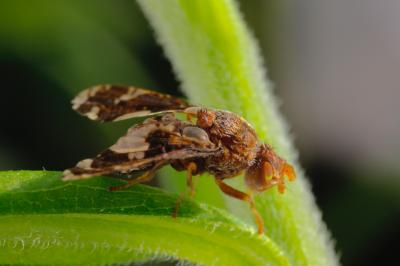
It cannot run away from the fly that does it so much damage, but tall goldenrod can protect itself by first "smelling" its attacker and then initiating its defenses, according to an international team of researchers. "We found another weapon in the arsenal of defenses that plants might employ against their herbivore attackers, in this case eavesdropping on a very specific chemical signal from an herbivore to detect its presence and prepare for future attack," said Anjel Helms, postdoctoral fellow in entomology, Penn State. According to Helms, the gall-inducing flies (Eurosta solidaginis) are specialists that, in Pennsylvania, feed only on tall goldenrod (Solidago altissima). The male flies emit a blend of chemicals that is attractive to females. Once the females arrive and the eggs are fertilized, the females deposit their eggs within the stem of a goldenrod plant. After the eggs hatch, the larvae begin feeding on the tissue inside the stem. Chemicals in the saliva of the larvae are thought to cause the plant to grow abnormally and form a gall, or protective casing of plant tissue, around the larvae. "The flies strongly reduce the plant's fitness by decreasing the number of seeds it produces, as well as the sizes of those seeds," said John Tooker, associate professor of entomology, Penn State. "That's because when the plant's tissues are damaged by the insect, it diverts its energy away from seed production and instead toward production of the gall." Helms and her colleagues previously found that goldenrod plants exposed to chemicals from the male flies produced greater amounts of a defense chemical known as jasmonic acid when they were damaged by herbivores. In their current study, the scientists aimed to identify the specific chemical compounds goldenrod plants are detecting and to determine how sensitive the plants are to the compounds. The researchers, including those at the U.S. Department of Agriculture, the University of Hamburg, Germany, and ETH Zurich, first identified the chemical compounds that make up the male fly's chemical emission. After identifying and quantifying the compounds in the male fly emission, the researchers exposed goldenrod plants to the individual compounds and examined their defense responses. They found that the plants responded most strongly to a compound in the blend called E,S-conophthorin. "E,S-conophthorin is the most abundant compound emitted by the flies," said Helms. "The compound appears to provide a strong and reliable cue for the plants to detect." Next, the team examined goldenrod's sensitivity to E,S-conophthorin by exposing plants to different concentrations of the compound and measuring their defense responses. "We found that goldenrod plants are sensitive to even small concentrations of this compound," said Tooker. "This is significant because it likely means that the plant has a dedicated mechanism to perceive this compound. The results provide evidence that goldenrod can detect a single compound from the fly, supporting the idea that there is a tight co-evolutionary relationship between these two species. In other words, over time, as the fly has adapted to take advantage of the plant, the plant has adapted to protect itself from the fly." The findings appear in today's (Aug. 24) issue of Nature Communications. According to Tooker, the team's previous work was the first to demonstrate a plant "smelling" its herbivore, and its current work is the first to document exactly what compound the plants are detecting. "How plants perceive volatile chemicals is poorly understood," said Tooker, "so having a somewhat unique or distinct molecule to explore that mechanism is promising, and a direction we will explore in the future." Other authors on the paper include Consuelo De Moraes and Mark C. Mescher of ETH Zurich, Armin Tröger and Wittko Francke of the University of Hamburg, and Hans Alborn of the USDA-Agricultural Research Service. The U.S. National Science Foundation, Swiss National Science Foundation, David and Lucile Packard Foundation and ETH Zurich supported this research.
###
Media Contact
A'ndrea Elyse Messer
[email protected]
814-865-9481
@penn_state
http://live.psu.edu