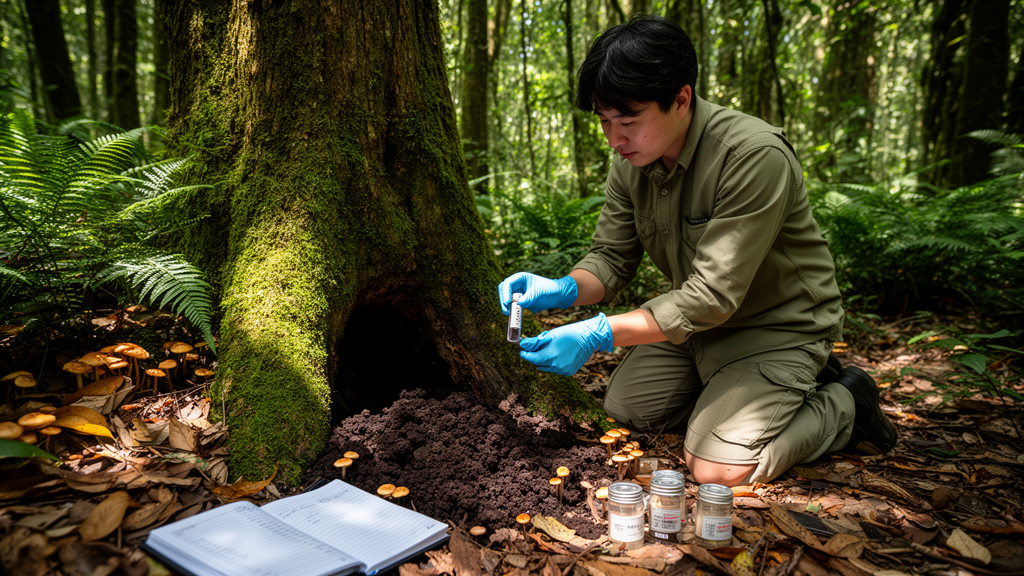
In the rugged karst landscape of Guizhou Province, China, a team of mycologists has identified two previously unknown species of fungi hidden within the nutrient-rich humus of tree holes. The discovery, published in the journal MycoKeys, highlights the ecological potential of these overlooked microhabitats in harboring unique biological diversity. The two new species, Leptobacillium doupengense and Metapochonia doupengshanensis, were isolated from the Doupengshan Scenic Area in Duyun City, a region characterized by its complex topography and heterogeneous environmental conditions. This finding underscores the importance of investigating spatially restricted substrates that have remained largely unexplored in modern fungal taxonomy.
The research team collected humus samples from tree holes in October 2024 and October 2025, transporting them to the laboratory under controlled conditions to preserve microbial integrity. Tree-hole humus represents a distinct microhabitat formed by the accumulation of decomposed plant material and organic residues, creating a nutrient-rich environment that supports diverse microbial communities. Despite its ecological significance, hypocrealean fungi associated with this specific substrate have been poorly investigated compared to fungi found in soil or on host surfaces. The isolation process involved suspending the humus in sterile water, serial dilution, and plating on potato dextrose agar supplemented with antibiotics to inhibit bacterial growth, allowing for the selection of pure fungal colonies.
Using a combined five-gene dataset comprising the internal transcribed spacer (ITS), nuclear small subunit ribosomal RNA (nrSSU), nuclear large subunit ribosomal RNA (nrLSU), translation elongation factor-1 alpha (tef-1α), and the largest subunit of RNA polymerase II (rpb1), the researchers conducted rigorous phylogenetic analyses. These molecular markers were amplified via polymerase chain reaction and sequenced to provide a robust genetic framework for species identification. The phylogenetic trees generated through both Bayesian inference and maximum likelihood methods revealed that the two new isolates formed distinct, well-supported lineages within their respective genera, clearly separated from other known species. This multi-locus approach is essential for resolving complex evolutionary relationships and ensuring accurate taxonomic placement in the order Hypocreales.
Leptobacillium doupengense, belonging to the family Cordycipitaceae, is characterized by its slender conidia and specific morphological traits. On potato dextrose agar, the colonies reached 35–40 mm in diameter after 14 days of growth at 25 °C, displaying a white, raised surface with a pale yellow to orange-yellow reverse. The species produces phialides that are mostly solitary and tapering, with conidia arranged in slender chains that are fusiform to narrowly cylindrical in shape. Phylogenetically, L. doupengense clusters closely with L. xianyushanense but is distinguished by its faster colony growth and smoother surface morphology, as well as specific sequence divergences in the ITS region. The holotype strain, GZUIFR DPS001, is deposited in the Institute of Fungus Resources at Guizhou University, ensuring long-term preservation and accessibility for future research.
Metapochonia doupengshanensis, a member of the family Clavicipitaceae, exhibits morphological similarities to its relative M. rubescens but differs in conidial shape and size. The colonies of M. doupengshanensis are slow-growing, reaching 38–41 mm in diameter, with a white, floccose surface and an orange-yellow to yellow reverse. The conidia are globose to ellipsoidal, produced in slimy heads at the tips of slender phialides. Molecular analysis of the tef-1α gene revealed significant sequence divergence from closely related species, supporting its recognition as a distinct taxon. The isolation of this species from tree-hole humus rather than animal-derived substrates, such as nematode eggs, expands the known ecological range of the genus Metapochonia and suggests potential interactions with microfauna or organic-matter-associated microbial communities within these microhabitats.
The discovery of these two species highlights the critical role of karst ecosystems in fostering fungal diversity. Guizhou Province is known for its rich hypocrealean fungal flora, yet previous studies have primarily focused on fungi isolated from host surfaces, fruiting bodies, or plant-associated substrates. Tree-hole humus, being a spatially discrete and relatively stable microhabitat, offers a unique environment for fungal colonization and evolution. The presence of L. doupengense and M. doupengshanensis in this substrate indicates that such microhabitats may serve as important reservoirs for undocumented fungal taxa. Further surveys combining broader sampling, culture-dependent isolation, and high-throughput sequencing are necessary to fully understand the diversity and ecological functions of hypocrealean fungi in these overlooked niches.
The morphological and molecular evidence provided in this study contributes to the clarification of species diversity and phylogenetic relationships within Leptobacillium and Metapochonia. The genus Leptobacillium, originally proposed in 2016, has seen an increase in accepted species, yet many remain poorly characterized due to limited sequence data in public databases. The accumulation of multi-locus sequence data from newly collected taxa is crucial for improving species delimitation and phylogenetic resolution. Similarly, Metapochonia, established to accommodate species previously placed in Pochonia, continues to reveal new diversity through integrative taxonomic approaches. The detailed descriptions and illustrations of the new species in this study provide valuable reference material for future mycological research and conservation efforts.
The ecological implications of these findings extend beyond taxonomy, offering insights into the roles of fungi in nutrient cycling and organic matter decomposition within karst forests. Tree-hole humus, composed primarily of decomposed plant material, may support fungal lineages involved in the colonization and turnover of plant-derived organic matter. While the specific ecological roles of L. doupengense and M. doupengshanensis require further experimental confirmation, their presence in this substrate suggests a potential association with plant-derived organic substrates. Understanding these interactions is vital for assessing the impact of environmental changes on fungal communities and the broader ecosystem services they provide. The study emphasizes the need for continued exploration of diverse microhabitats to uncover the full extent of fungal biodiversity in China’s karst regions.
Subject of Research: Two new species from tree-hole humus in Guizhou Province, China: Leptobacillium doupengense (Hypocreales, Cordycipitaceae) and Metapochonia doupengshanensis (Hypocreales, Clavicipitaceae)
Article Title: Two new species from tree-hole humus in Guizhou Province, China: Leptobacillium doupengense ( Hypocreales , Cordycipitaceae ) and Metapochonia doupengshanensis ( Hypocreales , Clavicipitaceae )
Article References: Lin, W.-K., Lou, L.-L., Zou, X., & Zhou, Y.-M. (2026). Two new species from tree-hole humus in Guizhou Province, China: Leptobacillium doupengense (Hypocreales, Cordycipitaceae) and Metapochonia doupengshanensis (Hypocreales, Clavicipitaceae). MycoKeys, 137, 299-316. https://doi.org/10.3897/mycokeys.137.196582
Image Credits: AI Generated
DOI: 10.3897/mycokeys.137.196582
Keywords: species, tree-hole, humus, Guizhou, Province, China, Leptobacillium, doupengense, Hypocreales, Cordycipitaceae, Metapochonia, doupengshanensis
News Source: Roger Howard. (October 18, 2026). Tree-Hole Humus Yields Two Novel Fungal Species in China. Scienmag.