Researchers have identified two new species of parasitic fungi and documented a new geographic record for a third within the genus Ophiocordyceps, all found in the subtropical forests of Yunnan Province, China. The discovery, published in the journal MycoKeys, highlights the ongoing biodiversity hidden within the leaf litter of tropical and subtropical regions. These fungi, members of the family Ophiocordycipitaceae, are known for their complex life cycles that involve infecting insects, particularly those in the order Hymenoptera, which includes ants, bees, wasps, and sawflies. The new species, named Ophiocordyceps yuanyangensis and O. gotrae, along with the new record of O. cylindrospora, expand the known diversity of the Hymenostilbe clade, a group of fungi that has attracted significant scientific interest due to its morphological distinctiveness and potential ecological roles.
The genus Ophiocordyceps was first established in 1931 to accommodate a distinct group of species previously classified under Cordyceps. For much of the twentieth century, its taxonomic status was debated, often being treated as a subgenus of Cordyceps. It was not until 2007 that molecular phylogenetic evidence revived the genus and established the family Ophiocordycipitaceae. Today, approximately 420 species are accepted within the genus, with the highest diversity occurring in tropical and subtropical areas. In China alone, more than 30 new species have been described in recent years, underscoring the region’s importance in fungal taxonomy. Most of these species are insect pathogens, infecting a wide range of insect orders, including Blattaria, Coleoptera, Diptera, Hemiptera, Hymenoptera, and Lepidoptera.
The specimens in this study were collected from wet monsoon evergreen broad-leaved forests in Pu’er City and the Honghe Hani and Yi Autonomous Prefecture. The fungi were found emerging from beneath fallen leaves, parasitizing adult hymenopterans. The research team combined detailed morphological observations with multi-gene phylogenetic analyses to confirm the identity of the specimens. Five genetic loci were amplified and sequenced: the nuclear ribosomal small subunit (nrSSU), nuclear ribosomal large subunit (nrLSU), translation elongation factor 1-alpha (tef-1α), and the largest and second largest subunits of RNA polymerase II (rpb1 and rpb2). This multi-locus approach is standard in modern mycology for resolving species boundaries, especially in groups with high levels of morphological similarity.
Phylogenetic analyses placed all five collected specimens within the Hymenostilbe clade of Ophiocordyceps with strong statistical support. Two of the specimens, HKAS 148940 and HKAS 148939, were identified as a new species, O. gotrae, named after its host, the ichneumonid wasp Gotra octocinctus. The other new species, O. yuanyangensis, was named after Yuanyang County, where the holotype was collected from an adult Ichneumonidae. The remaining two specimens, HKAS 148936 and HKAS 148937, clustered with O. cylindrospora, a species originally described from Thailand. This represents the first record of O. cylindrospora in China, expanding its known geographic range and host specificity to include the wasp Parapolybia varia.
Morphologically, O. gotrae is distinguished by its relatively small fertile head and shorter asci compared to closely related species such as O. sphecocephala and O. irangiensis. It produces solitary, pale yellow to yellow stromata that arise from the lateral side of the host thorax. The perithecia are obliquely immersed and elongated obpyriform to narrowly flask-shaped. In contrast, O. yuanyangensis exhibits smaller fertile parts and asci but larger perithecia and part-spores than its relatives, including O. vespulae and O. aphrophoridarum. Both new species possess filiform ascospores that disarticulate into fusiform part-spores, a characteristic feature of the Hymenostilbe clade. The asexual morphs of these fungi remain undetermined, as attempts to isolate cultures were unsuccessful.
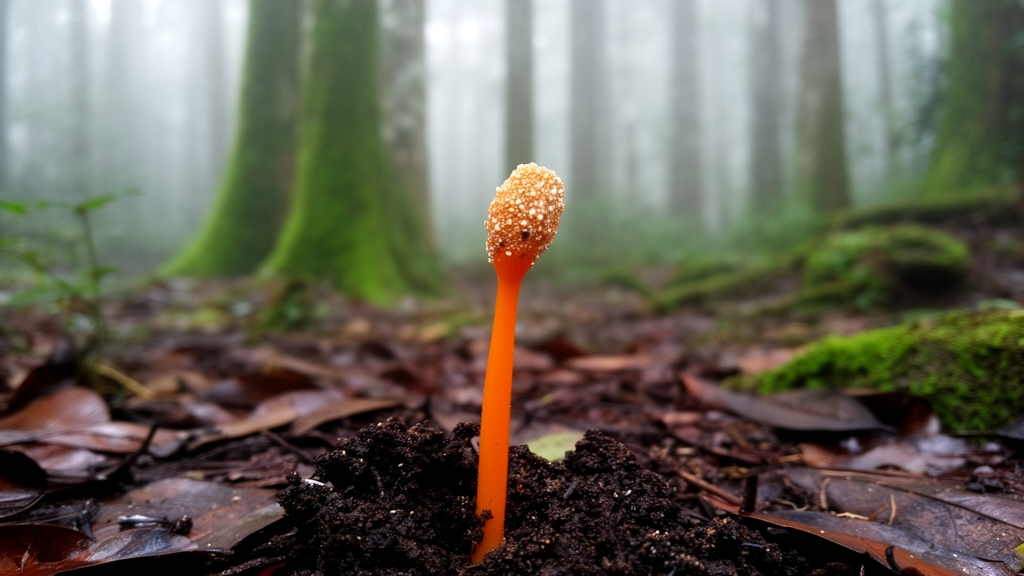
The Hymenostilbe clade is one of five primary groups within Ophiocordyceps, characterized by solitary, slender, pale yellow to orange, fleshy stromata. These fungi typically produce fertile parts terminally positioned on the stipe, often arising from gaps in the host’s head or thorax. Microscopically, they possess immersed, obliquely oriented perithecia and filiform ascospores that disarticulate into barrel- or column-shaped part-spores. To date, 24 species in this clade have been reported parasitizing Hymenoptera, with ants and wasps being the primary hosts. The high species richness and substantial biomass of Hymenoptera make them ideal hosts for the diversification of Ophiocordyceps, driving the evolution of specialized pathogen-host interactions.
The integration of morphological and molecular data is crucial for accurate taxonomic identification in this group. While the new species share general morphological traits with their relatives, subtle differences in the size and shape of reproductive structures, combined with distinct genetic sequences, support their recognition as separate taxa. For instance, pairwise sequence comparisons revealed clear nucleotide differences between O. yuanyangensis and its close relatives, with base-pair differences in nrLSU and tef-1α sequences ranging from 2.12% to 4.42%. These genetic distinctions, along with host specificity, provide robust evidence for species delimitation. The study underscores the limitations of relying solely on morphology, as cryptic species are common in the Hymenostilbe clade.
Beyond taxonomy, these fungi hold potential medicinal value. Representative species in the Hymenostilbe clade, such as O. oxycephala and O. sphecocephala, have been documented to possess antitumor activity and other therapeutic properties in traditional medicine. Given the substantial biomass of their hymenopteran hosts and the frequent observation of large aggregations of infected insects in the field, other species within this clade likely possess similar medicinal potential. However, research in this area faces challenges due to the incomplete description of many Hymenoptera species and insufficient regional surveys. Accurate identification of both the fungal pathogen and its insect host is essential for future drug discovery and ecological studies.
This study contributes to the growing body of knowledge on entomopathogenic fungi in China and highlights the importance of continued biodiversity surveys in understudied regions. The discovery of O. yuanyangensis and O. gotrae enriches the species diversity of the Hymenostilbe clade and provides new insights into the evolutionary relationships among Ophiocordyceps species parasitizing Hymenoptera. As molecular tools become more accessible, the ability to resolve cryptic species and understand host-pathogen dynamics will improve, offering new opportunities for both basic research and applied biology. The findings also emphasize the need for broader sampling and formal species delimitation analyses to fully assess the hidden diversity within this fascinating group of fungi.
Subject of Research: Molecular phylogeny and morphology reveal two new species and one new record of Ophiocordyceps (Ophiocordycipitaceae, Hypocreales) parasitic on Hymenoptera in China
Article Title: Molecular phylogeny and morphology reveal two new species and one new record of Ophiocordyceps ( Ophiocordycipitaceae , Hypocreales ) parasitic on Hymenoptera in China
Article References: Chen, Z.-M., Liao, H.-F., Lou, F.-W., Hu, R., Jia, J.-L., Zeng, W.-B., Yang, Z.-L., Zhang, A.-L., & Wang, Y.-B. (2026). Molecular phylogeny and morphology reveal two new species and one new record of Ophiocordyceps (Ophiocordycipitaceae, Hypocreales) parasitic on Hymenoptera in China. MycoKeys, 137, 337-359. https://doi.org/10.3897/mycokeys.137.191268
Image Credits: AI Generated
DOI: 10.3897/mycokeys.137.191268
Keywords: Molecular, phylogeny, morphology, reveal, species, record, Ophiocordyceps, Ophiocordycipitaceae, Hypocreales, parasitic, Hymenoptera, China
News Source: Gavin Prescott. (October 18, 2026). New Cordyceps Species Found in Yunnan Forests. Scienmag.