For more than two decades, a little-known genus of fungi named Splanchospora sat in a taxonomic limbo. Established in 1998 to accommodate a single species found on linden twigs in Europe, the genus was defined by just one visible trait: two-celled ascospores with a strongly constricted septum near their middle. Without DNA sequence data, its family-level placement could never be confirmed, and the genus remained listed as a genus of uncertain position within the Ascomycota. A new study published in IMA Fungus has now changed that picture dramatically, revealing both the family to which Splanchospora belongs and a hidden wealth of species that had been masquerading under a single name.
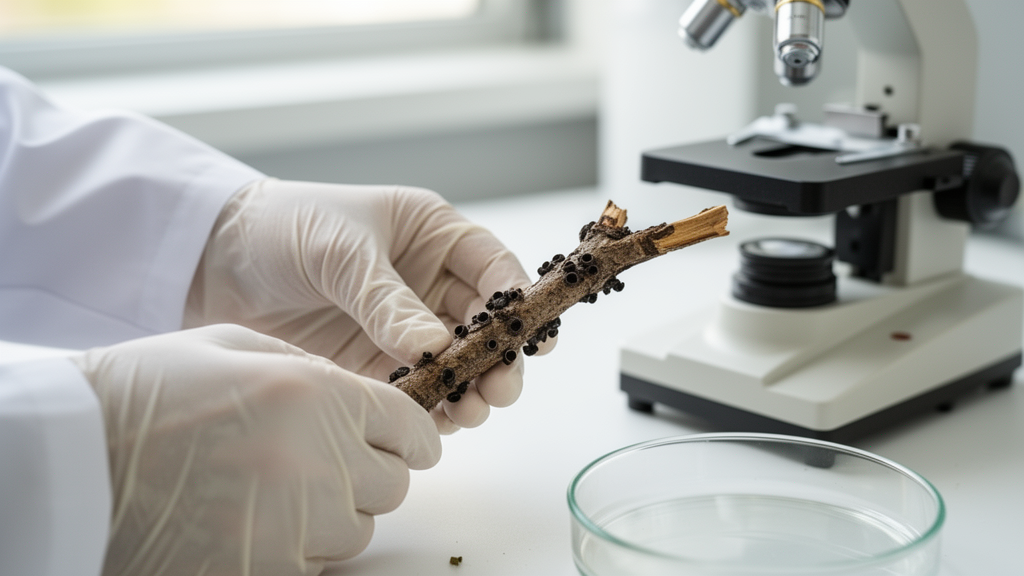
The research team, led by R. Yoshioka and colleagues, collected twenty-eight fresh fungal specimens from dead twigs of lindens and related trees in Japan and Europe between 2006 and 2024. Twenty-six of these came from linden trees, most of them planted in botanical gardens or parks. When the researchers examined the specimens under the microscope, they noticed something striking: in nearly every collection, a coelomycetous asexual form was consistently associated with the sexual form. When single ascospores were grown in culture, the resulting colonies produced asexual structures that matched those seen on the original specimens, confirming that the two forms belonged to the same organisms.
This discovery of a completely asexual morph for the first time gave the researchers a powerful new set of characters. The genus is now characterised by clavate-ellipsoid, thick-walled ascospores that are strongly constricted at the submedian septum, the presence of paraphyses within the conidiomata, and globose to ellipsoid, one-celled conidia. To resolve the genus’s phylogenetic position, the team sequenced five genetic loci: the small subunit and large subunit of the nuclear ribosomal DNA, the internal transcribed spacer region, the second largest subunit of RNA polymerase II, and the translation elongation factor 1-alpha gene. Maximum-likelihood and Bayesian analyses of these sequences placed Splanchospora firmly within the family Neohendersoniaceae in the order Pleosporales of the class Dothideomycetes.
The phylogenetic trees recovered Splanchospora as a monophyletic clade with full statistical support, closely related to but clearly distinct from the genus Neomedicopsis. Within the family Neohendersoniaceae, which now accommodates eight genera, Splanchospora stands out for its combination of sexual and asexual traits. Notably, the presence of paraphyses in the conidiomata expands the morphological concept of the asexual stage in this family, a feature that distinguishes Splanchospora from its closest relatives Neohendersonia and Neomedicopsis, which lack these sterile filaments in their asexual structures.
Perhaps the most consequential finding concerns the type species itself. Splanchospora ampullacea, long considered the sole member of the genus and thought to be distributed across the mid-latitudes of the Northern Hemisphere, turned out to be a species complex. Because the original type specimen of Sphaeria ampullacea, described by Persoon in 1801, is lost and the original description omitted ascospore details, the researchers designated a well-preserved Austrian collection as the neotype, complete with detailed morphology and DNA sequence data. Molecular analysis then revealed that what had been called S. ampullacea actually comprises multiple distinct lineages, including a cryptic European species and four entirely new species from Japan.
The four new species, named Splanchospora fulviconidia, S. microspora, S. oblongiconidia, and S. pseudomicrospora, were all isolated from linden twigs in Japan. Each shows subtle but consistent differences in conidial morphology. S. fulviconidia produces the largest conidia of the group, yellowish-brown and ellipsoid, darkening with age. S. microspora has smaller spores with a notably thick wall. S. oblongiconidia bears the longest conidia among the species with hyaline spores. S. pseudomicrospora, morphologically similar to S. microspora, can be separated by its slightly elongated, slender conidia and variable ascospore sizes, a variability the authors attribute to occasional meiotic failure that enlarges the remaining spores in the ascus.
Sequence comparisons reinforced these morphological distinctions. Across the five loci examined, interspecies variation was found at 22 of 452 sites in the ITS region, 10 of 1,346 sites in the SSU, 15 of 1,320 sites in the LSU, 85 of 1,065 sites in RPB2, and 102 of 1,253 sites in TEF1. Of the 5,436 total sites, S. fulviconidia showed the greatest number of unique bases or gaps at 117 sites, while S. ampullacea showed only 6. All SSU sequences of S. ampullacea and S. pseudomicrospora contained a distinctive 318-base-pair insertion, a molecular signature that may prove useful for future identification work.
The ecological picture that emerges is one of remarkable specificity and coexistence. All six recognised Splanchospora species were associated with dead twigs of linden trees, confirming that host preference for Tilia is a trait shared across the entire genus rather than a peculiarity of one species. In Japan, S. fulviconidia and S. pseudomicrospora were even collected from the same individual linden tree at the same time, demonstrating that although these species share a habitat, they remain reproductively isolated. The study also documented occasional occurrences on other host trees, including Carpinus cordata and Ostrya japonica, suggesting some latitude in host selection despite the strong association with lindens.
The researchers caution that the long-standing assumption of S. ampullacea as a single cosmopolitan species is likely to be overturned. Records from North America and the Russian Far East, where the fungus has been reported on Tilia americana and Tilia amurensis respectively, may represent distinct species reflecting differences in their original host trees. Given that four species were identified in Japan alone and one cryptic species in Europe, the authors consider it highly probable that multiple species also exist in these other regions. The emphasis on ascospore morphology and host preference in past identification efforts, they argue, is precisely why the genus appeared monotypic for so long.
The study concludes that conidial morphology, combined with secondary DNA barcodes such as TEF1 and RPB2, provides the most reliable markers for identifying species within Splanchospora and will be instrumental in uncovering unknown diversity. The revised generic concept, grounded in both sexual and asexual characteristics and anchored by molecular phylogenetics, resolves a long-standing taxonomic uncertainty and opens the door to a more accurate accounting of fungal diversity on linden trees worldwide. As culture studies of related genera such as Splanchnonema continue, the asexual morph is likely to prove equally decisive in untangling the evolutionary relationships of other poorly understood dothideomycetous fungi.
Subject of Research: Taxonomic revision and phylogenetic placement of the fungal genus Splanchospora
Article Title: Revision of the genus Splanchospora ( Pleosporales , Neohendersoniaceae )
Article References: Yoshioka, R., Voglmayr, H., Hashimoto, A., Matsumura, M., Kudo, Y., & Tanaka, K. (2026). Revision of the genus Splanchospora (Pleosporales, Neohendersoniaceae). IMA Fungus, 17, Article e179372. https://doi.org/10.3897/imafungus.17.179372
Image Credits: AI Generated
DOI: 10.3897/imafungus.17.179372
Keywords: Splanchospora, Neohendersoniaceae, Pleosporales, Dothideomycetes, fungal taxonomy, linden, Tilia, ascospores, conidia, DNA barcodes, species discovery, Japan
News Source: Roger Howard. (October 18, 2026). Hidden fungal diversity uncovered on linden twigs as scientists revise the genus Splanchospora. Scienmag.