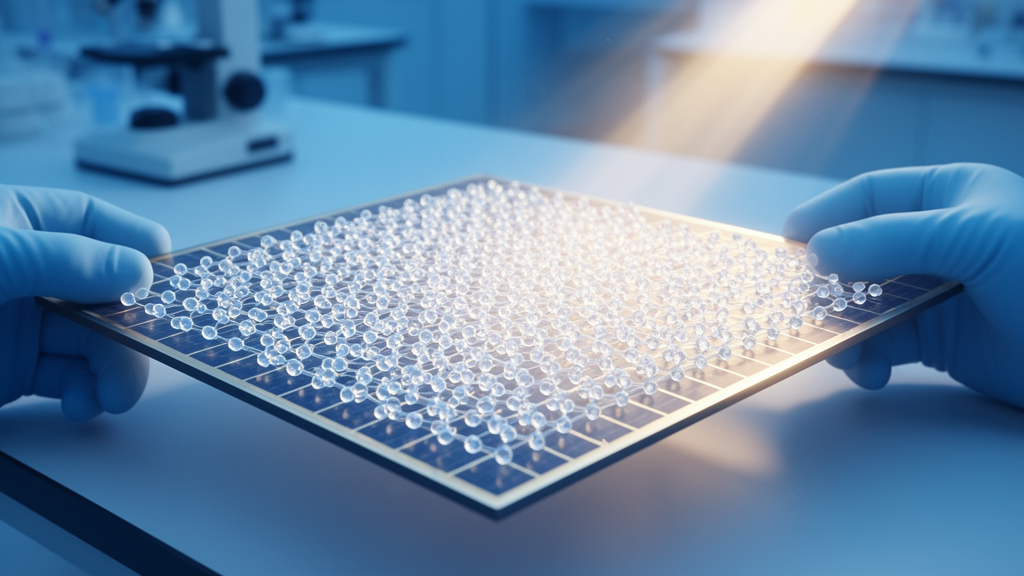
Crystalline silicon still rules the photovoltaic world, accounting for the overwhelming majority of solar modules installed every year. Yet the industry’s workhorse material carries a persistent cost: conventional p-type regions require high-temperature doping steps that complicate manufacturing and cap how far device performance can climb. Dopant-free carrier-selective contacts promise to change that, and molybdenum oxide (MoOₓ) has emerged as one of the most compelling hole-transport materials for the job. Now a team at Beijing University of Technology, led by Professors Qian Kang, Zilong Zheng, and Yongzhe Zhang, has shown that a molecular-scale interlayer of phosphomolybdic acid (PMA) can unlock MoOₓ’s full potential, delivering a record power conversion efficiency of 24.9 percent in MoOₓ-based silicon solar cells. The work, published in Nano-Micro Letters, tackles two stubborn problems that have long kept this otherwise attractive material from reaching its ceiling.
MoOₓ owes its appeal to a rare combination of properties. Its high work function means it can induce strong band bending at crystalline silicon interfaces without any conventional p-type doping, effectively persuading the silicon surface to behave as a hole-selective contact. It is also inexpensive and processable at low cost, two qualities that matter enormously for commercial feasibility. But the material hides a fundamental weakness at the interface where it meets hydrogenated amorphous silicon (i-a-Si:H), the thin passivating film typically paired with it in silicon devices. Oxygen vacancy defects in MoOₓ lower its effective work function, eroding the very band bending that makes it hole-selective. At the same time, the interaction between the two materials is dominated by weak van der Waals forces, which impair charge carrier transport across the junction.
The researchers’ solution is deceptively simple: insert an ultrathin PMA interlayer, roughly one nanometer thick, between the i-a-Si:H and the MoOₓ. Rather than acting as a passive additional film, PMA functions as a molecular bridge that simultaneously strengthens interfacial bonding, passivates oxygen-vacancy defects, raises the effective work function, and enhances band bending for more selective hole extraction. First-principles calculations reveal just how dramatic this transformation is. PMA forms bonding energies of 3.1 electron volts with i-a-Si:H and 2.6 electron volts with MoOₓ, compared with only 1.4 electron volts at the pristine MoOₓ/i-a-Si:H interface. That near-doubling of interfacial coupling provides the chemical foundation for improved hole transport across the junction.
Defect chemistry tells an equally important story. X-ray photoelectron analysis shows that PMA reduces the Mo⁵⁺/Mo⁶⁺ ratio in MoOₓ from 0.18 to 0.14, a clear indication that oxygen vacancies are being passivated. Fewer vacancies mean a higher effective work function, which the team measured as increasing from 5.0 to 5.1 electron volts. Meanwhile, the interfacial dipole rises dramatically from 1.63 to 6.34 debye, strengthening band bending and field-effect passivation at the silicon surface. PMA also acts as a dual-functional modifier by creating a strong interface dipole and reducing the tunneling barrier, which lowers contact resistance by 24 percent. These molecular-scale changes compound into macroscopic electrical gains that show up clearly in device measurements.
The performance improvements are striking across every metric that matters in silicon photovoltaics. The open-circuit voltage climbs from 713 to 730 millivolts, reflecting reduced recombination at the contact. The fill factor improves from 83.7 to 84.9 percent, indicating more efficient charge collection under operating conditions. The champion efficiency reaches 24.9 percent, compared with 23.8 percent for the MoOₓ control device. Crucially, the modification introduces negligible optical penalties: visible-light transmittance remains above 95 percent, so the ultrathin PMA layer preserves the transparency needed for front-side contact applications without sacrificing any of the incident sunlight.
Electrical characterization deepens the picture further. The minority-carrier lifetime, a sensitive indicator of surface passivation quality, increases from 1.18 to 2.44 milliseconds. The saturation current density, which quantifies recombination losses at the contact, falls by 63 percent, from 40.0 to 14.9 femtoamperes per square centimeter. Contact resistivity drops by 24 percent, from 140 to 106 milliohm square centimeters, confirming that PMA genuinely improves carrier transport rather than merely suppressing recombination. The built-in potential also increases from 722 to 741 millivolts, consistent with the enhanced band bending predicted by the dipole measurements. Device simulations independently predict an efficiency improvement from 23.9 to 24.7 percent, closely tracking the experimental results and validating the underlying physical model.
What makes this result scientifically interesting is that PMA addresses both defect-induced recombination and inefficient interfacial charge transport in a single molecular-scale modification. Most interfacial engineering strategies in photovoltaics tackle one problem at a time: either passivating defects or improving energy-level alignment. PMA does both simultaneously, tuning chemical bonding, defect chemistry, work function, band bending, and carrier transport in one coordinated step. The phosphomolybdic acid molecule, with its Keggin-type structure and multiple oxygen atoms, provides the chemical versatility needed to interact strongly with both the amorphous silicon surface and the transition metal oxide above it, acting as a genuine molecular-scale bridge rather than a simple spacer layer.
The broader implications extend well beyond a single efficiency record. The PMA/MoOₓ architecture provides a promising route toward dopant-free passivating contacts for high-efficiency crystalline silicon photovoltaics, and its solution-processable nature means the ultrathin interlayer can be deposited without expensive vacuum equipment or high-temperature processing. This matters for scalable and cost-effective photovoltaic manufacturing, where every added processing step must justify itself in efficiency gains. The molecular-scale interfacial bridging concept also offers a general strategy for engineering transition-metal-oxide interfaces in other optoelectronic devices, including displays, sensors, and next-generation electronics that require precisely engineered interfaces between dissimilar materials.
The achievement of 24.9 percent efficiency in a dopant-free MoOₓ-based silicon solar cell represents a meaningful milestone in the quest for high-performance photovoltaic contacts that avoid conventional doping. By simultaneously passivating oxygen vacancies, elevating the work function through dipole formation, and strengthening interfacial bonding to facilitate hole transport, the PMA interlayer demonstrates that molecular-scale engineering can overcome the intrinsic limitations of transition metal oxides in silicon photovoltaics. As the industry continues to push efficiency boundaries while reducing manufacturing costs, strategies like this one that deliver multiple benefits from a single ultrathin, solution-processable modification will play an increasingly important role in shaping the next generation of silicon solar cells.
Subject of Research: Dopant-free hole-selective contacts based on molybdenum oxide and phosphomolybdic acid interlayers for high-efficiency crystalline silicon solar cells
Article Title: A molecular interlayer boosts MoOₓ-based silicon solar cell efficiency
Article References: A molecular interlayer boosts MoOₓ-based silicon solar cell efficiency. (n.d.). Original publication
Image Credits: AI Generated
DOI: Not provided
Keywords: MoOx, phosphomolybdic acid, dopant-free contacts, silicon solar cells, passivating contacts, hole transport layer, oxygen vacancies, interfacial dipole, work function, carrier transport, photovoltaics, Nano-Micro Letters
News Source: Drew Townsend. (October 18, 2026). Molecular Interlayer Lifts MoOₓ Silicon Solar Cells to Record 24.9% Efficiency. Scienmag.