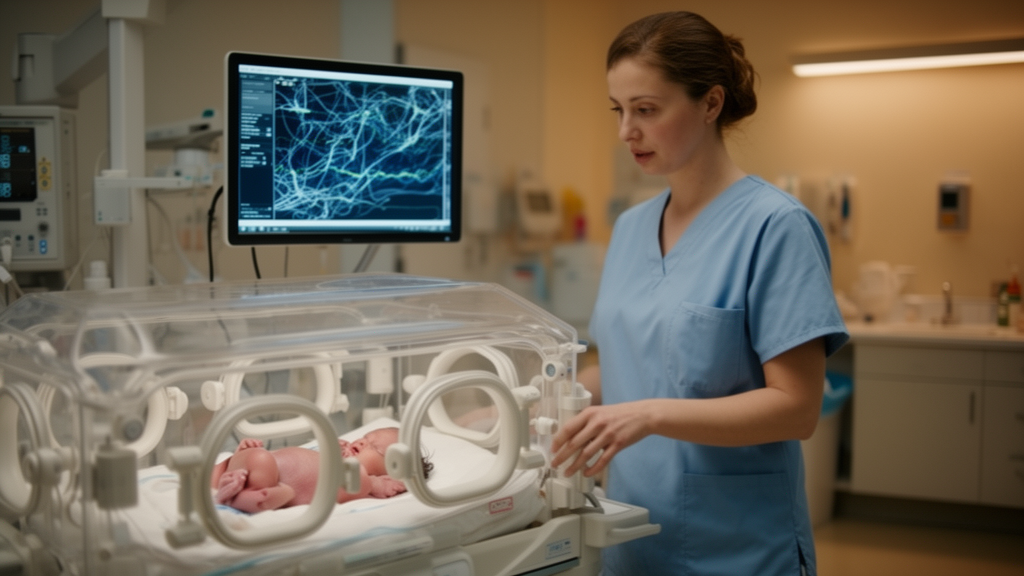
Neonatal intensive care units are among the most unforgiving environments in modern medicine. Every decision, from ventilator settings to fluid management, can determine whether a fragile newborn survives the night. It is precisely in this high-stakes arena that artificial intelligence is beginning to reshape clinical workflows, and a new study from Türkiye now offers one of the clearest quantitative portraits yet of how the nurses at the bedside feel about that transformation. The research, published in BMC Nursing, applied structural equation modeling to data from 200 neonatal nurses and reached a striking conclusion: artificial intelligence literacy is a powerful predictor of readiness to embrace AI in clinical decision-making, explaining a remarkable 57.3 percent of the variance in readiness scores.
The study was conducted between August 2025 and January 2026 by researchers in the Department of Pediatric Nursing at Bandırma Onyedi Eylül University, led by corresponding author Zübeyde Ezgi Erçelik. The team designed a cross-sectional, descriptive-correlational investigation and analyzed it using structural equation modeling, a statistical technique that allows researchers to test networks of hypothesized relationships among multiple variables simultaneously rather than examining each link in isolation. Before analysis began, the researchers screened the data for multivariate outliers and excluded five participants whose response patterns deviated substantially from the rest of the sample, leaving a final analytical cohort of 200 neonatal intensive care nurses.
The demographic profile of the sample reflects the realities of the nursing workforce in Türkiye’s neonatal units. Ninety-six percent of participants were female, with a mean age of 29.65 years and a standard deviation of 5.90. Most held a bachelor’s degree, at 62.5 percent, and 66.5 percent reported between one and five years of professional experience. What stands out most vividly, however, are the numbers on AI exposure: only 6.5 percent of these nurses had ever received any formal training in artificial intelligence, and just 13 percent reported using AI-based technologies in their clinical practice. In other words, the overwhelming majority of nurses caring for the country’s most vulnerable patients are navigating the arrival of AI with essentially no structured preparation.
Data collection relied on three instruments. A sociodemographic information form captured background characteristics, while the Artificial Intelligence Literacy Scale, abbreviated AILS, measured participants’ knowledge and competence across the dimensions of AI, from basic concepts to practical applications. The Medical Artificial Intelligence Readiness Scale, or MAIRS, assessed readiness across three subdomains: self-efficacy in using AI technologies, willingness to adopt them, and awareness of their benefits and limitations in medical settings. The researchers obtained permission from the authors of both scales before deployment, and the study received ethical approval from the Non-Interventional Clinical Research Ethics Committee of Bandırma Onyedi Eylul University in June 2025, with all procedures conducted in accordance with the Declaration of Helsinki.
The statistical architecture of the analysis deserves attention because it elevates the findings beyond simple correlation. Structural equation modeling combines factor analysis with path analysis, enabling the researchers to estimate how strongly one latent construct, AI literacy, predicts another, AI readiness, while accounting for measurement error in the scales themselves. The team evaluated the measurement models using established psychometric criteria, including average variance extracted and composite reliability to confirm that the scales measured their intended constructs consistently, and the heterotrait–monotrait ratio, or HTMT, to verify that literacy and readiness remained empirically distinct rather than collapsing into a single blurred variable. The study followed the STROBE guidelines for reporting observational research, a framework designed to strengthen the transparency and completeness of such studies.
The headline result is unambiguous. The model supported the study’s primary hypothesis, revealing that AI literacy significantly and positively predicted AI readiness, with a standardized path coefficient of 0.757 and a p-value below 0.001. In practical terms, a coefficient of this magnitude indicates that roughly three-quarters of a standard deviation increase in readiness accompanies each standard deviation increase in literacy, an exceptionally strong relationship in behavioral research. The literacy construct alone accounted for 57.3 percent of the variance in readiness scores, a proportion that social scientists rarely observe with a single predictor. Nurses with higher AI literacy scores did not merely report greater abstract enthusiasm; they reported greater self-efficacy and greater willingness regarding the integration of AI technologies into clinical decision-making processes.
Why does this matter so much for neonatal care specifically? AI tools are already entering the neonatal domain in forms ranging from predictive analytics for sepsis and deterioration risk to decision-support systems for respiratory management. These technologies promise faster and more accurate decision-making in units where minutes matter, but their benefits depend entirely on the humans operating them. A nurse who understands what an algorithm can and cannot do is better positioned to question its outputs, recognize when they conflict with bedside observation, and integrate them judiciously into care. The findings suggest that literacy is not a luxury but the gateway variable: improvements in AI literacy may directly enhance neonatal intensive care nurses’ readiness to weave AI into the decisions that determine newborn survival.
The near-total absence of prior training in the sample transforms the study from a descriptive snapshot into something closer to a warning. If 93.5 percent of neonatal nurses have received no AI education, and if literacy drives readiness this strongly, then the bottleneck is not nurse skepticism but institutional neglect. The authors argue that their empirical findings from Türkiye point toward a concrete intervention: structured AI literacy programs could raise readiness across the workforce, preparing nurses for technologies that are arriving whether or not hospitals plan for them. The researchers also note that participants with higher literacy reported greater self-efficacy and willingness, meaning that education would likely pay dividends not only in knowledge but in confidence and motivation.
There are limitations worth keeping in view. The cross-sectional design captures a single moment in time, so the modeling can demonstrate that literacy and readiness move together but cannot prove that boosting literacy causes readiness to rise; longitudinal and interventional studies would be needed to establish causality. The sample of 200 nurses, while adequate for the modeling technique, was drawn from a single national context, and the predominantly female, relatively young, bachelor’s-educated profile may not generalize to every workforce. Self-reported scales also depend on participants’ honest and accurate self-assessment. The authors received no specific grant from funding agencies in the public, commercial, or not-for-profit sectors, and they declare no competing interests.
Even with those caveats, the study lands at a pivotal moment. Hospitals worldwide are racing to deploy machine learning systems, yet the frontline clinicians who must live with those systems are rarely asked what they know or how prepared they feel. This research supplies the numbers: literacy is the strongest lever available, and it is currently almost untouched. For the nurses watching over newborns in intensive care, the message from the data is clear. The path to an AI-ready neonatal workforce runs directly through education, and the time to build that path is now, before the algorithms outpace the people expected to use them.
Subject of Research: Artificial intelligence literacy and readiness among neonatal nurses: a structural equation modeling study
Article Title: Artificial intelligence literacy and readiness among neonatal nurses: a structural equation modeling study
Article References: Erçelik, Z. E., Aydin Yilmaz, D., & Eryilmaz Taş, M. N. (2026). Artificial intelligence literacy and readiness among neonatal nurses: a structural equation modeling study. BMC Nursing. https://doi.org/10.1186/s12912-026-05337-w
Image Credits: AI Generated
DOI: 10.1186/s12912-026-05337-w
Keywords: Artificial, intelligence, literacy, readiness, neonatal, nurses, structural, equation, modeling, scientific research
News Source: Harold Sullivan. (October 18, 2026). Artificial intelligence literacy and readiness among neonatal nurses: a structural equation modeling study. Scienmag.