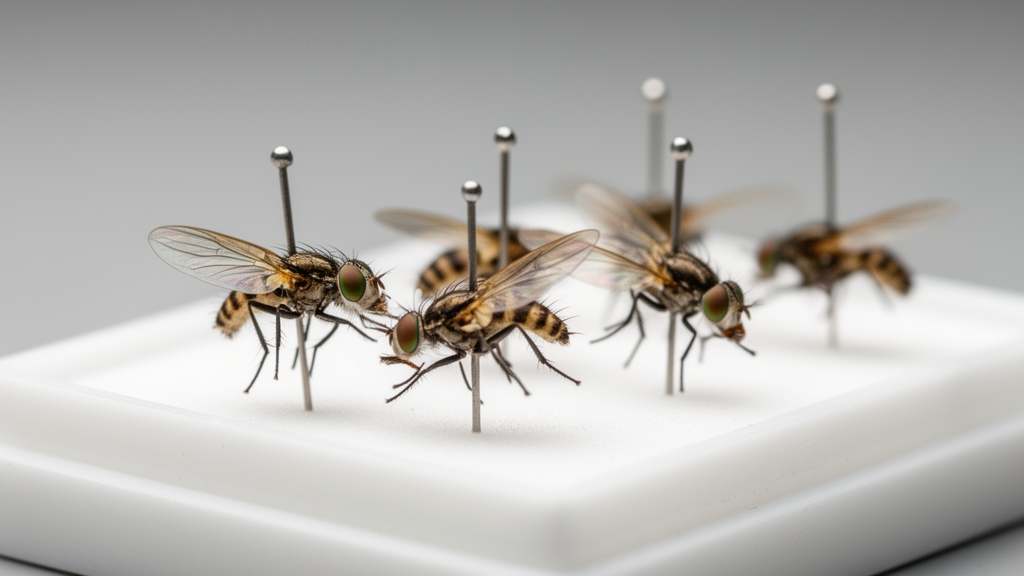
Entomologists have expanded the known boundaries of the Neotropical fly genus Armillipora by describing two new species and proposing a revised classification system that divides the group into two distinct lineages. Published in the journal Evolutionary Systematics, the study represents a significant contribution to the taxonomy of Psychodidae, a family of flies that includes moth flies and drain flies. The research not only adds to the global species count but also corrects previous taxonomic errors that had complicated the identification of males within the genus. By integrating detailed morphological descriptions with updated distribution data, the authors provide a clearer framework for understanding the evolutionary relationships among these small, often overlooked insects.
The genus Armillipora, originally described by Quate in 1996, remained monotypic for many years until a second species was added in 2020. Subsequent work by Jaume-Schinkel and Mengual in 2024 brought the total to four known species. The current study introduces Armillipora bifida and Armillipora nawak, increasing the known diversity of the genus to six species. These new additions are particularly notable because they extend the geographic range of the genus to Brazil and Venezuela for the first time. This expansion supports predictive distribution models that had suggested a broader potential range across several South American countries, including Colombia, French Guiana, Guyana, Peru, and Suriname.
The description of Armillipora bifida is based on specimens collected from Venezuela and Brazil. The species is named for the bifurcated apex of its gonostyli, a pair of appendages in the male genitalia. This distinctive feature allows it to be easily differentiated from other members of the newly proposed suapiensis group. The holotype was collected in Aragua, Venezuela, while paratypes were found in Rondonia, Brazil, and another location in Aragua. The female of this species remains unknown, as is common in many dipteran taxonomic studies where males are more frequently collected and examined for diagnostic characters.
The second new species, Armillipora nawak, was described from Costa Rica. Its name derives from the Cabécar word for synanthropic psychodines, reflecting its ecological context. This species is also part of the suapiensis group and is distinguished by its digitiform gonostyli with rounded apices. Unlike A. bifida, the gonostyli of A. nawak are as long as the aedeagus, the internal reproductive organ. The aedeagus itself features two digitiform sclerotized structures at its apex, a character that further separates it from its relatives. The holotype was collected in San Jose Moravia, Costa Rica, at an elevation of 1600 meters, indicating a preference for higher altitude habitats.
A critical aspect of this publication is the correction of a taxonomic error regarding the gonocoxites and gonostyli. Previous studies had misinterpreted the fusion of these structures, leading to an inaccurate identification key. The authors clarify that the gonocoxites are reduced and fused, while the gonostyli vary in their degree of fusion. This distinction is the basis for the two new species groups: the selvica group, where gonostyli are reduced and fused with the gonocoxites, and the suapiensis group, where gonostyli are not fused and are clearly divergent. This reclassification simplifies the identification process and provides a more robust phylogenetic framework for future research.
The morphological diagnosis of the genus includes specific features such as the arrangement of alveoli on the antennal flagellomeres and the structure of the epandrial appendages. In males, the flagellomeres possess a double row of alveoli, which is less conspicuous in females. The epandrial appendages are irregularly asymmetrical, featuring a basal patch of accessory tenacula and a row of short, cylindrical tip-folded tenacula. These detailed characters are essential for distinguishing Armillipora from other genera within the family Psychodidae. The authors provide detailed illustrations and photographs to aid in the recognition of these subtle features, which are often critical for accurate species identification.
The study also highlights the importance of integrative taxonomy in resolving species boundaries. While the suapiensis group exhibits higher morphological diversity in male genitalia, allowing for easier differentiation, the selvica group relies on more subtle characters. The authors note that combining morphological data with COI DNA barcodes offers valuable insights for accurate species delimitation, particularly within the selvica group. However, the absence of published DNA barcodes for any species in the suapiensis group currently impedes molecular species delimitation efforts. The integration of morphological and molecular data is expected to enrich our understanding of species boundaries and aid in future descriptions.
The distribution of Armillipora species is mapped across five countries, with the new species filling gaps in the known range. The presence of the genus in Brazil and Venezuela underscores the likelihood of further geographical records across the Neotropical region. The authors suggest that predictive models are crucial for guiding fieldwork and identifying potential new localities. This approach not only enhances our knowledge of the genus but also contributes to the broader goal of documenting biodiversity in underexplored regions of the Americas.
In conclusion, this study provides a comprehensive update to the taxonomy of Armillipora, introducing two new species and refining the classification of the genus. The corrections to previous taxonomic errors and the proposal of two species groups offer a clearer path for future research. By combining detailed morphological descriptions with updated distribution data, the authors have made a significant contribution to the field of dipteran systematics. The findings highlight the ongoing discovery of new species in the Neotropical region and the importance of rigorous taxonomic work in understanding the diversity of life on Earth.
Subject of Research: Further contributions to the taxonomy of Armillipora Quate (Diptera, Psychodidae) with the description of two additional new species
Article Title: Further contributions to the taxonomy of Armillipora Quate ( Diptera , Psychodidae ) with the description of two additional new species
Article References: Jaume-Schinkel, S. (2024). Further contributions to the taxonomy of Armillipora Quate (Diptera, Psychodidae) with the description of two additional new species. Evolutionary Systematics, 8(1), 145-154. https://doi.org/10.3897/evolsyst.8.124213
Image Credits: AI Generated
DOI: 10.3897/evolsyst.8.124213
Keywords: Further, contributions, taxonomy, Armillipora, Quate, Diptera, Psychodidae, description, additional, species, scientific research
News Source: Gavin Prescott. (October 18, 2026). New Fly Species Redefine Neotropical Genus Armillipora. Scienmag.