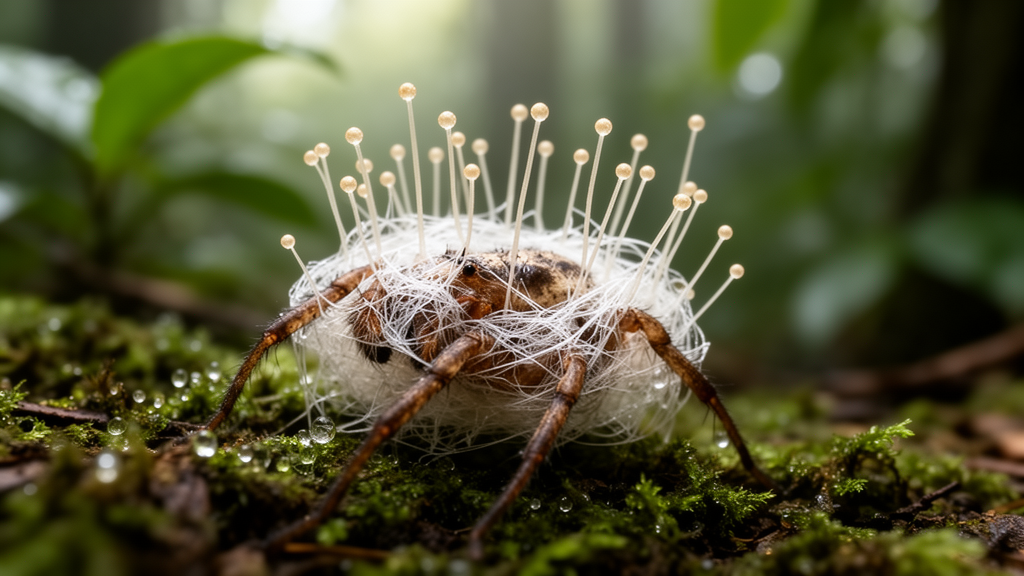
Deep in the humid mountain forests of southern China, a quiet arms race has been unfolding for tens of millions of years. Fungi stalk spiders, wrapping their victims in dense mats of mycelium before erupting in delicate spore-bearing structures. Now, a five-year survey across multiple Chinese provinces has delivered the most comprehensive look yet at this hidden world, describing eight new species, proposing six new combinations, and using a molecular clock built from 648 fungal strains to trace the deep evolutionary history of the group. The findings, published in IMA Fungus, substantially expand the documented diversity of spider-pathogenic fungi and reveal that these parasites did not descend from a single ancestor but evolved their spider-killing lifestyle independently, again and again.
Spiders are among the most diverse terrestrial arthropods, with more than 53,000 described species occupying nearly every ecosystem on Earth. Yet while over 700 species of insect-pathogenic fungi have been documented and studied extensively, fungi that specifically target spiders have historically received far less attention, frequently conflated with their insect-killing relatives in the broader arachnological literature. Recognizing their ecological uniqueness, Evans and Samson formally designated these organisms as a distinct ecological guild in 1987, coining the terms araneogenous fungi or araneopathogenic fungi to describe species that specifically infect and kill spiders. The first documented report of such an infection dates to Germany in 1817, and the first sexual morph from a spider was described in Cuba in 1869, but the group’s broader phylogenetic diversity remains significantly underrepresented compared to entomopathogenic fungi.
Between 2021 and 2025, the research team collected 166 specimens from forest regions across China, primarily during field surveys conducted from June to September each year, when abundant rainfall and warm, humid mountain climates provide favorable conditions for fungal proliferation. Collections were made by inspecting typical spider microhabitats, including tree bark, decaying wood, leaf surfaces, moist rock faces, stones, and riverside walls, to identify spiders infected by fungi. The team then isolated living cultures on potato dextrose agar supplemented with antibiotics and characterized colony morphology, pigmentation, and microscopic structures such as perithecia, asci, ascospores, conidiophores, phialides, and conidia under stereomicroscopes and compound microscopes.
To resolve the taxonomic relationships of the newly collected isolates, the researchers sequenced five nuclear loci: the internal transcribed spacer region (ITS), the nuclear large subunit ribosomal DNA (nrLSU), and the protein-coding genes TEF1, RPB1, and RPB2. These sequences were aligned with reference sequences from GenBank, concatenated into partitioned datasets, and analyzed using maximum likelihood inference in IQ-TREE and Bayesian inference in MrBayes. The resulting phylogenies, combined with diagnostic morphological evidence and the principle of genealogical concordance phylogenetic species recognition, which requires concordance among at least three independent unlinked loci, provided robust support for the recognition of eight novel species: Arachnidicola anhuiensis, Gamszarella araneae, Gibellula alba, Gibellula guizhouensis, Hevansia pseudonelumboides, Husseyia sinensis, Liangia guizhouensis, and Purpureocillium araneicola.
Each new species carries distinctive morphological signatures. Arachnidicola anhuiensis, collected from Anhui Province, produces larger ellipsoidal to ovoid conidia measuring 3.0 to 6.2 micrometers in length, compared to the smaller fusiform conidia of its closest relatives. Gibellula alba, discovered in the Guniujiang Scenic Area, is notable for producing only its sexual morph, with ivory to maize-yellow perithecia measuring up to 802 micrometers, a rarity in a genus where most congeners are known solely from their asexual forms. Hevansia pseudonelumboides, found on Lushan Mountain in Jiangxi Province, exhibits both sexual and asexual morphs simultaneously on the same host, with stipitate stromata emerging from the spider’s dorsal side and slender conical synnemata covering its body surface. Husseyia sinensis provides the first comprehensive morphological characterization within a genus previously described solely from molecular data.
Beyond the formally described species, the phylogenetic framework identified five potential cryptic species, provisionally designated as Gibellula sp. XYC-2025e, Gibellula sp. XYC-2025f, Gibellula sp. TW-2025a, Chlorocillium sp. XYC-2025d, and Husseyia sp. XYC-2025g. These strains form well-supported monophyletic clades in molecular analyses but lack stable morphological differences from known taxa, and the researchers conservatively deferred their formal description to avoid premature taxonomic inflation. The study also resolved long-standing taxonomic uncertainties, providing robust phylogenetic evidence for the placement of Chlorocillium and Husseyia within Clavicipitaceae, a family historically regarded as primarily plant-pathogenic, and transferring three members of the former Lecanicillium aranearum species complex into the genus Nuciformispora.
The most striking results emerged from the molecular clock analysis. Using a concatenated five-locus dataset from 648 fungal strains, calibrated with the fossil Paleoophiocordyceps coccophagus preserved in amber and a secondary calibration based on the divergence between Leotiomycetes and Sordariomycetes, the team estimated that the order Hypocreales originated in the Late Triassic around 250 million years ago, with a crown age in the Middle Jurassic around 209 million years ago. The analysis resolved the order into 15 well-supported families, with Niessliaceae, associated with plant-based nutrition, representing the earliest-diverging lineage, followed by predominantly plant-associated families such as Sarocladiaceae, Stachybotryaceae, and Nectriaceae.
Within this framework, the spider-pathogenic lineage is estimated to have originated around 77.4 million years ago during the mid-Cretaceous, coinciding with the angiosperm-driven diversification of insects and spiders, including the radiation of modern spider families such as Araneidae and Salticidae. The diversification of insect-pathogenic fungi preceded that of spider-pathogenic lineages, but during later stages of evolution, both groups underwent nearly parallel and independent radiations within distinct phylogenetic clades. Obligate spider-associated genera such as Polystromomyces, Pseudoniveomyces, Gibellula, Hevansia, and Jenniferia emerged with stem ages ranging from 76.3 to 48.1 million years ago, while in Ophiocordycipitaceae, specialized spider pathogens such as Purpureocillium atypicola and P. araneicola diverged approximately 35 million years ago. In Clavicipitaceae, the spider-pathogenic genera Chlorocillium and Husseyia originated around 12.5 and 13.6 million years ago, respectively, during the Miocene.
These findings indicate that the diversification of obligate spider-pathogenic fungi did not stem from a single ancestral lineage. Instead, various insect-pathogenic and plant-associated fungi independently acquired the capacity to parasitize spiders in subsequent evolutionary phases. While many entomopathogenic fungi display broad host ranges, spider-pathogenic lineages demonstrate a clear evolutionary trajectory toward greater host specificity. The researchers hypothesize that spider pathogens adopted highly efficient parasitism under limited host resources, evolving adaptations to spider cuticles, immune responses, and behaviors to occupy distinct ecological niches and reduce competition. Spider defenses, including exoskeletons, immune responses, and behaviors, may have delayed fungal adaptation relative to insect pathogens, leading to the emergence of obligate spider-associated genera through long-term host specialization.
By integrating the newly isolated taxa with published global records, the study provides an updated framework indicating that spider-pathogenic fungi currently comprise 181 species in 35 genera across four families of Hypocreales. In China, 79 species in 22 genera and four families have been reported to date, though the country’s highly diverse topography and climatic conditions suggest that many species remain undiscovered. Beyond their ecological role as regulators of spider populations, these fungi represent an underexplored reservoir of bioactive secondary metabolites with antimicrobial, antiviral, and immunomodulatory properties. The ecological specialization observed in spider-pathogenic fungi suggests highly refined metabolic pathways adapted to overcome spider-specific immune defenses, and understanding these biochemical adaptations may provide insights into novel bioactive compounds and mechanisms of host-pathogen interaction that could be exploited for therapeutic applications. As sampling continues and molecular techniques advance, the researchers anticipate a significant increase in recognized diversity, which may rekindle interest among mycologists, arachnologists, and related specialists in these ecologically significant but historically overlooked organisms.
Subject of Research: Mycology
Article Title: Taxonomy, phylogeny, and evolutionary diversification of spider-pathogenic fungi from China ( Hypocreales , Ascomycota )
Article References: Chang, X.-Y., Qi, Y.-J., Wang, T., Li, Z.-Z., Li, G.-S., Huang, B., & Chen, M.-J. (2026). Taxonomy, phylogeny, and evolutionary diversification of spider-pathogenic fungi from China (Hypocreales, Ascomycota). IMA Fungus, 17, Article e171548. https://doi.org/10.3897/imafungus.17.171548
Image Credits: AI Generated
DOI: 10.3897/imafungus.17.171548
Keywords: fungi, spiders, phylogenetics, molecular clock, taxonomy, Hypocreales, China, evolution, phylogeny, evolutionary, diversification, spider-pathogenic
News Source: Roger Howard. (October 18, 2026). Spider-Killer Fungi From China Reveal Eight New Species and a Cretaceous Origin. Scienmag.