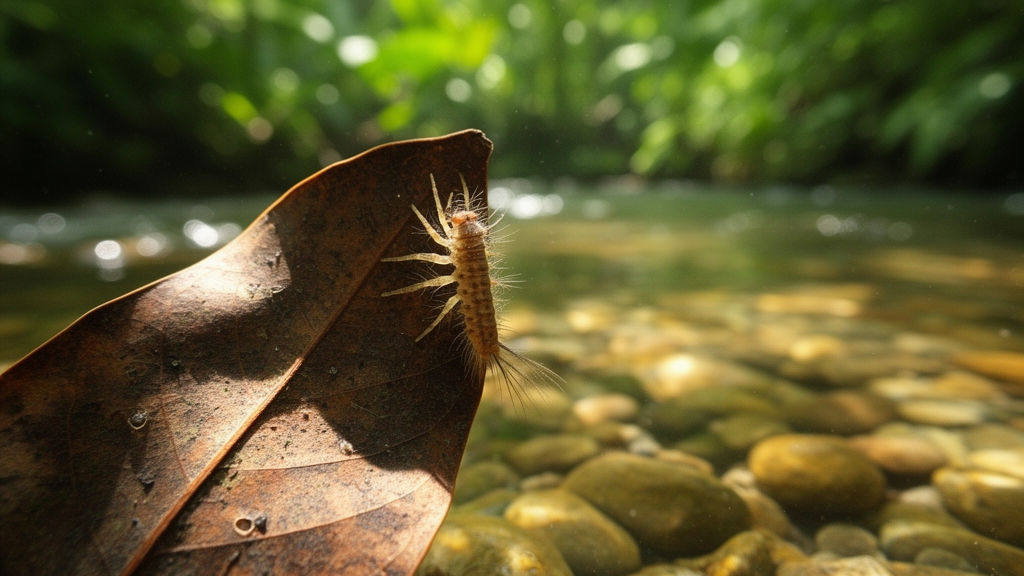
In the forested highlands of Guatemala, a quiet mystery has puzzled freshwater ecologists for years: why do the insects that shred leaf litter in tropical streams—the unsung recyclers of the entire aquatic food web—show such low local diversity compared with their temperate counterparts, even though regional tropical diversity is just as high? A new study published in Neotropical Biology and Conservation offers a compelling answer rooted not in food, climate, or water chemistry, but in the simple physics of flight. Aquatic shredder insects, the researchers found, appear to be markedly poorer dispersers than other aquatic insects in the same streams, and this dispersal limitation seems to be the dominant force shaping their communities.
The research team, led by scientists working across the Salinas, Cahabon, and Polochic river watersheds of northern Central America, set out to test a long-standing hypothesis about tropical stream ecology. Shredders—mostly the larval stages of caddisflies, beetles, and true flies—chew fallen leaves into fine particles, consuming up to 64 percent of the leaf litter entering forested streams. This makes them a central link between terrestrial organic matter and the fish and amphibians that prey on aquatic insects. If shredder diversity is suppressed in tropical headwaters, the consequences ripple outward through decomposition rates, nutrient cycling, and ultimately the productivity of entire stream food webs.
One leading explanation for the puzzling latitudinal pattern—shredder diversity actually declining toward the equator, opposite to the classic biodiversity gradient—has been dispersal capacity. Tropical aquatic insects in general are known to be weaker dispersers than temperate species, a pattern linked to their tendency toward shorter flight periods and greater physiological sensitivity to temperature. The researchers reasoned that if tropical shredders are even more dispersal-limited than other tropical aquatic insects, this could explain why local shredder assemblages are so species-poor despite high regional pools.
To test this, the team sampled 16 headwater stream reaches spread across an elevational gradient of more than 2,000 meters, from lowland rainforest at Parque Nacional Laguna Lachuá at roughly 156 meters above sea level to pine-oak forest at Parque Regional Altos de San Miguel Totonicapán at 2,720 meters. All sites were chosen within protected or minimally disturbed areas with native riparian vegetation and more than 85 percent forest cover in their catchments, ensuring that human alteration would not confound the natural patterns the researchers sought to detect. Fieldwork spanned from June 2017 to March 2020, always during dry-season baseflow conditions.
At each reach, the team used a Surber sampler with 250-micrometer mesh to quantitatively collect benthic insects from six sub-samples within a 100-meter stretch, moving upstream to avoid disturbing downstream habitat. They identified specimens to the lowest taxonomic level possible—mostly genus—using regional taxonomic keys, and classified each taxon into one of six functional feeding groups. The result was a regional pool of 118 non-shredder taxa, 13 shredder taxa, and 2 predator-shredder taxa. Shredder richness per reach ranged from just 2 to 10 taxa, while non-shredder richness ranged from 8 to 50.
Alongside the biological sampling, the researchers measured 12 environmental variables at each site, including water temperature, dissolved oxygen, electrical conductivity, pH, discharge, stream width and depth, and concentrations of nitrate, ammonium, and soluble reactive phosphorus. Dissolved oxygen and temperature were logged continuously for periods ranging from 3 to 30 days using miniature data loggers, while nutrient samples were analyzed using standard EPA colorimetric methods at the Flathead Lake Biological Station in the United States. This environmental characterization allowed the team to explicitly test whether niche-based mechanisms—where similar environments harbor similar species—could explain the observed assemblage patterns.
The analytical approach centered on distance-decay relationships, a foundational concept in biogeography. If dispersal limitation controls community structure, then assemblage similarity should decline as spatial distance between sites increases, while showing no relationship with environmental dissimilarity. Conversely, if environmental filtering dominates, similarity should track environmental differences rather than geographic distance. The team calculated Bray-Curtis similarity between all pairs of reaches and computed two types of distance: straight-line Euclidean distance, representing potential overland flight paths, and in-network distance along the stream channel, representing the watercourse route that drifting or corridor-flying individuals would follow.
The results were striking. Shredder assemblage similarity decayed with increasing in-network distance, while non-shredder assemblage similarity showed no such relationship along the stream network. More tellingly, the shredder distance-decay relationship was 1.6 times steeper when measured with Euclidean distance than with in-network distance—a pattern the researchers interpret as evidence that adult shredders do disperse overland between headwaters, but only over relatively short distances. Euclidean distances between some site pairs were as short as 200 to 900 meters, while the corresponding watercourse distances stretched to 1.5 to 9 kilometers, and previous work has shown that aquatic insects can indeed fly hundreds of meters overland.
Crucially, assemblage similarity for both shredders and non-shredders showed no relationship with environmental dissimilarity between sites, despite the 12 measured variables spanning a wide gradient from warm, nutrient-rich lowland streams to cold, dilute cloud-forest headwaters. The environmental gradient was clearly large enough to matter—environmental dissimilarity itself increased with Euclidean distance between sites—yet communities did not track it. This combination of findings, the authors argue, rules out niche-based mechanisms and points squarely at dispersal limitation as the primary driver of shredder assemblage structure in these tropical streams.
The study also yielded a surprise regarding elevation. Previous work in tropical Australia and Malaysia had reported shredder richness increasing with elevation, but here, after rarefying richness to account for uneven sampling effort, neither shredder nor non-shredder richness varied significantly with altitude. The researchers suggest that the use of rarefied richness—which weights species counts by the number of individuals collected—may explain the discrepancy, since earlier studies did not control for sample size. At the highest-elevation site in Totonicapán, for instance, only 8 shredder individuals representing 2 species were collected, yet non-shredders were abundant there with over 1,500 individuals, indicating that low shredder numbers were not simply an artifact of overall low insect density.
What emerges from this work is a picture of tropical shredder communities governed not by environmental sorting but by the constraints of movement. The estimated distance-decay slopes for shredders were roughly 25 times shallower than those reported for benthic macroinvertebrate assemblages across 91 sites in North America, suggesting that the dispersal signal detected here, while statistically real, reflects genuinely weak dispersal capacity rather than a methodological artifact. For shredders, whose adults tend to be short-lived and weak-flying compared with predators or collector species, the inability to move far between headwater catchments may be the invisible thread that keeps local diversity low even as regional species pools remain rich.
The findings carry practical implications for conservation and stream management in the Neotropics. If shredder assemblages are dispersal-limited, then fragmentation of riparian corridors—through deforestation, agriculture, or urbanization—could further isolate already-vulnerable populations and reduce the ecosystem functions they provide. Protecting not just the streams themselves but the terrestrial matrix between them may be essential for maintaining the connectivity that allows shredders to recolonize disturbed headwaters. The authors call for future research using direct flight measurements and genetic tools to quantify how far shredders actually move overland and how much gene flow connects populations that are close in straight-line distance but far apart along the river network.
Subject of Research: Dispersal capacity and distance-decay relationships in aquatic shredder insect assemblages across Neotropical headwater streams
Article Title: Dispersal capacity as assessed by distance-decay relationships is lower for aquatic shredder insects than aquatic non-shredder insects in a Neotropical river network
Article References: García, P., & Hall Jr, R. O. (2024). Dispersal capacity as assessed by distance-decay relationships is lower for aquatic shredder insects than aquatic non-shredder insects in a Neotropical river network. Neotropical Biology and Conservation, 19(2), 235-252. https://doi.org/10.3897/neotropical.19.e113285
Image Credits: AI Generated
DOI: 10.3897/neotropical.19.e113285
Keywords: aquatic insects, shredders, dispersal capacity, distance-decay relationship, Neotropical streams, Guatemala, leaf litter decomposition, freshwater ecology, elevational gradient, community assembly, riparian corridors, biodiversity
News Source: Gavin Prescott. (October 18, 2026). Tropical Shredder Insects Are Poor Fliers, New Study of Guatemalan Streams Reveals. Scienmag.