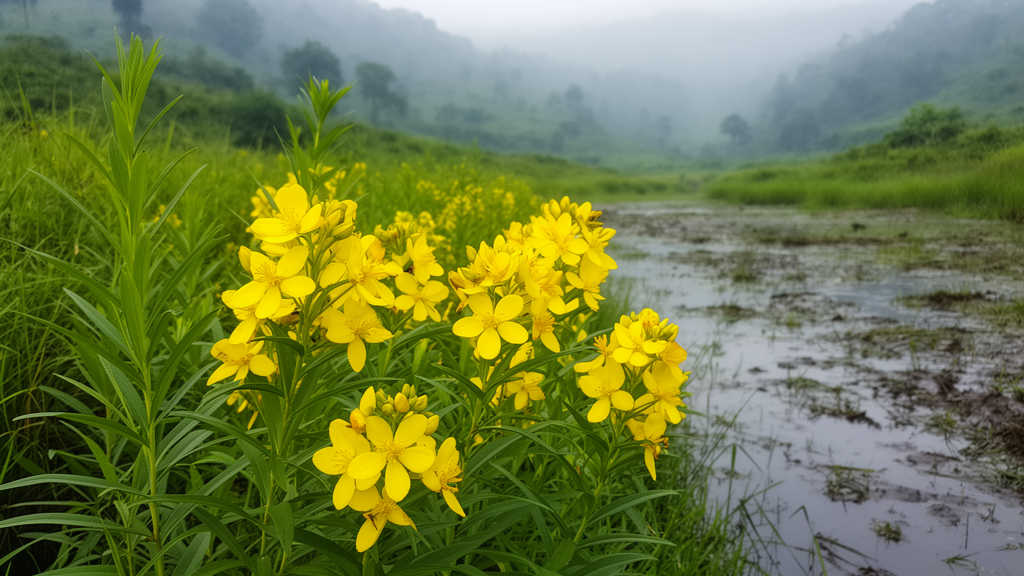
Botanists surveying the hills and valleys of Manipur in Northeast India have documented six species of the flowering plant genus Lysimachia that had never before been recorded in the state, according to a new taxonomic study published in Discover Plants. The team, led by researchers based in Manipur and Nagaland, identified Lysimachia candida, Lysimachia congestiflora, Lysimachia deltoidea, Lysimachia evalvis, Lysimachia japonica and Lysimachia lobelioides from field collections made at sites including Mao and other locations in Senapati district. The findings expand the known flora of one of India’s most biodiverse regions and provide the first detailed morphological descriptions and identification keys for these species within Manipur.
The genus Lysimachia, commonly known as loosestrifes, belongs to the primrose family Primulaceae and comprises roughly 280 species distributed across temperate and tropical Asia, Europe and North America. Members of the genus are typically herbaceous plants, often with yellow, white or reddish flowers, and several species are valued as ornamentals. Northeast India, which forms part of the Indo-Burma biodiversity hotspot, is home to a rich diversity of Lysimachia, yet the flora of Manipur has remained incompletely documented, with many groups of flowering plants still awaiting systematic survey.
Fieldwork for the study was carried out in Senapati district in the northern part of Manipur, an area of rolling hills, subtropical forest and traditional village lands that lies close to the border with Nagaland. The researchers collected flowering specimens during botanical expeditions, pressed and dried them according to standard herbarium practice, and examined their vegetative and floral characters in detail. Comparative study against herbarium material and published taxonomic literature allowed the team to confirm the identity of each collection and to determine that none of the six species had previously been reported from Manipur.
Among the newly recorded species, Lysimachia candida stands out for its pure white flowers and its preference for wet habitats. The Manipur collections were made from marshy ground and stream banks, where the plant grows as an erect herb with lanceolate leaves and small, star-like blossoms borne on slender stalks. Lysimachia congestiflora, by contrast, is a low-growing species with paired, broadly ovate leaves and dense clusters of golden-yellow flowers, often marked with reddish spots at the base of the petals. This species creeps along the ground of forest margins and shaded paths, forming mats that flower profusely after the monsoon.
Lysimachia deltoidea proved to be one of the more distinctive finds, recognisable by its triangular-ovate leaves and its tall flowering stems that can reach well over a metre in height. The species bears numerous small yellow flowers along elongated racemes and was collected from open slopes and roadside verges. Lysimachia evalvis, a smaller plant with narrowly elliptic leaves and solitary yellow flowers arising from the leaf axils, was found growing among grasses on hill slopes. Lysimachia japonica resembles L. congestiflora in its creeping habit but can be distinguished by subtle differences in leaf shape, hair covering and the structure of its flower clusters, characters that the authors document in a comparative key to aid future identification.
The sixth species, Lysimachia lobelioides, is perhaps the most striking in appearance. It produces tall spikes of deep reddish-purple to maroon flowers and was recorded from shaded forest clearings. The species name refers to its resemblance to plants of the genus Lobelia, and its discovery in Manipur represents a significant range extension within the Indian flora. The authors note that all six species were found growing in habitats shaped by traditional land use, including village forests, fallow fields and the edges of terraced cultivation, underscoring the importance of community-managed landscapes for plant diversity in the region.
To help botanists and field researchers distinguish the newly recorded species from one another and from other Lysimachia known in India, the team constructed a detailed taxonomic key based on floral colour, leaf arrangement, hair type and inflorescence structure. Each species account includes a full morphological description, notes on flowering and fruiting periods, habitat information, geographic distribution and examined specimens. The study also provides photographs of living plants in their natural habitats, along with illustrations of key diagnostic features, making the work a practical reference for future surveys in Manipur and neighbouring states.
The researchers emphasise that their findings likely represent only a fraction of the undocumented plant diversity in Manipur. The state lies at the meeting point of several biogeographic zones, where Himalayan, Indo-Burmese and Chinese floristic elements overlap, and its hilly terrain creates a mosaic of microhabitats that can harbour locally restricted species. Historical under-sampling, difficult terrain and limited herbarium coverage have all contributed to gaps in knowledge, and the authors call for continued systematic exploration of remote areas, particularly during the flowering season when identification is most reliable.
Beyond its taxonomic significance, the study highlights the potential value of Lysimachia species for horticulture and local livelihoods. Several loosestrifes are grown internationally as ornamental groundcovers and border plants, and the newly recorded species, with their attractive flowers and adaptability to moist hill habitats, could be candidates for sustainable cultivation. The authors also point to the need for ecological research on the pollinators, seed dispersal and population dynamics of these plants, information that will be essential for assessing their conservation status and for developing evidence-based management plans.
As Northeast India faces mounting pressures from infrastructure development, shifting cultivation and climate change, documenting the region’s flora has become an increasingly urgent task. The six new state records from Manipur add to a growing body of work showing that even well-studied plant groups continue to yield surprises in the Eastern Himalaya and Indo-Burma regions. The researchers hope that their detailed species accounts and identification tools will encourage both professional botanists and citizen scientists to survey more widely, ensuring that Manipur’s botanical heritage is recorded, understood and conserved before it is lost.
Subject of Research: First records of six Lysimachia species in the flora of Manipur, Northeast India
Article Title: New records of Lysimachia (Primulaceae) to the flora of Manipur, Northeast India
Article References: Eshuo, K., Kashung, S., Lokho, K., Mero, P.-Ü., Kaini, K., Maheo, R. S., Gangmei, K., Kashung, G., Leishilembi, U., & Rupa, T. (2026). New records of Lysimachia (Primulaceae) to the flora of Manipur, Northeast India. Discover Plants, 3(1), 470. https://doi.org/10.1007/s44372-026-00960-y
Image Credits: AI Generated
DOI: 10.1007/s44372-026-00960-y
Keywords: Lysimachia, Primulaceae, Manipur, Northeast India, new records, taxonomy, floristics, biodiversity, Senapati district, plant conservation, records, flora
News Source: Margaret Porter. (October 18, 2026). Six Yellow Loosestrife Species Recorded for the First Time in Manipur, India. Scienmag.