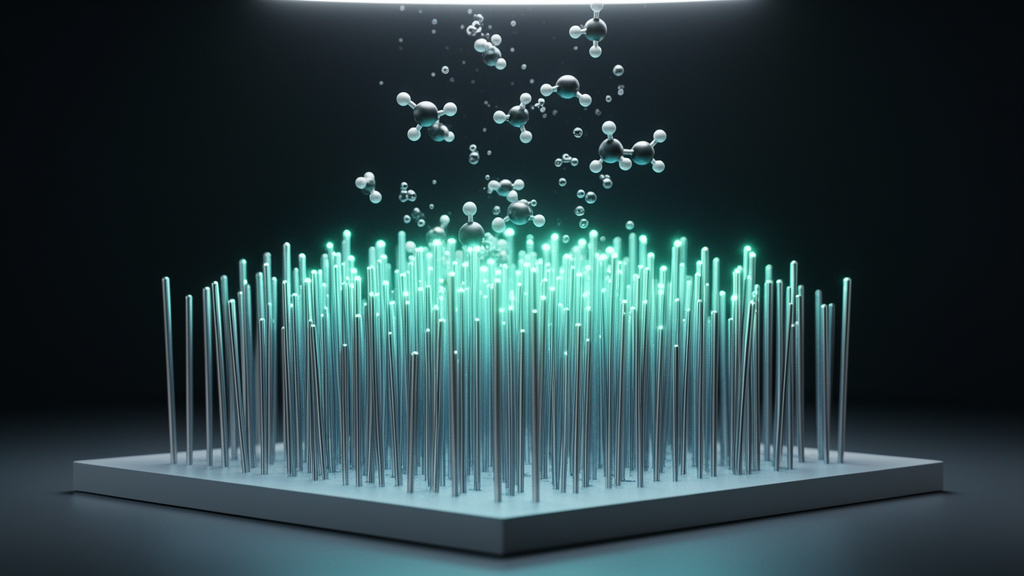
Electrochemical conversion of carbon dioxide into useful chemicals has long been one of the most promising routes for turning a waste stream into a resource, yet the electrodes at the heart of this technology have carried a hidden weakness. Most conventional catalyst electrodes are held together by polymer binders, gluelike additives that coat active sites, impede the flow of reactants, and degrade over time. A research team led by Professors MENG Guowen and TANG Haibin at the Institute of Solid State Physics, part of the Hefei Institutes of Physical Science at the Chinese Academy of Sciences, has now shown that abandoning binders altogether can unlock substantially better performance. Their self-supported nanowire array electrodes, described in two papers published in Energy & Environmental Materials and ACS Nano, convert carbon dioxide into carbon monoxide and n-propanol with high efficiency and remarkable stability.
The appeal of removing polymer binders becomes clearer when considering how conventional electrodes are actually made. In a typical fabrication, catalyst particles are mixed with a polymer such as Nafion or PTFE along with a conductive additive, and the resulting slurry is painted onto a support. This approach is cheap and scalable, but the binder inevitably buries a fraction of the catalytic surface, adds resistance at every particle-particle and particle-substrate junction, and can swell, crack, or detach under the strongly alkaline conditions common in carbon dioxide electrolysis. Over hours of operation, such degradation manifests as rising overpotentials and falling selectivity. A self-supported architecture, in which the active material grows directly as an integrated array on a conductive scaffold, eliminates these failure modes at the source, which is precisely the design philosophy behind the nanowire electrodes developed by the Hefei team.
The template method they employed deserves particular attention. Anodic aluminum oxide is a classic nanofabrication material, formed by electrochemically oxidizing aluminum in an acidic electrolyte so that self-organized, hexagonally packed pores grow perpendicular to the metal surface. Conventional AAO templates, however, produce only straight, isolated channels, and nanowires grown within them emerge as parallel but disconnected pillars. The three-dimensional AAO used in this work incorporates transverse pores that intersect the longitudinal ones, creating a genuinely interconnected network. When metal is deposited into this template and the alumina is dissolved, the resulting nanowire membrane is not a bundle of separate wires but a woven, scaffold-like structure in which every wire is electrically continuous with its neighbors. This connectivity means that even if individual contact points degrade, electrons can still find alternative conduction paths, a redundancy that conventional particulate electrodes lack.
The silver electrode, designated 3D-ICAg, illustrates how this architecture translates into measurable electrochemical advantages. Silver is well established as the most selective metal for reducing carbon dioxide to carbon monoxide, operating through a mechanism in which adsorbed carbon dioxide is activated at the surface, protonated to form a carboxyl intermediate, and then cleaved to release carbon monoxide. The competing reaction, hydrogen evolution, consumes the same electrons and protons, so selectivity hinges on how quickly carbon dioxide intermediates form relative to hydrogen adsorption. The reported Faradaic efficiency of 97.28 percent indicates that nearly every electron passing through the electrode went into making carbon monoxide rather than hydrogen gas, a figure that places the electrode among the better-performing silver catalysts reported in H-type cells. The current density of 59.06 milliamperes per square centimeter is equally significant, because high selectivity is easy to achieve at low current densities where carbon dioxide supply is not limiting; maintaining it at industrially relevant current densities is the harder test.
Mass transport is where the open, scaffold-like geometry pays its greatest dividend. In a conventional bound electrode, carbon dioxide dissolved in the electrolyte must diffuse through tortuous pathways flooded with polymer to reach buried active sites, and the gaseous products must diffuse back out. As current density rises, this diffusion limitation causes local carbon dioxide depletion and pH gradients that erode selectivity. The interconnected nanowire array, by contrast, presents open channels between the wires through which reactants and products can move freely, so the concentration of carbon dioxide at the active surface stays closer to the bulk value even at high current densities. The ordered, parallel arrangement of the wires also ensures uniform current distribution, avoiding the hot spots that accelerate degradation in disordered electrodes.
The fifty-hour stability test provides a meaningful benchmark for this design. Catalyst electrodes frequently show excellent initial performance followed by rapid decline as binders fail or nanostructures agglomerate. Sustaining near-quantitative carbon monoxide selectivity for two days of continuous operation suggests that the direct electrical integration of the nanowires into the substrate, without any intermediate adhesive layer, resists the mechanical and chemical stresses of prolonged electrolysis. The team complemented these performance measurements with in situ Raman spectroscopy, a technique in which a laser is focused on the working electrode while it operates, allowing vibrational fingerprints of adsorbed intermediates to be recorded in real time. Such measurements can reveal which surface species accumulate during the reaction and how their populations change with applied potential, offering mechanistic insight that static ex situ characterization cannot provide.
The copper electrode, GB-ICCu, tackles an even more demanding problem. Copper is the only elemental metal that reduces carbon dioxide to multicarbon products with appreciable efficiency, because its unique surface chemistry stabilizes the carbon monoxide intermediates long enough for them to couple through carbon-carbon bond formation. Yet this same reactivity produces a bewildering mixture of products, including ethylene, ethanol, acetate, and various alcohols, with n-propanol typically a minor component. Forming the three-carbon chain of n-propanol requires at least two carbon-carbon coupling steps and careful control of intermediate coverage on the surface, which is why Faradaic efficiencies for this product have historically remained in the single digits for most catalysts. The reported 17.47 percent efficiency therefore represents a substantial advance for an H-type cell configuration.
Two design features of GB-ICCu appear to drive this selectivity. The first is the abundance of surface grain boundaries, the disordered interfaces where crystalline domains of different orientation meet. Grain boundaries introduce strained, undercoordinated atoms whose electronic structure differs from that of terrace sites, and prior computational and experimental studies have linked such sites to enhanced carbon dioxide activation and stabilized carbon-carbon coupling intermediates. By deliberately engineering a nanowire surface dense with these defects, the team increased the population of the most reactive sites. The second feature is the nanoconfinement effect arising from the interconnected geometry. When reaction intermediates are generated within the narrow spaces between closely spaced nanowires, their effective local concentration rises, and the probability that two carbon-containing intermediates encounter each other before desorbing increases accordingly. Confinement thus biases the branching of the reaction network toward coupling rather than toward protonation to single-carbon products.
The flow cell measurement of 77.7 milliamperes per square centimeter partial current density for n-propanol points toward practical relevance. In an H-type cell, carbon dioxide reaches the catalyst only by dissolving in the electrolyte, and its low solubility caps the achievable current density. Flow cells circumvent this by pumping carbon dioxide gas through a gas diffusion electrode so that the gas, liquid, and catalyst meet at a three-phase interface, dramatically increasing the carbon dioxide supply. Achieving high partial current density in this configuration is a critical step because industrial deployment requires both high selectivity and high throughput, and the two are usually in tension. The fact that the same self-supported nanowire concept performs well in both cell types suggests the architecture is robust rather than tuned to one narrow operating regime.
Taken together, the two studies demonstrate that the template-synthesized, binder-free nanowire approach is a general platform rather than a material-specific trick. The same three-dimensional interconnected architecture accommodates silver, a selective single-carbon product catalyst, and copper, a multicarbon product catalyst, with the grain boundary and confinement levers providing additional control over product distribution. As carbon dioxide electrolysis moves from laboratory curiosity toward industrial deployment, the remaining challenges include scaling the template synthesis to large electrode areas, integrating the arrays into gas diffusion layers, and verifying durability over thousands of hours. The Hefei team’s results indicate that the structural foundations of the electrode, long treated as a secondary consideration behind catalyst composition, can be as decisive for performance as the choice of metal itself.
Subject of Research: Self-supported nanowire electrodes for electrocatalytic carbon dioxide reduction
Article Title: Self-supported nanowire electrodes improve CO2 conversion rate
Article References: Self-supported nanowire electrodes improve CO2 conversion rate. (n.d.). Original publication
Image Credits: AI Generated
DOI: Not provided
Keywords: CO2 reduction, electrocatalysis, nanowire electrodes, silver nanowires, copper nanowires, n-propanol, carbon monoxide, Faradaic efficiency, anodic aluminum oxide, grain boundaries, flow cell, Energy & Environmental Materials
News Source: Faith Mcneil. (October 18, 2026). Binder-free nanowire electrodes boost electrochemical CO2 conversion to fuels. Scienmag.