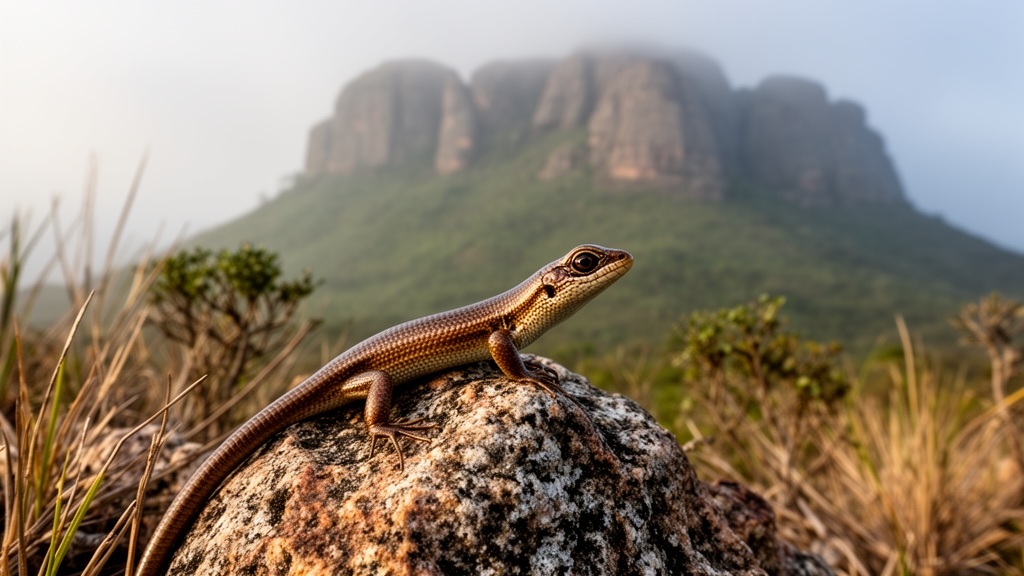
On an isolated granite mountain rising from the arid plains of southwestern Angola, scientists have identified two species of lizard that exist nowhere else on Earth. The animals are snake-eyed skinks, small ground-dwelling reptiles named for their fixed, spectacle-like eyelids that give them an unblinking, serpentine stare. Both were collected on the Serra da Neve inselberg, a subvolcanic mountain in northern Namibe Province that is Angola’s second highest peak at 2,489 meters, and both have now been formally described in the journal Evolutionary Systematics. The discovery brings the number of skink species known from this single mountain to four, a remarkable density for a genus previously considered morphologically conservative and difficult to split into distinct species.
The new species have been named Panaspis ericae and Panaspis mundavambo. Before this study, only four species of Panaspis were known from the whole of Angola, so the addition of two more from one inselberg of roughly 630 square kilometers basal area is taxonomically striking. The genus belongs to a group of African leaf-litter skinks that scavenge through forest floors feeding on termites and other small invertebrates. Because species in the group look extraordinarily alike, distinguishing them requires more than a caliper and a scale count. The research team, working with specimens collected during surveys in October and November 2022, applied an integrative taxonomy approach that combines measurements and scale characters with DNA sequence data from both a mitochondrial gene and a nuclear gene.
Genetically, the analysis targeted the mitochondrial 16S rRNA gene and the nuclear recombination activating gene 1, known as RAG-1. Sequences from the newly collected animals were aligned with previously published data from across sub-Saharan Africa, producing a concatenated dataset of 1,319 nucleotides. Phylogenetic trees were estimated using both maximum likelihood and Bayesian inference methods, and tests for substitution saturation and conflict between the two genes showed the data were clean and congruent. The results placed the Serra da Neve skinks into four distinct lineages. Two of these matched already known species, Panaspis cabindae and Panaspis mocamedensis, while the other two could not be assigned to any named taxon.
The magnitude of that genetic separation is telling. Panaspis ericae displays 5.3 percent uncorrected pairwise sequence divergence in the 16S gene from its closest relative, P. cabindae, while Panaspis mundavambo diverges by 2.9 percent from its nearest neighbor, P. annettesabinae of central Ethiopia. Both values fall within the range typically recognized as species-level divergence in the genus. A haplotype network built from the nuclear RAG-1 sequences reinforced the picture: whereas some widespread Panaspis species share nuclear haplotypes across their ranges, the two newly described species share none with any other sequenced taxon. The researchers also identified fixed nucleotide substitutions that diagnose each new species molecularly, an important step when morphological differences are subtle enough that the animals were initially confused in the field with P. cabindae.
Morphologically, the two new species can still be told apart from their relatives by consistent combinations of scale characters. Panaspis ericae, known from six specimens, has supranasal scales, a pre-ablepharine eye condition in which the lower eyelid is only partially fused to the lid margin, frontoparietal scales that are not fused, and 23 to 26 rows of scales around the midbody. Its dorsum is coppery brown with a light dorsolateral stripe running from behind the eye along the body and tail. Panaspis mundavambo, described from a single specimen, lacks supranasals, has a fully ablepharine eye in which the lower eyelid is completely fused, fused frontoparietals, exactly 24 midbody scale rows, and a pattern of dark spots forming longitudinal series along the middle of the back. Both are small animals, with maximum snout-vent lengths of about 35 millimeters.
The two species also occupy different microhabitats on the mountain, hinting at ecological partitioning among the four Panaspis species that coexist there. Panaspis ericae was collected both in the humid highlands near Catchi village at around 1,600 meters elevation, under leaf litter in dense Miombo woodland, and in the arid lowlands near Maylowe at about 720 meters, in dry riverbeds lined with mopane woodland and sandy soils. Its occurrence in both habitats suggests some ecological adaptability. Panaspis mundavambo, by contrast, was found under a log in denser woodland associated with a riparian gallery at high elevation, and appears to be tied to these more shaded, moisture-retaining corridors. Panaspis mocamedensis, previously known only from the Namib coast, occurs in more open and arid woodland at the base of the inselberg, while P. cabindae occupies lowland humid and forested areas.
Biogeographically, the two new species tell different stories about how Serra da Neve’s fauna assembled. Panaspis ericae belongs to a Central African lineage that includes P. cabindae and the skinks of the Gulf of Guinea oceanic islands, a relationship that points to past connectivity along north-south humid and highland corridors that once allowed Central African taxa to expand southward into Namibe Province. Panaspis mundavambo, whose closest relative lives in the Eastern African highlands of Ethiopia, echoes a pattern already documented for other Serra da Neve endemics, including a legless skink and a dwarf gecko with close relatives in the same region. The presence of P. mocamedensis at the mountain’s base ties the local skink fauna to the endemic fauna of southwestern Angola. Serra da Neve thus emerges as a biogeographic melting pot where lineages from Central, Eastern and southwestern Africa converge.
The inselberg’s capacity for producing endemics is now well established. In just the last five years, fieldwork on Serra da Neve has yielded a strictly endemic toad of the genus Poyntonophrynus, three endemic geckos from the genera Lygodactylus, Afroedura and Rhoptropus, an endemic cordylid lizard of the genus Cordylus, and an endemic legless skink of the genus Acontias, along with several other lizard species described from the mountain and its surroundings. The mountain rises abruptly from Namibian woodland savanna and the arid Namib Desert, and its Miombo forest cover creates a humid island habitat that contrasts starkly with the lowlands. This isolation, combined with the elevation gradient from about 720 to nearly 2,500 meters, appears to have fostered evolutionary divergence in many lineages, and researchers expect further discoveries as surveys continue.
Because both new species are assumed to be endemic to the inselberg, their known area of occurrence does not exceed 630 square kilometers, making them inherently vulnerable to any threat that affects the mountain. The authors note that the available data are insufficient for a full conservation assessment and recommend a provisional status of Data Deficient under IUCN criteria, while stressing that the accumulation of strictly endemic species on Serra da Neve underscores the urgent need for its protection. The mountain lies within what ecologists define as the southern escarpment landscape, an area stretching from Angola’s Coporolo River to Namibia’s Huab River that is increasingly recognized as a priority for conservation.
For the researchers, the two new skinks are more than additions to a checklist. They demonstrate that even groups long considered cryptic and ecologically conservative can harbor unexpected diversity when poorly explored habitats are surveyed with modern genetic tools. The four Panaspis species of Serra da Neve, partitioned by soil type, habitat structure and elevation, may become a valuable case study for understanding how closely related species coexist. As fieldwork continues on this isolated Angolan mountain, the treasure trove of endemics is likely to keep growing, one unblinking skink at a time.
Subject of Research: A treasure trove of endemics: two new species of snake-eyed skinks of the genus Panaspis Cope, 1868 (Squamata, Scincidae) from the Serra da Neve Inselberg, southwestern Angola
Article Title: A treasure trove of endemics: two new species of snake-eyed skinks of the genus Panaspis Cope, 1868 ( Squamata , Scincidae ) from the Serra da Neve Inselberg, southwestern Angola
Article References: P. Marques, M., Parrinha, D., Lopes-Lima, M., Tiutenko, A., Bauer, A. M., & Ceríaco, L. M. P. (2024). A treasure trove of endemics: two new species of snake-eyed skinks of the genus Panaspis Cope, 1868 (Squamata, Scincidae) from the Serra da Neve Inselberg, southwestern Angola. Evolutionary Systematics, 8(2), 167-182. https://doi.org/10.3897/evolsyst.8.121103
Image Credits: AI Generated
DOI: 10.3897/evolsyst.8.121103
Keywords: treasure, trove, endemics, species, snake-eyed, skinks, genus, Panaspis, Cope, Squamata, Scincidae, Serra
News Source: Margaret Porter. (October 18, 2026). Two new snake-eyed skink species found on Angola’s isolated Serra da Neve. Scienmag.