We are normally born with a highly sophisticated array of molecules that act as "sentries," constantly scanning our bodies for injuries such as cuts and bruises. One such molecular sentry, known as von Willebrand factor (VWF), plays a critical role in our body's ability to stop bleeding.
To prevent hemorrhage or life-threatening blood clots, VWF must strike a delicate balance between clotting too little or too much. Researchers have long suspected that the mechanical forces and shear stress of blood flow could be closely-related to VWF's function.
"In some ways, like in the movie Star Wars, VWF may be considered a Jedi knight in our body that can use 'the force' to guard the bloodstream," says Timothy Springer, PhD, of Boston Children's Hospital and Harvard Medical School (HMS).
It has not been possible to witness exactly how VWF senses and harnesses these mechanical forces — until now.
A team in the Boston Children's Program in Cellular and Molecular Medicine and the HMS Department of Biological Chemistry and Molecular Pharmacology, co-led by Springer and Wesley P. Wong, PhD, has revealed exactly how VWF does its job.
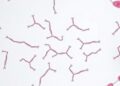
Cutting-edge fluorescence imaging and microfluidic tools, developed by the team, allowed them to capture images of individual VWF molecules on camera while manipulating the molecules with life-like mechanical forces emulating natural blood flow.
The team's findings, published in Nature Communications, reveal that VWF undergoes a two-step, shapeshifting transformation to activate blood clotting. This transformation is triggered when VWF senses certain changes in blood flow that are indicative of injury.
The closest-ever look at blood clotting
"Under normal circumstances, VWF molecules are compact and globular in shape," says Hongxia Fu, PhD, a researcher in Springer's lab and co-first author on the paper. "But we found that when blood flow rate increases, VWF rapidly elongates, stretching out more and more in response to higher shear stress."
However, elongating is not sufficient on its own to activate blood clotting. To safeguard against unnecessary — and potentially life threatening — blood clots, it's only when the tensile forces generated in the elongated VWF hit critical levels that the shapeshifter's transformation becomes complete.
The tensile forces activate"sticky" sites along VWF, allowing it to adhere to circulating platelets, the cells that work in conjunction with VWF to clump up and stop blood loss.
Normally, the rush of blood needed to reach these critically-high tensile forces can only occur at sites of injury inside blood vessels. This specificity enables VWF to sense blood loss and activate rapidly and locally, without activating elsewhere in the body.
"If you can imagine stretching out your arms, and then opening your hands to capture platelets, that's basically what we are seeing VWF do in response to bleeding," says Wong. "It's so important that this process occurs only when and where it is needed – this two-step activation process makes that possible."
A new view on blood disease diagnostics and drugs
Yan Jiang, PhD, a postdoctoral fellow in Wong's lab, also a co-first author on the paper, says the new findings could inspire smart drugs that are designed to treat the obstructive clotting, like deep vein thrombosis, at only diseased areas of the body.
"When you're putting a generic drug into the circulatory system, it's taking effect everywhere, even in places that can cause detriment," says Jiang. "For example, anticoagulants are medically necessary in many cases to prevent blood clots from forming, but they also carry the risk of excessive bleeding. But, what if we could design a smart drug that can mimic the two-step shapeshifting of VWF and only takes effect in areas where clotting is likely to occur?"
Revealing how VWF responds to changes in flow in the highly dynamic bloodstream is a critical step to understanding the interplay between mechanical force and biology in clotting-related diseases and developing novel therapeutics.
"This experiment really represents a new platform for seeing and measuring what's happening in the blood on a molecular level," says Wong. "Through the use of novel microfluidic technologies that allow us to mimic the body's vasculature in combination with single-molecule imaging techniques, we are finally able to capture striking images that uncover the mystery of nature's forces at work in our bodies."
###
Darren Yang (Boston Children's) and Friedrich Scheiflinger (Shire) were also co-authors on the paper. The work was supported by a National Hemophilia Foundation Judith Graham Pool Postdoctoral Research Fellowship, a National Science Foundation Graduate Research Fellowship (DGE-1144152), the American Heart Association (13SDG17000054), the National Institutes of Health (NIGMS R35 GM119537, HL108248, and HL103526) and the Wyss Institute.
Media Contact
Kristen Dattoli
[email protected]
617-919-3141
@BostonChildrens
http://www.childrenshospital.org/newsroom
http://dx.doi.org/10.1038/s41467-017-00230-2