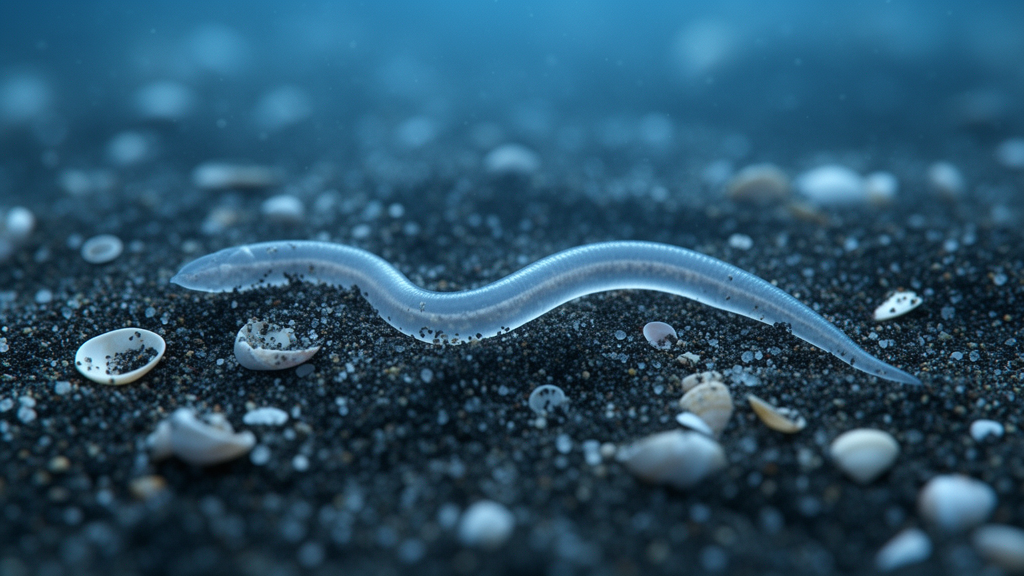
Marine nematodes may be among the most abundant animals on Earth, but along the coasts of Costa Rica they remain almost entirely anonymous. A new review published in Neotropical Biology and Conservation has compiled every published record and database entry for the country’s marine roundworms, and the result is striking: despite decades of biodiversity research in one of the world’s most biologically rich nations, only ten marine nematode species have ever been formally identified from Costa Rican waters, five free-living and five parasitic. The authors argue that vast stretches of coastline and nearly the entire Exclusive Economic Zone remain unexplored for this phylum, which routinely dominates meiofaunal communities in the sediments where it occurs.
Nematodes are the fourth most speciose animal phylum, with roughly 25,000 described species, and by sheer numbers of individuals they are the most abundant animal group on the planet, accounting for around one percent of total animal biomass. They thrive in nearly every ecosystem on Earth, from polar sediments to agricultural soils, occupying niches that range from free-living grazers to parasites of plants and animals. In marine environments, free-living nematodes are generally the most speciose component of the meiofauna, the community of microscopic animals living between sediment grains. Their ubiquity and sensitivity to environmental conditions also make them valuable bioindicators, capable of signaling the health of estuarine and marine ecosystems long before changes become visible at larger scales.
To assess what is actually known about Costa Rica’s marine nematodes, the researchers systematically searched the scientific literature and four international biodiversity databases: the Ocean Biodiversity Information System (OBIS), the Global Biodiversity Information Facility (GBIF), Nemys, the world database of nematodes, and the World Register of Marine Species (WoRMS). From each publication they extracted the level of taxonomic identification, the sampling locality, and the year of collection. The search revealed just fourteen papers mentioning marine nematodes from Costa Rica, and of those, only three included any taxonomic detail at all. The remaining eleven treated nematodes simply as a group, reporting their abundance without identifying a single species.
The geographic pattern of this sparse record is equally telling. Thirteen of the fourteen publications concern the Pacific coast, while only one, a 1974 study of sandy beach infauna by Dexter, touches the Caribbean side. All ten identified species were found on the Pacific coast, and five of the free-living species were described in a single burst of taxonomy more than a century ago, by the nematologist Cobb in 1920, from samples collected at Puntarenas. No nematode data exist for Caribbean seagrass beds or coral reefs, and sampling on the Caribbean sandy beaches has been so limited that Dexter reported nematodes at only one of five Caribbean beaches surveyed, compared with one of eight Pacific beaches.
The five free-living species described by Cobb, Antomicron pellucidum, Hypodontolaimus punctulatus, Pseudochromadora quadripapillata, Pseudolella cephalata, and Zygonemella striata, have had complicated taxonomic histories. A. pellucidum, the type species of its genus, remains valid even though the illustrations in the original description are considered insufficient for comparison, and remarkably, a specimen later studied in the Gulf of Mexico off Florida was assigned to this species originally described from the Pacific coast of Costa Rica. P. quadripapillata has accumulated multiple synonyms and has been reported from locations as distant as Belize, Canada’s Bay of Fundy, the Maldives, Brazil, New Guinea, and Australia, with some databases even listing freshwater as a plausible habitat. Z. striata, the sole species of its genus, was recently matched by Operational Taxonomic Units in Antarctic sediments through DNA metabarcoding, with sequence identity above ninety percent, hinting at a distribution far broader than the historical record suggests.
The parasitic side of the record is equally thin but medically and ecologically significant. The most recent free-living-adjacent description is Echinocephalus janzeni, a parasite described in 1998 from the intestine of a Pacific sting ray, based on specimens collected in Costa Rica and Mexico. The remaining parasitic records come from stranded marine mammals: unidentified species of Anisakis, the genus responsible for human anisakiasis, have been recovered from the digestive tracts of striped, pantropical spotted, and spinner dolphins and Cuvier’s beaked whale. Crassicauda anthonyi, a kidney parasite that can be fatal, was found in a stranded Cuvier’s beaked whale, and nematodes of the genus Halocercus, including H. lagenorhynchi, were collected from the lungs and air passages of pantropical spotted dolphins. Four additional parasitic taxa were reported from stranded cetaceans in 2023, underscoring how much parasite diversity likely remains undocumented.
Where taxonomic identification is absent, abundance data still reveal how dominant nematodes can be. Studies of intertidal mud flats in the Gulf of Nicoya in the mid-1980s found nematodes comprising between 74.9 and 88.1 percent of total organisms, with vertical distribution analyses showing that over 82 percent of individuals concentrated in the top two centimeters of sediment. On coral reefs at Isla del Caño Biological Reserve, nematodes represented about 19 percent of sediment fauna. Around Isla del Coco, a remote oceanic island, nematodes were the second most abundant group at 24 of 27 sampling stations, totaling more than 3,300 individuals, yet every specimen was logged simply as unidentified Adenophorea, a broad subclass, with no species-level resolution.
Perhaps the most dramatic numbers come from deep water. A study of meiofauna along the central Pacific coast at depths of 400 and 1,800 meters found nematodes averaging nearly 80 percent of total abundance, peaking at 99.9 percent within the Oxygen Minimum Zone at 400 meters. The nematode density recorded there, roughly 3,688 individuals per ten square centimeters, is the highest reported for any oxygen minimum zone in the eastern Pacific, even though species richness in that zone was among the lowest. At a methane seep near Mound 12 at about 1,000 meters depth, nematodes made up nearly 10 percent of the meio-epifaunal organisms colonizing deployed woodblocks, and were more abundant on wood at inactive seep sites than at active ones.
The review’s authors emphasize that this scarcity of taxonomic data is not a reflection of the group’s true diversity. Comparable tropical ecosystems elsewhere tell a very different story: a single study of Cuban seagrass beds identified 215 nematode species across 138 genera, 35 families, seven orders, and two classes. Nematodes are also the most abundant taxon in methane seeps of the Gulf of Cádiz, and Costa Rica’s Pacific margin hosts numerous methane seeps of its own. On the parasitic front, Mediterranean studies have documented nematodes in edible scallops and in sea turtles such as the loggerhead, hosts that also occur in Costa Rican waters, suggesting similar or identical parasites await discovery there.
The message of the review is a call to action for tropical marine taxonomy. Because nematodes are simultaneously the most abundant meiofaunal group, sensitive indicators of environmental quality, and key players in sediment food webs, the near-total absence of species-level data from Costa Rica represents a significant gap in understanding the country’s marine biodiversity. The authors argue that dedicated taxonomic effort, combining classical morphology with modern molecular tools, is needed to explore the actual diversity of marine nematodes on both coasts, in habitats ranging from sandy beaches and mud flats to coral reefs, oxygen minimum zones, and deep-sea seeps. Until that work is done, the microscopic majority of Costa Rica’s marine fauna will remain, quite literally, unnamed.
Subject of Research: Diversity and taxonomy of marine nematodes in Costa Rica
Article Title: Marine nematodes of Costa Rica: state of the art
Article References: Sánchez-Monge, A., & Cortés, J. (2024). Marine nematodes of Costa Rica: state of the art. Neotropical Biology and Conservation, 19(2), 319-331. https://doi.org/10.3897/neotropical.19.e115345
Image Credits: AI Generated
DOI: 10.3897/neotropical.19.e115345
Keywords: marine nematodes, Costa Rica, meiofauna, taxonomy, biodiversity, bioindicators, oxygen minimum zone, parasitic nematodes, Pacific coast, Caribbean coast, deep sea, Neotropics
News Source: Margaret Porter. (October 18, 2026). Costa Rica’s Marine Nematodes Remain Largely Unknown, Review Finds. Scienmag.