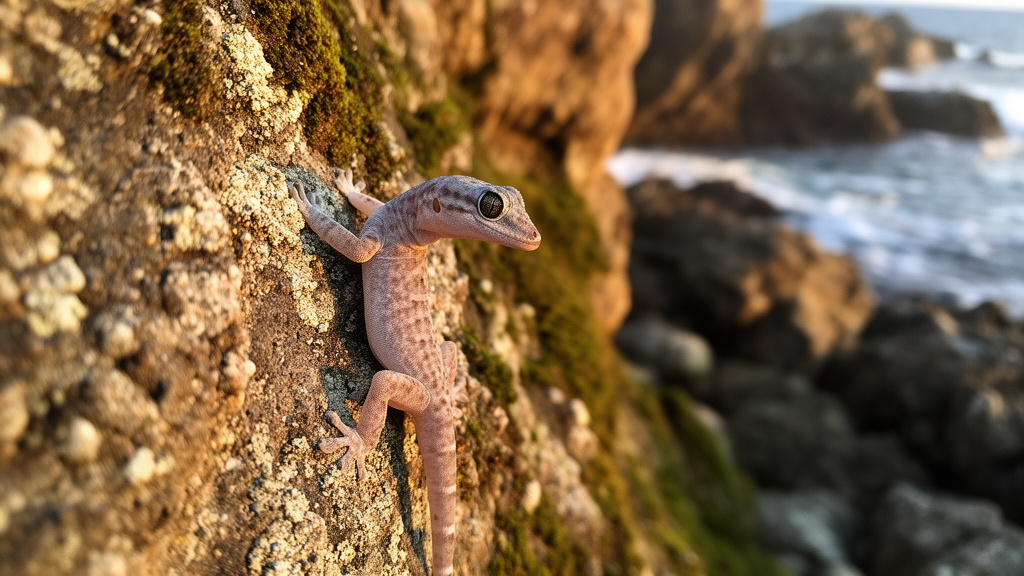
For nearly four decades, a mysterious gecko has been lurking on the sea cliffs and stone walls of western Japan, so familiar to local naturalists that it even earned a place on official Red Lists — yet science had no name for it. Referred to provisionally as the “Nishi-yamori,” or Western Gecko, this nocturnal reptile was long treated as a cryptic species within the genus Gekko, recognized by its distinctive appearance but never formally described. Now, an integrative study combining mitochondrial DNA sequencing with detailed morphological analysis has finally given the animal its scientific identity: Gekko asahi, a new species of rock-dwelling gecko from the islands and peninsulas of Nagasaki and Kagoshima Prefectures in western Kyushu, Japan.
The discovery, published in the journal Zoosystematics and Evolution, is remarkable not because the gecko is rare or hard to find, but because it has been hiding in plain sight. Field surveys conducted between January 2024 and July 2025 across the Gotō Islands, Hirado Island, the Koshiki Islands, and coastal sites on the Kyushu mainland collected eighteen specimens of the unnamed lineage. These animals, which inhabit low-elevation rocky shores and the walls of coastal buildings at elevations of just 2 to 50 meters above sea level, were photographed, humanely euthanized, and preserved for study at the Museum of Natural and Environmental History in Shizuoka. Fresh liver tissue was extracted and stored at minus 20 degrees Celsius for genetic analysis.
To resolve the evolutionary relationships of this enigmatic gecko, the research team extracted genomic DNA from ethanol-preserved liver tissue using a standard phenol-chloroform-proteinase K procedure with isopropanol precipitation. DNA quality was assessed by agarose gel electrophoresis, and concentrations were adjusted to approximately 100 nanograms per microliter. Two mitochondrial gene fragments — NADH dehydrogenase subunit 2 (ND2) and 16S ribosomal RNA (16S) — were amplified via polymerase chain reaction using established primer pairs. The resulting sequences, submitted to GenBank under accession numbers PZ033202 through PZ033226 for ND2 and PZ014854 through PZ014878 for 16S, were combined with 47 additional sequences representing 36 individuals from 34 species of the subgenus Japonigekko retrieved from public databases.
A concatenated dataset of the two gene fragments, totaling 1,506 base pairs, was aligned using MUSCLE and subjected to Maximum Likelihood analysis in IQ-TREE. The best-fit evolutionary models, determined by ModelFinder according to the Akaike information criterion, were GTR+F+I+R3 for the 16S fragment and TIM+F+R4 for ND2. Node support was assessed using both the Ultrafast Bootstrap Approximation with 5,000 replicates and the SH-like approximate likelihood ratio test with 1,000 replicates. The results were unambiguous: all eighteen samples from Nagasaki and Kagoshima Prefectures formed a strongly supported independent lineage within Japonigekko, with internal genetic divergence ranging from just 0.0 to 2.5 percent in ND2 and 0.0 to 0.6 percent in 16S — evidence that these populations represent a single, cohesive evolutionary unit.
Phylogenetically, the new species occupies a fascinating position. It forms a sister group relationship with Gekko kaiyai, a species currently known only from the Dabie Mountain region of Henan Province in central China, and together these two lineages cluster with Gekko hokouensis in what the authors refer to as the G. hokouensis clade. The uncorrected p-distances between the unnamed lineage and other members of Japonigekko ranged from 15.1 percent against G. kaiyai to 26.2 percent against G. adleri in ND2, and from 7.6 percent against G. hokouensis to 16.4 percent against G. adleri in 16S. These values are markedly greater than the smallest interspecific divergences recovered within the subgenus in this study — 3.3 percent in ND2 between G. cib and G. tawaensis, and 2.2 percent in 16S between G. chinensis and G. similignum — confirming that the western Kyushu population is genetically distinct from all recognized congeners.
Morphological evidence reinforced the molecular story. The team measured external morphometric characters — including snout-vent length, head length, head width, eye-to-ear distance, and forelimb and hindlimb lengths — with digital calipers to the nearest 0.1 millimeter, and counted meristic scalation features under a binocular scope. Statistical comparisons using one-way ANOVA with the Tukey-Kramer test, the Kruskal-Wallis test, and a Principal Component Analysis on log-transformed character ratios revealed that the three molecular operational taxonomic units of the G. hokouensis clade show no overlap in morphospace. PCA1 accounted for 30.36 percent of total variance and loaded most heavily on snout-eye, nares-eye, and eye-to-ear ratios, while PCA2 accounted for 16.20 percent and loaded most heavily on eye length, head height, head length, and hindlimb ratios. Univariate analyses showed significant differentiation in snout-vent length and ten body ratios between the three lineages.
The new species can be diagnosed by a distinctive combination of traits: a moderate body size reaching up to 73.96 millimeters in snout-vent length; 34 to 44 interorbital scales between the anterior corners of the eyes; large, strongly elevated dorsal tubercles arranged in 12 to 16 rows at midbody; 127 to 158 midbody scale rows; 32 to 45 ventral scale rows; 158 to 189 ventral scales between the mental and the cloacal slit; subdigital lamellae numbering 8 to 11 on finger I, 9 to 14 on finger IV, 9 to 12 on toe I, and 10 to 18 on toe IV; the complete absence of interdigital webbing; 6 to 9 precloacal pores in males, absent in females; and one postcloacal tubercle on each side, with the midpoint distinctly concave in some males. In life, the dorsum is predominantly yellowish-gray with 8 to 9 indistinct pale yellowish-brown rounded blotches, while the venter glows pale golden-yellow — a coloration that inspired the species name.
The epithet “asahi” derives from the Japanese word 朝日, meaning morning sun or rising sun, referring to the faint yellow to light orange-red hue on the body and limbs and the bright reddish-yellow to pale golden-yellow ventral surface, which resembles the warm glow of early morning sunlight. Suggested common names include “West Japanese Gecko” in English, “Nishi-yamori” in Japanese, “chén xī bì hǔ” in Chinese, and “Zapadnoyaponskiy gekkon” in Russian. The holotype, an adult male designated SPMN-HP 003810, was collected on Nakadori Island in Shinkamigoto Town, Nagasaki Prefecture, on January 8, 2024, by Seiji Tsujita. Nine paratypes from Nagasaki and Kagoshima Prefectures and fifteen additional specimens complete the type series.
Ecologically, Gekko asahi is a nocturnal specialist of coastal rocky shores, though it readily occupies the walls of coastal buildings on islands where invasive congeners such as G. japonicus and G. hokouensis have not yet established. On uninhabited islands or those where invasive geckos are present, it appears to retreat exclusively to natural rocky habitats — a pattern suggesting that competitive interactions with introduced species shape its microhabitat use. Females lay two eggs within rock crevices in relatively dry, sunlit sites during May and June, and communal nesting is common, with numerous eggs sometimes occurring in a single crevice. Seasonal microhabitat preferences shift from sunny rocky areas in early spring to cool shaded crevices in midsummer and deep rock crevices for overwintering. The diet consists mainly of insects and wharf roaches, though predation on small mollusks has been reported, and multiple ant heads were detected in the feces of several individuals on the Koshiki Islands.
The formal description of Gekko asahi raises the total number of recognized species in the subgenus Japonigekko to 40, of which seven are now known from Japan. Divergence-time estimates from previous work indicate that populations on the Gotō and Koshiki Islands diverged approximately 11,000 years ago, while those on Kami-Koshiki and Shimo-Koshiki Islands separated only around 500 years ago. Population-genetic analyses have revealed limited hybridization with introduced G. japonicus and G. hokouensis in parts of southern Kyushu, yet across many islands in its native distribution no evidence of gene flow with other congeners has been detected, supporting long-term isolation. The pronounced geographic disjunction between G. asahi in western Japan and its sister species G. kaiyai in central China — separated by vast mountain systems and the intervening sea — indicates independent evolutionary trajectories and provides further evidence for the biogeographic hypothesis that Japonigekko originated in Indochina with subsequent diversification in mainland China and numerous dispersal events to East Asian islands, including the Japanese Archipelago. The discovery demonstrates that surveying amphibian and reptile diversity on the islands of Kyushu remains insufficient, and future studies aim to clarify the genetic population structure by including populations from numerous uninhabited islands that could not be surveyed in this analysis.
Subject of Research: Taxonomy and evolutionary biology of a new gecko species from western Kyushu, Japan
Article Title: A new coastal rock-dwelling gecko of the subgenus Japonigekko ( Squamata , Gekkonidae , Gekko ) from western Kyushu, Japan
Article References: Matsukoji, T., Cao, J., Poyarkov, N. A., Okamiya, H., Xu, Y., & Yuan, Z. (2026). A new coastal rock-dwelling gecko of the subgenus Japonigekko (Squamata, Gekkonidae, Gekko) from western Kyushu, Japan. Zoosystematics and Evolution, 102(2), 557-574. https://doi.org/10.3897/zse.102.186960
Image Credits: AI Generated
Keywords: gecko, Gekko asahi, Japonigekko, new species, Japan, Kyushu, taxonomy, phylogenetics, herpetology, biodiversity, coastal, rock-dwelling
News Source: Margaret Porter. (October 18, 2026). New gecko species hiding in plain sight on Japan’s rocky western coast. Scienmag.