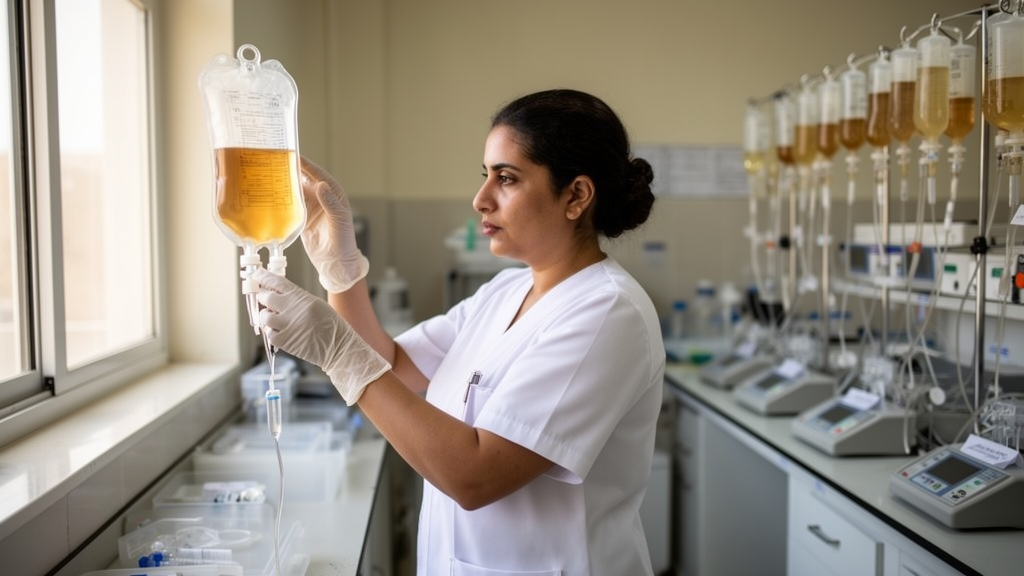
When a patient’s gut fails, nutrition must arrive another way: through a vein. Parenteral nutrition, the intravenous delivery of carbohydrates, amino acids, lipid emulsions, vitamins, trace elements, and electrolytes, is one of the most complex and error-prone treatments in modern medicine. It is classified as a high-alert medication, meaning that mistakes anywhere along the chain from ordering to dispensing carry a real potential for patient harm. Yet despite its centrality to the care of premature babies, critically ill hospital patients, and people with irreversible gastrointestinal loss such as short bowel syndrome, little has been known about how the pharmacists who actually prepare and manage these mixtures go about their work in Iraq and its neighboring Middle Eastern countries.
A new qualitative study published in Pharmacia has now mapped that territory in detail. Researchers interviewed 27 pharmacists working in Baghdad’s government hospitals using semi-structured, face-to-face interviews conducted in Arabic over two months in late 2025. Recruitment continued until data saturation was reached, the point at which no new themes or meaningful insights emerged from additional interviews. The participants, aged 26 to 48 with a mean of about 31 years, represented a wide range of educational backgrounds, from bachelor’s degrees to clinical pharmacy board certification and postgraduate residency training, and their parenteral nutrition experience ranged from three months to seven years.
The interviews surfaced four major themes: knowledge, complications, the roles of pharmacists, and the challenges and barriers that make their tasks difficult. On the knowledge front, the most common learning activities were institutional lectures and workshops, reported by 21 pharmacists, followed by clinical pharmacy board study, mentioned by 16, and undergraduate education, cited by 12. Eight pharmacists pointed to training during postgraduate residency programs as a crucial stage. Peer-to-peer sharing also played a supporting role, with six participants describing how experienced residents pass practical know-how to colleagues with less exposure to the therapy.
When it comes to information sources, the pharmacists rely on international authorities. Seventeen mentioned the American College of Clinical Pharmacy’s Updates in Therapeutics as their reference for parenteral nutrition, 15 cited the American Society for Parenteral and Enteral Nutrition guidelines, and 14 reported using the European Society for Clinical Nutrition and Metabolism recommendations. Technological platforms such as UpToDate were also mentioned. Nineteen pharmacists reported complete adherence to these guidelines, while seven admitted only partial adherence, often because resources such as line filters were simply unavailable. Most participants, 23 in total, expressed a strong commitment to lifelong learning, emphasizing that old information cannot be trusted in a field that evolves as rapidly as clinical nutrition.
The complications the pharmacists encounter read like a checklist of metabolic hazards. Fluid and electrolyte abnormalities were the most frequently reported problem, mentioned by 12 pharmacists, including imbalances such as hyperkalemia, hypokalemia, and hypocalcemia, often at the initiation of therapy when baseline electrolyte measurements are skipped or the patient has renal dysfunction. Refeeding syndrome, the dangerous rapid intracellular electrolyte shift that occurs when a malnourished patient is fed too quickly, was identified by eight pharmacists, some of whom noted that pretreatment with electrolyte correction has reduced its likelihood. Hepatobiliary disorders, including liver injury linked to soybean-based lipid emulsions, were reported by seven participants, while hyperglycemia, hypoglycemia, and hypertriglyceridemia each appeared in the accounts of five pharmacists.
Infectious complications were the second major concern, mentioned by ten pharmacists, who traced them to problems with line handling, aseptic technique, and patient status. One described a patient who appeared completely normal with no signs of infection, only for an infection to appear after two days on parenteral nutrition, indicating that something in the conditions or handling had not been sterile. Opportunistic infections, especially in neonates, were also flagged. Mechanical and technical issues, such as line access problems, drug administration through the same line, and pump or catheter failures, rounded out the picture for four participants.
The pharmacists’ roles emerged as far broader than traditional compounding and dispensing. Before therapy begins, 26 pharmacists calculate the dosage and requirements for calories, amino acids, lipids, and electrolytes, and 25 prepare and compound the solutions. Twenty integrate biochemical data with clinical conditions to detect complications early, examining laboratory results and nutritional status before initiation. Eighteen assess prescriptions and indications to ensure the patient genuinely needs the therapy rather than starting it improperly. During and after administration, all 27 pharmacists emphasized educating patients or caregivers on what the intravenous solution contains and why it matters, while 26 described regular monitoring and follow-up, usually daily at first, with adjustments such as changing glucose concentrations or stopping lipids or amino acids depending on the patient’s condition. Twenty-two described managing complications as a shared responsibility of the nutrition support team, and ten reported setting infusion pump rates as part of their duties.
But the barriers are formidable. The most common obstacle, reported by 26 participants, was the shortage of parenteral nutrition components. One pharmacist described the problem with phosphorus replacement: because intravenous phosphorus is unavailable, the team prepared an oral phosphate solution that causes gastrointestinal disturbances in addition to its bad taste. Twenty pharmacists cited a shortage of compounding facilities, noting that basic supplies such as syringes of various sizes are frequently unavailable. Eleven reported that the availability and functionality of infusion pumps sometimes jeopardize precise administration, and five noted that some laboratory tests needed for follow-up, such as phosphorus levels, are not always accessible.
Human resources present their own set of challenges. Thirteen pharmacists called for continuing education programs to improve clinical competence, noting that seminars should be held for nursing staff, doctors, and both board-certified and non-certified pharmacists. Eleven identified the shortage of experienced staff as a main challenge to effective monitoring, with some describing situations where on-call staff lack strong experience, forcing patients to wait for the morning shift when problems occur. Communication issues hampered cooperation among healthcare professionals for five participants, and burnout and staff turnover increased task demands for two. Organizational barriers included the lack of consistent institutional rules, with seven pharmacists urging the Iraqi Ministry of Health to establish a comprehensive national protocol that all health departments must follow. The absence of computerized prescribing systems, cited by seven, results in lengthy manual calculation times for what is a delicate and error-prone process. Nine pharmacists also mentioned that limited patient or caregiver health literacy and negligence affect therapy management.
The study’s authors argue that these findings carry implications for healthcare policy, pharmacist training, and the establishment of multidisciplinary nutrition support teams in Iraq. The results can prompt the Ministry of Health to create a national parenteral nutrition protocol, target budget allocations to areas of highest clinical need, and mandate strict compounding standards. They also support updating university pharmacy curricula and requiring continuing education workshops in nutrition support. The researchers acknowledge limitations, including possible social desirability bias from self-reported experiences and the restriction to government hospitals in Baghdad, which may limit generalizability to private hospitals or other governorates. However, they note that the inclusion of pharmacists with varied educational backgrounds and practice environments provided a wide range of perspectives, and that because Iraq’s healthcare infrastructure and supply of parenteral nutrition components are highly centralized under the Ministry of Health, the operational barriers identified reflect systemic rather than isolated local issues. Given the scarcity of published literature on parenteral nutrition practices in Iraq, the study offers a critical baseline perspective that highlights gaps relevant to other healthcare settings facing similar resource constraints, and it underscores that pharmacists are essential at every step of the process, from nutritional assessment and customized calculations to monitoring, complication management, and patient education.
Subject of Research: A qualitative study of 27 pharmacists in Baghdad's government hospitals maps how parenteral nutrition is prepared, monitored, and managed, revealing both the breadth of pharmacists' roles and the shortages of components, facilities, and trained staff that hamper the therapy.
Article Title: Exploring the current practices of parenteral nutrition from pharmacists’ perspectives: a qualitative study
Article References: Ibrahim Saleh, O., Jabbar Kadhim, D., & Faris Nassir, K. (2026). Exploring the current practices of parenteral nutrition from pharmacists’ perspectives: a qualitative study. Pharmacia, 73, Article e208575. https://doi.org/10.3897/pharmacia.73.e208575
Image Credits: AI Generated
DOI: 10.3897/pharmacia.73.e208575
Keywords: parenteral nutrition, clinical pharmacy, qualitative research, Iraq, nutrition support, medication safety, pharmacists, Exploring, current, practices, parenteral, nutrition
News Source: Daisy Hatcher. (October 18, 2026). Inside the IV bag: pharmacists reveal how parenteral nutrition really works in Baghdad hospitals. Scienmag.