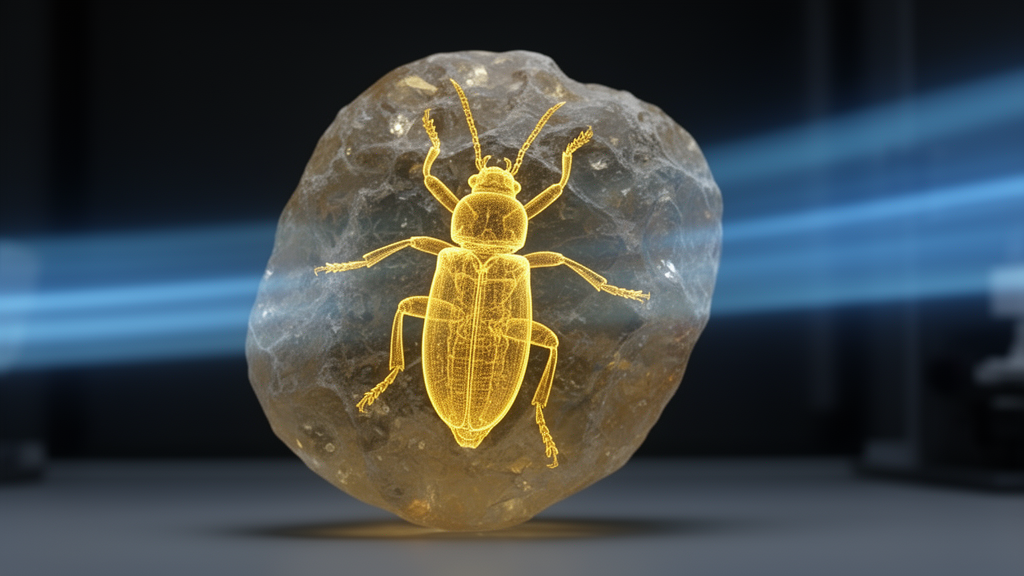
Deep inside a lump of 99-million-year-old amber from northern Myanmar’s Hukawng Valley, one of the rarest beetles ever discovered has been brought back to life in extraordinary three-dimensional detail. Archaeocerus uenoi, the only known extinct species of the carrion beetle subfamily Catopocerinae, has now been redescribed using some of the most advanced X-ray imaging technology on the planet, revealing internal anatomy that has never before been seen in a fossil of this family. The findings, published in the journal Subterranean Biology, confirm the genus’s placement among a peculiar group of small, mostly eyeless and wingless beetles that today live hidden in the soil and caves of North America, Siberia, and Japan.
The original description of Archaeocerus uenoi in 2019 was based on a single male specimen, the holotype, preserved in Cretaceous amber dating to roughly the Albian/Cenomanian boundary. Now, a second specimen has come to light, deposited in the private collection of Michel Perreau, and it is a female. This discovery allowed the researchers to describe the female of the species for the first time, along with the internal genital morphology of both sexes, using a technique that amounts to virtual dissection without ever touching the fragile fossil.
The imaging was performed at the European Synchrotron Radiation Facility in Grenoble, France, using two complementary methods. Propagation phase contrast micro-tomography on beamline BM05 delivered voxel resolutions of 0.73 micrometers for the female and an astonishing 0.34 micrometers for the male, acquiring 6000 projections over a full 360-degree rotation at an energy of 29 kiloelectronvolts. For the finest structures, the team turned to beamline ID16B, where X-ray holotomography pushed the resolution down to 60 nanometers, using four tomographic scans at slightly different propagation distances and a contrast transfer function algorithm for phase retrieval. The result is a dataset sharp enough to resolve individual setae and the delicate internal sclerotized structures of the male genitalia.
That resolution matters enormously for a beetle measuring just 1.2 millimeters long as a male and 1.5 millimeters as a female. The scans revealed a body that is elongate, flattened, and dark brown, with antennae, legs, and mouthparts in lighter brown. The antennae carry 11 antennomeres, with the eighth extremely flat and significantly narrower than its neighbors, a distinctive feature. The pronotum is transverse, about 1.4 times as wide as long, with a shiny surface bearing tiny punctures and fine microreticulation. The elytra are parallel in their basal two-thirds before rounding at the apex, with a single parasutural longitudinal stria and punctures aligned in oblique strigae associated with short setae.
Perhaps the most surprising external finding is that Archaeocerus uenoi possesses developed eyes and flight wings, probably functional ones, with nervation present near the base and ciliate margins. This sets it apart from every living member of the subfamily, all of which are anophthalmic and apterous, having abandoned both sight and flight as they adapted to life underground. Most extant Catopocerinae are endogean, living within the soil, while one species, Glacicavicola bathyscioides, is troglobitic, inhabiting lava caves in Idaho and Wyoming with a slender elongated body shape reminiscent of European cave beetles. The fossil, by contrast, retains eyes and wings while otherwise resembling its soil-dwelling relatives, and its size matches the smallest species of the North American genus Pinodytes.
The virtual dissection also exposed the beetle’s leg architecture in unprecedented detail. The tarsal formula is 5-4-4 in both sexes, another departure from the 5-5-5 formula of most extant genera. Male protarsi are imperceptibly dilated and equipped with tenent setae of two kinds on their ventral side: some very long and straight, others shorter, curved, and slightly dilated at the apex. Protibiae are thickened in their basal half and bear a dense bunch of setae on the inner margin of the apical half in both sexes. The outer side of the protibiae is spineless, while the meso- and metatibiae carry strong spines on their outer edges, features now documented in stereo-anaglyph images viewable with simple red/cyan glasses.
The crown jewel of the redescription is the aedeagus, the male genital structure, which the nano-tomography resolved with a voxel size of just 0.06 micrometers. In dorsal or ventral view it is parallel in its basal two-thirds before pointing triangularly at the apex, and flat in lateral view. The parameres are slightly shorter than the median lobe, each bearing two subapical distant setae. Most remarkably, the endophallus, the internal sac of the genitalia, carries a wide basal structure with two lateral expansions and a long, roughly cylindrical stylus that is not closed on the dorsal side, giving it a gutter-like shape. No living genus of Catopocerinae shows anything like this long tubular stylus, making it a truly unique internal signature of this Cretaceous beetle.
Comparing these genital structures with extant genera provides crucial phylogenetic evidence. The apical setae of the parameres are distant and dorso-lateral, a configuration shared with Muganryus, Perkovskius, and a few species of Pinodytes. The complex basal structure of the endophallus is in some ways similar to that of Perkovskius, but the long tubular stylus remains unmatched. The internal structures look somewhat like the Y-shaped basal piece found in the tribe Leptodirini of the subfamily Cholevinae, which also extends into a long stylus, though that stylus has never been observed to be tubular. An internal stylus also occurs in Ptomaphagini, but without the dorsal longitudinal opening seen in Archaeocerus, although some species of Adelopsis hint at an internal void near the apex.
The subfamily Catopocerinae is a small group, currently containing six genera and 53 described species, and it is one of only two subfamilies of Leiodidae recovered as monophyletic in a major molecular phylogeny of beetles. Archaeocerus shares all the defining characteristics of the subfamily: the invagination of abdominal segment VIII inside the abdomen, leading to five visible abdominal coxosternites instead of six; a prosternum longer than the coxal width; and the presence of a spiculum ventrale in both sexes. Both male and female ventrite VIII carry this spiculum ventrale, a genital feature now documented in the fossil for the first time. The female genital segment, however, lacks visible appendicular parts, though the researchers cannot determine whether this reflects an actual reduction or simply the poor state of preservation of the amber specimen.
The bionomics of these beetles remain poorly known, but the new anatomy offers tantalizing clues about how they lived. Except for the cave-dwelling Glacicavicola, which has been observed feeding on decayed arthropods, the other extant genera are at least partly mycophagous, feeding on fungal sporocarps, and fungal spores have been found directly in the guts of several species. The mixing of plesiomorphic character states, such as the retention of eyes and wings, with presumably apomorphic features like the tarsal formula and the complex basal structure of the endophallus suggests that Archaeocerus might be the sister group of all extant genera, though the researchers caution that this remains speculative in the absence of a comprehensive phylogenetic analysis. What is certain is that a beetle trapped in amber for 99 million years has now had its most intimate anatomy revealed, thanks to X-rays a billion times more penetrating than any scalpel.
Subject of Research: Redescription of the Cretaceous species Archaeocerus uenoi Perreau, 2019 based on synchrotron radiation micro-tomography and nano-tomography (Coleoptera, Leiodidae, Catopocerinae)
Article Title: Redescription of the Cretaceous species Archaeocerus uenoi Perreau, 2019 based on synchrotron radiation micro-tomography and nano-tomography ( Coleoptera , Leiodidae , Catopocerinae )
Article References: Perreau, M., Njunjić, I., de Groot, M. D., Van Caenegem, W., & Haelewaters, D. (2025). Redescription of the Cretaceous species Archaeocerus uenoi Perreau, 2019 based on synchrotron radiation micro-tomography and nano-tomography (Coleoptera, Leiodidae, Catopocerinae). Subterranean Biology, 52, 187-200. https://doi.org/10.3897/subtbiol.52.154293
Image Credits: AI Generated
DOI: 10.3897/subtbiol.52.154293
Keywords: Redescription, Cretaceous, species, Archaeocerus, uenoi, Perreau, based, synchrotron, radiation, micro-tomography, nano-tomography, Coleoptera
News Source: Drew Townsend. (October 18, 2026). Cretaceous Beetle Resurrected in 3D Using Synchrotron X-Rays. Scienmag.