Cadmium is one of the most toxic heavy metals in agricultural soils, and it does not degrade or disappear with time. It enters crops through the roots, moves through the xylem, and accumulates in edible or medicinal organs, where it can cause oxidative damage, disrupt photosynthesis, and interfere with essential metabolic pathways. For medicinal plants, cadmium contamination is a particularly serious problem because the dried leaves, roots, or flowers are consumed directly as herbal remedies, and any metal they contain ends up in the final product. Understanding how a medicinal species handles cadmium at the physiological, cellular, and molecular levels is therefore a prerequisite for producing safe herbal medicine on contaminated land.
A new study published in BMC Plant Biology examined cadmium distribution and tolerance mechanisms in Artemisia argyi, a species whose dried leaves are the medicinal organ used in traditional Chinese medicine. The research team, led by Zheyong Li, Luojing Xiang, Chaobo Huang, and Qiang Zhang of the Hubei Provincial Academy of Eco-Environmental Sciences, together with Mi Lei of the Hubei University of Chinese Medicine, grew A. argyi plants hydroponically and exposed them to cadmium concentrations ranging from 0 to 40 milligrams per liter for 14 days. This acute exposure system allowed the researchers to control the metal dose precisely and to observe how the plants responded across a wide range of cadmium levels, from mild to severe stress.
The results showed a clear threshold in the plant’s response. At cadmium concentrations of 1 to 10 milligrams per liter, growth was barely affected, suggesting that A. argyi can tolerate moderate cadmium exposure without significant cost to biomass. But at 20 and 40 milligrams per liter, growth was markedly inhibited, indicating that the plant’s defense systems were overwhelmed at higher doses. This transition between 10 and 20 milligrams per liter is specific to the acute hydroponic system used in the study and should not be interpreted as a field threshold, the authors caution, since soil chemistry, microbial activity, and organic matter all modify cadmium availability in real-world conditions.
To understand how the plant defends itself, the researchers measured the activity of key antioxidant enzymes and the content of osmoprotective compounds. Peroxidase (POD) activity and proline content both increased under cadmium stress, consistent with a classic oxidative defense response. Proline acts as an osmolyte and a reactive oxygen species scavenger, helping to stabilize proteins and membranes when cells are under metal stress. Catalase (CAT) activity, by contrast, declined at high cadmium exposure, suggesting that this particular antioxidant line of defense was weakened when the metal dose became severe. Total flavonoids showed a biphasic response, rising and then falling across the cadmium gradient, hinting that the plant adjusts its secondary metabolism in a dose-dependent way rather than simply increasing it.
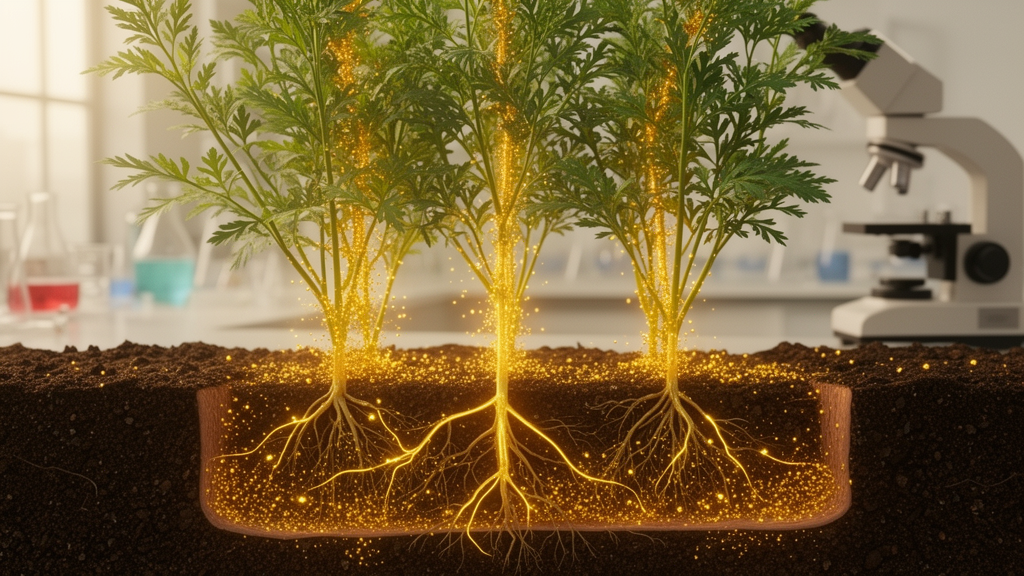
The distribution of cadmium within the plant proved to be a central part of the tolerance strategy. Using inductively coupled plasma mass spectrometry (ICP-MS), the team found that cadmium accumulated mainly in the roots, with much smaller amounts reaching the leaves. The translocation factor, which expresses the ratio of cadmium in shoots to cadmium in roots, decreased to 0.59 at the highest cadmium dose, confirming that the plant restricts the movement of the metal from roots to shoots under severe stress. This root retention is a well-known tolerance mechanism in many plant species, and it is particularly valuable for a medicinal crop whose leaves are the harvested organ, because keeping cadmium in the roots reduces contamination of the medicinal product.
Within the cells themselves, the researchers used operationally defined cell-wall fractionation to determine where cadmium was stored. The results showed that cadmium was concentrated in the operational leaf cell-wall fraction, indicating that the plant sequesters the metal in the apoplast rather than allowing it to accumulate in the cytoplasm. Cell-wall sequestration is a widely documented tolerance mechanism, and it works because the cell wall contains pectin and other polysaccharides with carboxyl groups that can bind metal ions. By trapping cadmium in the wall, the plant keeps the metal away from sensitive metabolic machinery in the cytosol and organelles. The transcriptional data supported this interpretation, with prominent responses in genes related to pectin modification, including pectin methylesterase (PME) and pectin acetylesterase (PAE), enzymes that alter the degree of methylesterification of pectin and thereby change its metal-binding capacity.
Transmission electron microscopy revealed the cellular cost of cadmium exposure. Representative micrographs showed progressive disorganization of thylakoid membranes in chloroplasts as cadmium concentration increased, even though chlorophyll contents remained relatively stable. This dissociation between structural damage and pigment content is notable, because it suggests that the plant can maintain chlorophyll synthesis even as the photosynthetic apparatus itself is being physically disrupted. Thylakoid disorganization impairs the light reactions of photosynthesis, reducing the efficiency with which the plant converts light energy into chemical energy. The transcriptional data were directionally consistent with this observation, showing prominent responses in genes related to photosynthesis and chloroplast function.
To capture the molecular response at a genome-wide scale, the researchers performed RNA sequencing on 11 libraries and identified 8,434 differentially expressed genes in the comparison between the control and the highest cadmium treatment. The most prominent transcriptional responses involved phenylpropanoid metabolism, pectin modification, transmembrane transport, photosynthesis, and flavonoid- and terpenoid-related pathways. Phenylpropanoid metabolism, which includes enzymes such as phenylalanine ammonia-lyase (PAL), 4-coumarate:CoA ligase (4CL), and caffeoyl-CoA O-methyltransferase (CCoAOMT), produces lignin, flavonoids, and other secondary metabolites that contribute to cell-wall reinforcement and antioxidant defense. The activation of this pathway under cadmium stress is consistent with the plant’s need to strengthen its cell walls and to produce more antioxidant compounds.
The transcriptional responses in transmembrane transport were also notable, with differentially expressed genes encoding transporters from several families, including ATP-binding cassette (ABC) transporters, multidrug and toxic compound extrusion (MATE) transporters, natural resistance-associated macrophage protein (NRAMP) transporters, zinc-regulated transporter/iron-regulated transporter-like protein (ZIP) transporters, and yellow stripe-like (YSL) transporters. These transporters are involved in moving metal ions across membranes and in compartmentalizing them within cells or tissues. The activation of these transport-related genes is directionally consistent with the observed increase in cell-wall cadmium allocation and the restriction of high-dose translocation, suggesting that the plant uses both physical sequestration and active transport to manage cadmium distribution.
The study’s conclusions support a multi-level cadmium-response model in A. argyi involving root retention, cell-wall sequestration, transport-related compartmentalization, and stress-responsive metabolic remodeling. This model integrates the physiological, cellular, and molecular levels of the plant’s response and provides a framework for understanding how a medicinal species tolerates cadmium contamination. The authors emphasize that targeted metabolite and residue analyses are required before drawing conclusions about medicinal quality or safe production, since the current study measured total flavonoids and transcriptional responses but did not analyze specific active compounds or metal residues in the final medicinal product. The work nonetheless provides a detailed molecular and physiological portrait of how A. argyi handles cadmium, and it lays the groundwork for future studies aimed at producing safe herbal medicine on contaminated land.
Subject of Research: Plant Biology
Article Title: Cadmium distribution and tolerance mechanisms in Artemisia argyi under cadmium stress
Article References: Li, Z., Xiang, L., Huang, C., Zhang, Q., & Lei, M. (2026). Cadmium distribution and tolerance mechanisms in Artemisia argyi under cadmium stress. BMC Plant Biology. https://doi.org/10.1186/s12870-026-09850-7
Image Credits: AI Generated
DOI: 10.1186/s12870-026-09850-7
Keywords: Artemisia argyi, cadmium stress, cell wall sequestration, transcriptome, secondary metabolism, plant stress responses, medicinal plants, heavy metal tolerance, Cadmium, distribution, tolerance, mechanisms
News Source: Alan Morgan. (October 18, 2026). Cadmium distribution and tolerance mechanisms in Artemisia argyi under cadmium stress. Scienmag.