Ultra-high strength martensitic steels are the backbone of modern automotive safety engineering, forming crash structures and press-hardened components that must absorb enormous impact energy without failing. Yet a new study published in the Journal of Materials Science reveals that an invisible metallurgical flaw, manganese segregation inherited from the casting process, can quietly sculpt these steels into a patchwork of soft and hard regions that behave in startlingly different ways depending on how fast the metal is loaded. The research, led by Jianhui Yan and Laiqi Zhang of the State Key Laboratory for Advanced Metals and Materials at the University of Science and Technology Beijing, together with Peng Xue of Shanghai Jiao Tong University and Baoshan Iron and Steel, provides some of the clearest guidance yet on how compositional design choices ripple all the way through to crash performance.
The team investigated two ultra-high strength martensitic steels with deliberately different carbon-manganese compositional designs, which they refer to as the LCHM and HCLM steels. These labels describe two opposing strategies: one pairs low carbon with high manganese, while the other pairs high carbon with low manganese. Both compositions can deliver the same headline strength, but the study shows they do not deliver the same internal architecture. By integrating experimental characterization across multiple length scales with multiscale computational approaches, the researchers traced how manganese, an essential austenite stabilizer and solid-solution strengthener in martensitic steels, redistributes itself during solidification and heat treatment, and how that redistribution dictates the local microstructure and mechanical response of the finished product.
The experimental results uncovered distinctly different manganese segregation characteristics in the two steels. The LCHM steel, with its low carbon and high manganese design, was dominated by dendritic segregation, the branching, tree-like chemical patterns that form as alloy crystals grow from the melt and push solute atoms ahead of the solidification front. The HCLM steel, by contrast, exhibited more pronounced centerline segregation, in which solute enrichment concentrates along the central axis of the cast slab where the last liquid freezes. This distinction matters enormously for downstream processing, because dendritic patterns can be partially erased by diffusion during soaking and hot rolling, whereas centerline bands tend to persist as continuous, aligned chemical heterogeneities that thread through the entire thickness of the product.
To understand why the two compositions segregate so differently, the researchers turned to CALPHAD calculations, a computational thermodynamics framework that predicts equilibrium phase behavior from the underlying free energies of the constituent phases. The calculations demonstrated that the carbon content markedly affects the equilibrium partitioning behavior of manganese as well as the evolution of the liquid fraction during solidification. In physical terms, carbon changes how strongly manganese prefers the liquid phase relative to the growing solid crystals, altering the partition coefficient that governs solute rejection at the solidification front. It also shifts the temperature range over which liquid and solid coexist, changing the time available for solute to diffuse and homogenize. This finding provides a direct thermodynamic lever for steel designers: adjusting carbon is not just a strength decision, it is a segregation decision.
The consequences of this segregation are spatially heterogeneous local microstructures. Manganese-rich zones and manganese-poor zones transform differently during cooling, because manganese lowers the martensitic transformation start temperature and stabilizes austenite. Regions with elevated manganese can retain softer constituents or transform into coarser, more tempered substructures, while manganese-depleted regions transform into harder, finer martensite. The result is a steel whose nominal composition promises uniformity but whose actual microstructure contains embedded soft bands and hard bands, each with its own local strength, local ductility, and local resistance to damage. These are not microscopic curiosities; they are engineered-scale features that can span millimeters and align with the processing direction.
Under quasi-static tensile loading, the kind of slow, controlled deformation experienced in standard laboratory testing and in many forming operations, the study found that segregation-induced soft and hard regions exhibit pronounced strain partitioning and deformation heterogeneity. The soft regions yield first and accommodate a disproportionate share of the plastic strain, while the hard regions remain largely elastic and constrain the deformation around them. This strain partitioning creates local stress concentrations at the interfaces between soft and hard zones, and it means that the macroscopic tensile curve of the steel averages over what is actually a highly uneven internal deformation field. For automotive engineers, this heterogeneity influences local formability, springback, and the onset of necking, all critical parameters in stamping and press-hardening operations.
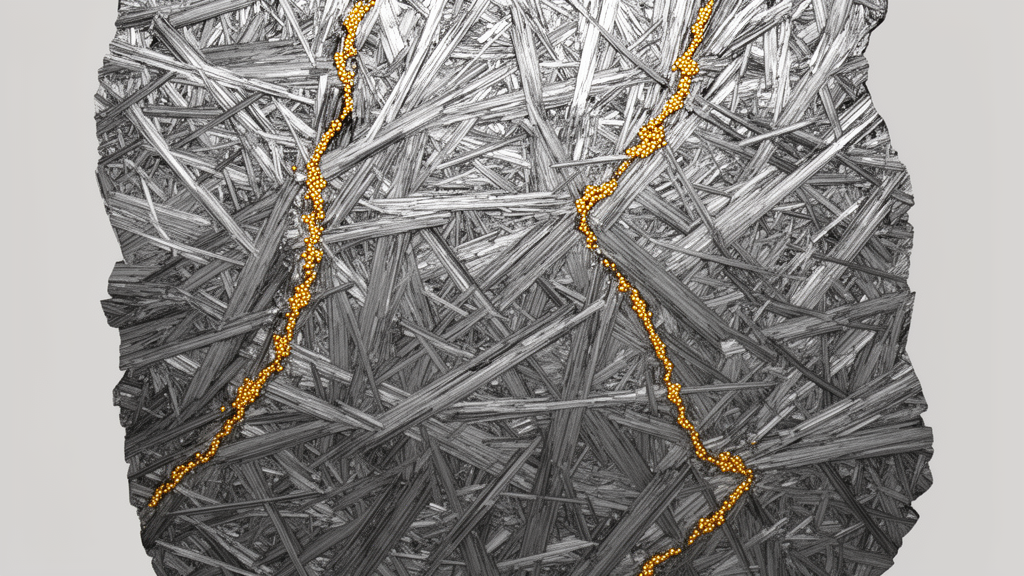
The picture changes dramatically under dynamic impact loading, the regime that governs crash performance. Here, the study revealed a more dangerous role for segregation: continuous segregation bands can serve as preferential crack-propagation paths, leading to significant anisotropy in impact toughness. When a crack encounters a continuous soft band oriented along its propagation direction, it can race along that band rather than cutting through the tougher surrounding matrix. Because these bands align with the casting and rolling direction, the steel becomes directionally weak, resisting cracks poorly along the banding direction while performing better across it. This anisotropy means that a component might pass impact testing in one orientation and fail in another, a hazard that standard tensile specifications completely miss.
The implications for compositional design and microstructural homogenization control are direct. The study provides new guidance for high-performance automotive steels, suggesting that the carbon-manganese balance should be chosen not only for strength but also for its effect on segregation morphology. A composition that produces dendritic, dispersible segregation patterns may be preferable to one that produces continuous centerline bands, even at equivalent strength levels. Process interventions such as soaking treatments, soft reduction during continuous casting, and controlled hot rolling schedules can then be targeted at erasing the specific segregation morphology that a given composition produces. The work also connects to a broader research effort on segregation-neutralized steels, in which alloy design accounts for inherent segregation from the outset rather than treating it as an unavoidable defect.
What makes this study particularly valuable is its multiscale integration. By combining experimental characterization with CALPHAD-based thermodynamic modeling, the researchers built a causal chain from solidification thermodynamics through segregation morphology to microstructural heterogeneity and finally to mechanical anisotropy under different loading rates. This chain allows prediction rather than post-mortem diagnosis: a steel designer can now estimate, before casting a single slab, how a proposed carbon-manganese composition will segregate, what microstructural banding will result, and how that banding will degrade impact toughness along the processing direction. As automakers push toward ever-higher strength steels to lightweight vehicles and improve crash safety, controlling the invisible chemical architecture inside the metal may prove as important as the strength number on the specification sheet.
Subject of Research: Materials Science
Article Title: Mn segregation-induced microstructural heterogeneity and mechanical response in ultra-high strength martensitic steels with different C-Mn compositions
Article References: Yan, J., Xue, P., Li, W., Wang, J., Zhu, X., Zhang, L., & Zhang, L. (2026). Mn segregation-induced microstructural heterogeneity and mechanical response in ultra-high strength martensitic steels with different C-Mn compositions. Journal of Materials Science, 61(41), 32357-32387. https://doi.org/10.1007/s10853-026-13744-2
Image Credits: AI Generated
DOI: 10.1007/s10853-026-13744-2
Keywords: manganese segregation, martensitic steel, ultra-high strength steel, automotive steel, CALPHAD, microstructural heterogeneity, impact toughness, solidification, segregation-induced, microstructural, heterogeneity, mechanical
News Source: Denise Maddox. (October 18, 2026). Manganese Segregation Creates Hidden Weak Zones in Ultra-High Strength Martensitic Steels. Scienmag.