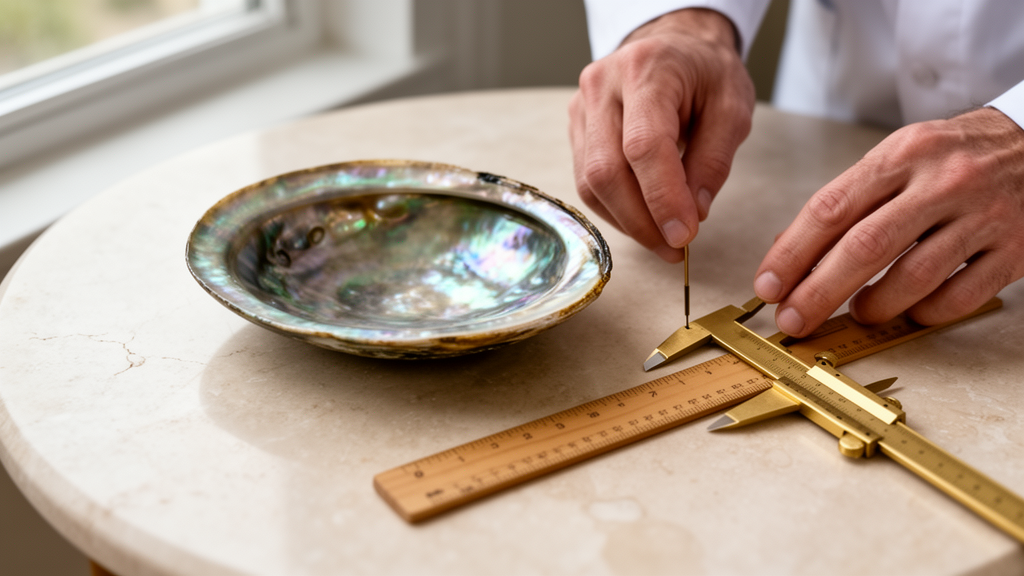
Every abalone shell is a diary. Written in the grammar of curves, coils and contours, it records where an animal grew, how it was raised and which species it belongs to — if only you know how to read it. A new study published in the Biodiversity Data Journal shows that a mathematical technique called geometric morphometrics can do exactly that, separating five commercially important abalone species with complete accuracy and even distinguishing wild Pacific abalone from farmed ones. For an industry that ships hundreds of millions of dollars of molluscs a year and increasingly struggles to prove where its product came from, that is a quietly revolutionary result.
The stakes are larger than they might appear. Abalone is one of the most valuable molluscs in global aquaculture, and China dominates the trade outright: the country produced 203,500 tonnes in 2020 — nearly 90 percent of worldwide output — and by 2025 that figure had climbed to 252,000 tonnes across 17,582 hectares, making abalone the second most important marine-farmed mollusc in the country. The Pacific abalone, Haliotis discus hannai, is the workhorse of that industry. But decades of intensive farming have taken a toll: prolonged inbreeding has degraded stocks, individuals are shrinking, stress resistance is falling, and inadequate record-keeping has mixed populations so thoroughly that producers often cannot tell which family line — let alone which geographic origin — a given animal belongs to. DNA barcoding can untangle that history, but it is expensive, slow and requires destroying the animal. Breeders need a tool that is fast, cheap and non-lethal.
The research team, led by scientists examining specimens collected between 2023 and 2024, gathered 177 abalone spanning five species: Haliotis madaka, H. diversicolor, H. gigantea, H. ovina and H. discus hannai. Crucially, the Pacific abalone sample came from three distinct populations — wild animals dredged from the coastal waters off Dalian in Liaoning Province, raft-cultured animals from the same region, and raft-cultured animals from Lianjiang County in Fujian Province, more than a thousand kilometres to the south. Shell lengths ranged from the modest 45-millimetre H. ovina to the imposing 137-millimetre H. madaka, giving the team a genuine morphological spectrum to work with.
The methodological pipeline is where the study gets technically interesting. Rather than photographing each shell flat and hoping for the best, the researchers took a minimum of 80 images per specimen from anterior, posterior, lateral and dorsal angles, then reconstructed a three-dimensional mathematical model of every shell using photogrammetry software. The 3D step is not decorative: abalone shells are asymmetrically coiled, so no single camera angle captures the whole animal, and reconstructing the full form allowed the team to re-orient every shell into a consistent anatomical reference frame before extracting two-dimensional landmark coordinates. That standardisation eliminates the systematic bias that mounting angle and perspective would otherwise inject into the data — a subtle but critical safeguard for everything that follows.
On each standardised shell, the team digitised 54 points: nine anatomical landmarks pinned to unambiguous features such as the shell apex, the mid-points of the anterior and ventral margins, and a characteristic point near the respiratory pores, plus 45 semi-landmarks slid along the shell contour to capture its flowing outline. Before any statistics, the raw coordinates went through Generalised Procrustes Analysis, or GPA — the mathematical workhorse of modern shape science. GPA translates, rotates and scales every specimen’s landmark configuration onto a common origin, stripping away all variation caused by size, position and orientation in the original photographs. What survives that procedure is pure shape: the geometry itself, isolated from every artefact of how the shell happened to be photographed.
The first statistical test, Principal Component Analysis, compressed that high-dimensional shape data into interpretable axes — and the five species fell apart into clean, non-overlapping clusters. The first principal component alone explained 62.23 percent of total shape variance, with the second adding another 12.68 percent for a cumulative 74.91 percent. PC1 turned out to encode the shell’s width-to-length ratio: positive scores corresponded to elongated, narrow shell discs, negative scores to flatter, rounder forms. The most dramatic outlier was H. ovina, which occupied the extreme negative region of PC1, far from everything else — fitting, the authors note, for the sole tropical species in the sample, whose elliptical body plan diverges sharply from the elongated temperate forms. H. madaka and H. gigantea clustered in the positive-positive quadrant, separable from each other along PC2, which tracks shell ellipticity, while H. discus hannai and H. diversicolor overlapped substantially, a reminder that even clean methods have their hard cases.
Canonical Variate Analysis, a supervised technique that explicitly maximises separation between known groups, delivered the study’s headline result: complete separation of all five species in two-dimensional discriminant space, with the first two canonical variates accounting for 69.59 percent of between-group variance. A Jackknife cross-validation — the statistical equivalent of hiding one specimen at a time and asking the model to identify it — correctly assigned 74.91 percent of individuals to their species, with overall classification accuracy of 75.8 percent. For a technique that requires nothing more than a camera, a stand and open-source software, those numbers put geometric morphometrics in genuine competition with molecular identification for routine species screening.
But the study’s most socially significant finding concerns the three Pacific abalone populations. When PCA was run on H. discus hannai alone, the first component explained 50.57 percent of variance and split the sample cleanly down environmental lines: the wild Liaoning animals occupied the positive region of PC1 with complete separation from both farmed groups, while the Fujian-cultured population formed the largest and most dispersed cluster on the negative side. Wild and farmed abalone, in other words, wear their upbringing on their shells. The mechanism is well understood — wild animals forage under natural temperature and salinity regimes, while farmed ones grow under uniform feeding schedules and stocking densities — but this is among the clearest demonstrations that the difference is legible in shell geometry alone.
Then comes the complication that keeps the study honest. The two farmed populations — Dalian in the north, Fujian in the south — overlapped almost completely along the primary discriminant axis, despite being separated by a thousand kilometres of coastline and markedly different seawater temperatures. The authors attribute this to the homogenising hand of aquaculture itself: high-density, human-managed conditions impose similar selection pressures regardless of geography, driving both populations toward convergent morphology. The timing is pointed, because China’s industry increasingly ships northern abalone south for overwintering to escape the energy costs of heating indoor tanks through Liaoning’s freezing winters. If southern overwintering erases the morphological signature of origin, shell shape alone cannot currently certify where a farmed abalone came from — a genuine limitation for provenance tracing, and one the authors state plainly rather than paper over.
Even with that caveat, the implications ripple outward. A validated, non-destructive, low-cost method for distinguishing species could support customs inspection, market fraud detection and the rapid family selection that abalone breeding programmes urgently need — no tissue samples, no sequencing runs, no dead animals. The technique also dovetails with a growing body of molluscan morphometrics, from scallop growth stages to pollution signatures in snail shells, suggesting shell geometry is a broadly readable environmental archive. For an industry built on an animal whose shell has been quietly recording everything all along, the message of this study is simple: the data was always there. Now there is a rigorous, reproducible way to read it — and a clear-eyed account of exactly where the reading stops.
Subject of Research: Geometric morphometric classification of five abalone species and wild versus cultured Pacific abalone populations
Article Title: Application of geometric methods to the morphological classification of five abalone species
Article References: Tian, Y., Li, W., Zhang, J., Sun, W., Li, Q., Hou, S., & Hao, Z. (2026). Application of geometric methods to the morphological classification of five abalone species. Biodiversity Data Journal, 14, Article e201558. https://doi.org/10.3897/bdj.14.e201558
Image Credits: AI Generated
Keywords: abalone, geometric morphometrics, Haliotis discus hannai, aquaculture, Procrustes analysis, principal component analysis, canonical variate analysis, shell morphology, species identification, population origin tracing, Biodiversity Data Journal, China aquaculture
News Source: Drew Townsend. (October 18, 2026). Geometry Cracks the Shell: Reading Abalone Origins in Their Shapes. Scienmag.