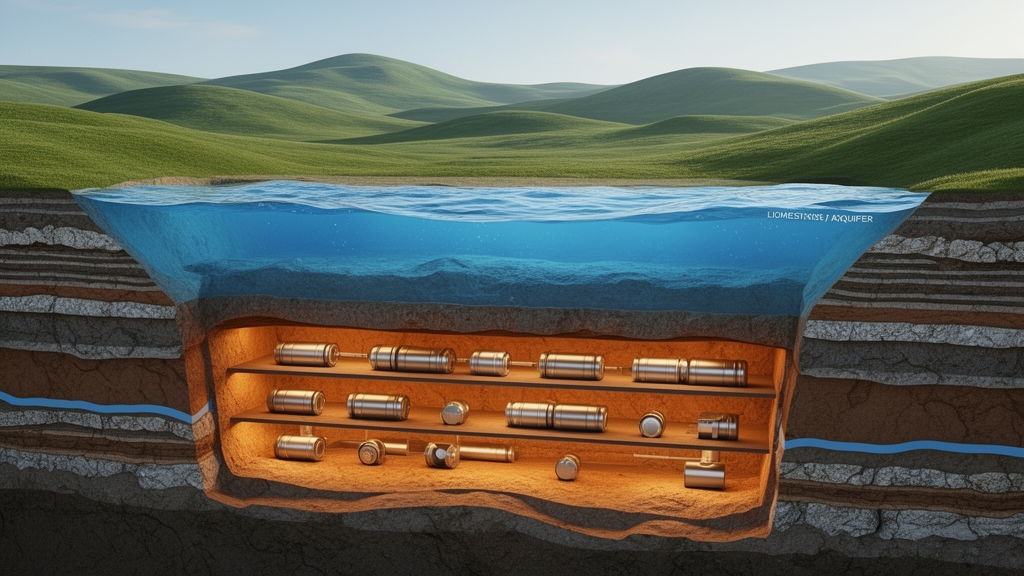
Deep beneath the rolling farmland of northern Switzerland, in a band of 170-million-year-old claystone lying 800 to 900 metres below the surface, the country’s radioactive waste is intended to spend the next million years in near-perfect isolation. The rock in question, the Opalinus Clay, has been studied by Switzerland’s national cooperative for the disposal of radioactive waste, Nagra, for more than three decades. Now, in a comprehensive synthesis published in Frontiers in Nuclear Engineering, Nagra geologists have assembled the full geological evidence base for the safety case that will underpin the Swiss general licence application for a deep geological repository. The paper, led by Raphael Wüst and colleagues, distils data from high-resolution 3D seismic surveys, nine deep boreholes and decades of laboratory and underground fieldwork into a single, internally consistent argument: this clay formation, together with its confining rock units, forms an extraordinarily effective natural barrier against radionuclide migration.
The Swiss repository concept relies on passive safety, meaning the protection of people and the environment must not depend on human intervention after closure. The system combines engineered barriers, including waste canisters and bentonite backfill, with the geological barrier centred on the Opalinus Clay. Crucially, the Swiss safety case does not treat the host rock alone. It defines a containment-providing rock zone, or CRZ, which encompasses the Opalinus Clay plus the low-permeability formations above and below it, the Keuper, Lias and Dogger Groups. This entire sequence hydraulically separates the two major regional aquifers, the Malm limestones above and the Muschelkalk dolomites below. At the selected Nördlich Lägern siting region, the CRZ is the thickest of the three candidate regions and offers the greatest distance between the host rock and the nearest bounding aquifers, an exceptionally favourable configuration for long-term containment.
The technical heart of the argument is the rock’s hydraulic behaviour. Laboratory measurements and in-situ packer tests show that the rock-mass hydraulic conductivity of the Opalinus Clay at repository depth ranges between 10^-13 and 10^-14 metres per second, several orders of magnitude lower than typical aquifers. Combined with the low hydraulic gradient, this means solute transport through the formation is diffusion-dominated, with a Peclet number well below 1. In practical terms, dissolved radionuclides would move through the clay by molecular diffusion, a process orders of magnitude slower than groundwater flow. Anomalous hydraulic heads observed in the Opalinus Clay, including persistent underpressures that can only be maintained when the formation is hydraulically decoupled from its surroundings over geological timescales, provide independent confirmation of these extremely low conductivities.
Perhaps the most striking evidence comes from natural tracers preserved in the rock’s porewater. Profiles of stable water isotopes, chloride and noble gases measured across the CRZ in the Nördlich Lägern boreholes show smooth, laterally coherent gradients with no abrupt shifts that would signal advective flow. Quantitative modelling demonstrates that these isotope distributions could only have developed through diffusion-dominated transport over hundreds of thousands to millions of years. The bounding aquifers tell a consistent story: the Malm groundwater carries krypton-81 model ages of at least several hundred thousand years, and the Keuper aquifer waters below the clay show residence times of 0.4 to 0.9 million years. The Opalinus Clay porewaters at Nördlich Lägern contain the highest fraction of old formation water of any candidate region, a signature of particularly conservative long-term hydraulic isolation that developed without any human influence.
Laboratory diffusion experiments add a mechanistic layer to this picture. For tritiated water, treated as a conservative reference tracer, the Opalinus Clay shows quasi-homogeneous effective diffusion coefficients of roughly 0.7 to 1.2 × 10^-11 square metres per second and porosities of about 0.11 to 0.13, values that match measurements from the Mont Terri underground rock laboratory despite differing tectonic settings. Charged species deviate systematically: chloride anions diffuse an order of magnitude more slowly because the permanently negatively charged clay mineral surfaces exclude anions from much of the pore space, leaving an anion-accessible porosity of only about 0.05 to 0.07. These effects, quantified with experimentally validated electrical double layer and Donnan models, are directly incorporated into the radionuclide-specific transport parameters used in safety assessment.
Retention is the second pillar of the clay’s protective function. The Opalinus Clay contains 50 to 70 weight percent clay minerals, averaging around 60 percent, dominated by illite and illite/smectite mixed-layer minerals with a high external surface area of 25 to 35 square metres per gram. Cation-exchange capacities of several tens to more than 100 milliequivalents per kilogram correlate closely with clay content across the CRZ, providing a robust proxy for radionuclide sorption capacity. Bottom-up sorption experiments and predictive modelling show that retention of cationic radionuclides such as caesium, nickel, europium, thorium and uranium is well constrained and dominated by sorption on illite and mixed-layer clays. The consequence is elegant: the radionuclide species capable of influencing dose rates are predominantly anions, precisely the species that diffuse most slowly through the anion-excluding pore network.
Self-sealing is the third, and arguably most remarkable, property. Fractures in the Opalinus Clay, whether natural or mechanically induced, rapidly lose transmissivity once in-situ stress and pore pressure conditions are restored. Packer test intervals containing small-scale faults show hydraulic conductivities below 1 × 10^-13 metres per second, indistinguishable from undisturbed rock. Injection tests at about 600 metres depth in the borehole Rheinau 1-1 demonstrated self-sealing at rock-mass scale after fault reactivation. At Mont Terri, tunnel sections monitored for up to 20 years after excavation show recovered seismic velocities, stabilised water contents and fracture transmissivities that decreased by orders of magnitude, approaching those of the intact rock. Even gas migration experiments show transient, pressure-dependent pathway opening that ceases once pressure drops, without permanent permeability increase. In the Mont Russelin anticline, where the formation has been intensely folded and faulted, porewaters remain strongly mineralised, proving that low hydraulic conductivity persisted even under substantial tectonic strain.
The synthesis also confronts the geological features that could, in principle, compromise the barrier. Within the CRZ, thin carbonate-rich hard beds and the Herrenwis Unit, a 4.5 by 8 kilometre isolated reefal carbonate platform about 40 metres above the Opalinus Clay, are mechanically more competent and clay-poor. Yet hydraulic testing confirmed very low porosity and conductivity, and geochemical tracer profiles indicate diffusion-dominated exchange with no measurable advective signature, showing the reef has been effectively hydraulically isolated within the surrounding clay-rich strata. To cover remaining uncertainties, these units are deliberately treated with bounding parameter values in the safety assessment, a systematic abstraction approach that groups geological units with similar properties into a transparent layer-cake modelling framework preserving safety-relevant features while enabling deterministic and probabilistic calculations.
Looking forward one million years, the probabilistic future-evolution scenarios are sobering but reassuring. Three to five large foreland glaciations are expected, with ice thicknesses potentially reaching 400 metres and cumulative glacial erosion of around 70 metres below the future erosion base. Fluvial incision at the Aare-Rhine confluence could plausibly range from 80 to 380 metres within the next million years. Even in less likely scenarios where glacial overdeepening reaches the mechanically resistant Malm limestones, further incision would be subdued. The models conclude that a remaining repository overburden of at least 550 metres is most likely after the assessment period, sufficient to keep the host rock’s barrier properties, hydraulic conductivity, porewater salinity and diffusion characteristics, essentially unchanged. Permafrost reaching 100 to 200 metres deep cannot affect a barrier buried at 800 to 900 metres, and past glaciations left no advective signatures in the natural tracer profiles.
The regional setting completes the case. Northern Switzerland exhibits low seismicity, low uplift rates and a structurally simple configuration, situated outside the major tectonic elements that dominate recent deformation, the Alps, the internal Jura Fold-and-Thrust Belt and the European Cenozoic rift system. Geodetic measurements show no evidence of differential horizontal movement across regional fault zones, and modern fluvial incision rates are on the order of tenths of a millimetre per year. A broad zone in the central part of Nördlich Lägern is devoid of seismically mappable faults, offering significant flexibility for optimising repository placement and layout. Taken together, the integrated evidence, from seismic imaging and borehole characterisation to laboratory experiments, natural tracers and long-term in-situ observations, demonstrates how a systematic geological investigation reduces uncertainty and builds confidence in long-term safety. The synthesis provides not only the transport parameters for the Swiss safety assessment but also a reference framework for other waste management organisations developing repositories in clay-rich formations worldwide.
Subject of Research: The safety case for a deep geological repository in Switzerland: site and geological barrier characteristics
Article Title: The safety case for a deep geological repository in Switzerland: site and geological barrier characteristics
Article References: Wüst, R. A. J., Schnellmann, M., Landgraf, A., Giger, S., Roy, N., Traber, D., Deplazes, G., Schneeberger, R., Becker, J. K., Looser, N., Fischer, U. H., Zampetti, V., & Vietor, T. (2026). The safety case for a deep geological repository in Switzerland: site and geological barrier characteristics. Frontiers in Nuclear Engineering, 5, Article 1849685. https://doi.org/10.3389/fnuen.2026.1849685
Image Credits: AI Generated
DOI: 10.3389/fnuen.2026.1849685
Keywords: safety, case, deep, geological, repository, Switzerland, site, barrier, characteristics, scientific research
News Source: Violet Maxwell. (October 18, 2026). The safety case for a deep geological repository in Switzerland: site and geological barrier characteristics. Scienmag.