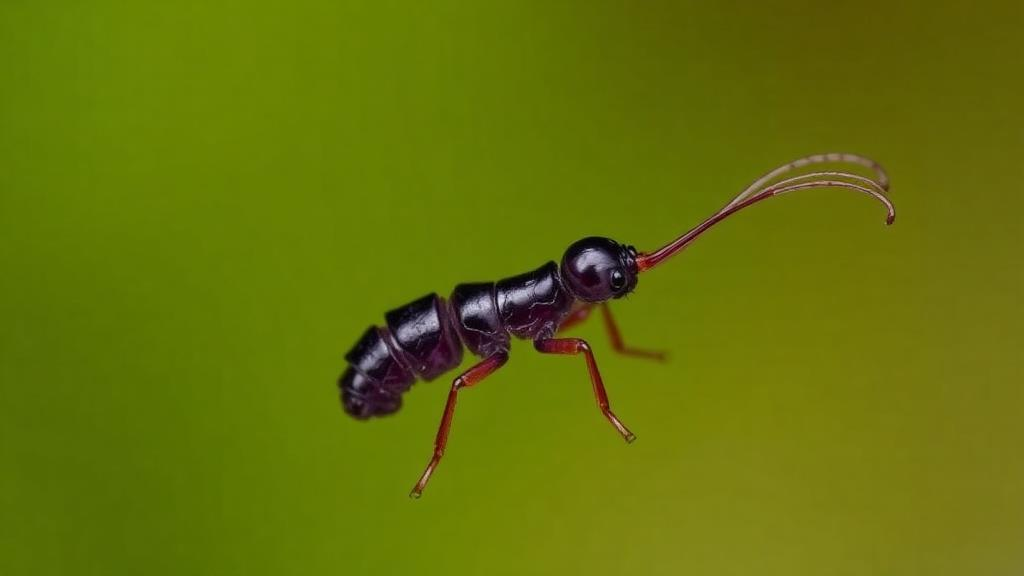
Deep in a protected fragment of dry forest in northeastern Brazil, researchers sorting pitfall-trap samples found something unexpected: tiny, globular springtails with a deep purple sheen and two faint brownish stripes running down their backs. Under the microscope, the animals turned out to belong to Collophora, one of the rarest and most poorly understood genera of globe-bodied springtails. The specimens represented a species new to science, now named Collophora greensladeae in honor of the Australian soil biologist Penelope Greenslade, and their description in the Deutsche Entomologische Zeitschrift brings the number of known species in the genus to eight.
Springtails, or Collembola, are six-legged arthropods related to insects but usually placed in their own class. The group studied here, the Symphypleona, are the globe-bodied springtails, so called because their thorax and much of the abdomen are fused into a rounded capsule. Within this order, the superfamily Katiannoidea is defined by two traits: a subanal appendage directed toward the genital opening, and a trochanteral organ, a small modified chaeta sitting inside a circular, oval, or triangular alveolus on the third leg. Katiannoidea is widespread across terrestrial habitats worldwide, and its largest family, Katiannidae, accounts for roughly 200 of the superfamily’s approximately 360 recognized species.
Collophoridae, the family that contains Collophora, is monogeneric, meaning it holds just one genus, and that genus holds only seven nominal species before this study. The animals are minute, and their distribution is described as Holotropical, with species recorded across the Americas, Africa, and Asia. Three species are known from the Americas, two from Africa, and two from Asia. What makes Collophora stand out among its relatives is a rare combination of features: exactly four eyes on each side of the head, and a modified capitate bothriotrichum D, a specialized sensory hair with a swollen, somewhat leaf-shaped tip housed in a large papilla on the large abdomen. No other group of Symphypleona, or indeed any other Collembola, shows this particular morphology.
The taxonomic history of the genus is convoluted. The earliest species were originally placed in Arrhopalites, a genus in the family Arrhopalitidae, because they shared a reduced number of eyes, a subanal appendage facing the genital pore, and a trochanteral organ. But in 1964, Richards separated them into their own genus on the basis of three differences: the circular shape of the trochanteral organ, which is narrow and oval in Arrhopalites; the modified apex of the D bothriotrichum, which is regular in Arrhopalites; and the composition of the large abdomen, which in Collophora includes the thorax and abdominal segments I through V, whereas in Arrhopalites the fifth abdominal segment belongs to the small abdomen. In 1999, Bretfeld went further and removed Collophora from Arrhopalitidae entirely, erecting the family Collophoridae for it.
The new species was collected in April 2022 at the National Forest of Palmares in the municipality of Altos, in the state of Piauí, within the Cerrado biome, a savanna-like ecosystem that also receives some influence from the neighboring Caatinga and Amazon biomes. The specimens came from pitfall traps set in shaded forested areas with rocky soil covered by gravel and dead foliage. The type series consists of a holotype female and three male paratypes, all preserved in 70 percent ethanol, clarified in Nesbitt’s solution, washed in Arlé’s liquid, and mounted on glass slides in Hoyer medium for study under compound microscopes. The holotype and two paratypes are deposited in the Collembola Collection of the Federal University of Rio Grande do Norte, and one paratype is held at the Invertebrate Collection of the National Institute for Amazonian Research.
Collophora greensladeae is strikingly colored. Living specimens appear somewhat brownish, while fixed specimens are almost entirely purplish, marked with two longitudinal brownish stripes on the large abdomen. Body length in the type series ranges from about 242 to 543 micrometers, with the holotype female at the upper end and males averaging around 264 micrometers. The antennae are shorter than the body and the fourth antennal segment is divided into five or six subsegments, bearing ciliated external chaetae. The labrum carries chaetae in a 5/5/4 arrangement, three of them blunt and thick in the middle row. Two small sensilla surround the A bothriotrichum and three surround the D bothriotrichum, a pattern not seen in any other species of the genus.
Several other characters set the new species apart from its closest relatives. It resembles the South American species C. terrabrasilis, described from Brazil in 2013, and C. remanei, from Peru, in having the female anal valve chaetae ms1 and ps1 as regular chaetae and eight dorsal chaetae on the dens, the toothed segment of the jumping organ. But it differs from C. remanei in lacking blunt chaetae on the fourth antennal segment, from both in bearing ciliated chaetae on that segment, and from C. terrabrasilis in having a serrated ps2 chaeta on the female anal valve, two rather than no winged chaetae on the dorsal anal valve, and four rather than three spines on the dorsal dens. Compared with C. sudanica from Sudan and Somalia, which shares a similar purple color pattern and labral chaetotaxy, the new species has a subdivided fourth antennal segment, more sensilla around both the A and D bothriotricha, a manubrium with four rather than three pairs of chaetae, and a dens with eight dorsal chaetae, four of them modified into spines, rather than nine with five spines.
To make sense of this sparse genus, the authors compiled a bibliographic survey of the diagnoses of all species, built a comparative table of their main diagnostic characters, and produced an identification key covering all eight species. The survey reveals an uncomfortable truth: most Collophora species were described with remarkably limited detail by current standards of Symphypleona taxonomy. Many lack information on the detailed chaetotaxy of the anal valves, the mouthparts, the antennae, and the large abdomen, and several species pairs are difficult to separate. Denis in 1948 and Hüther in 1967 both noted the difficulty of distinguishing C. quadrioculata from C. subquadrioculata, and a character Denis used to separate them, the absence of a capitate bothriotrichum D, was later shown by Richards in 1968 to be present after all. Most type series contain no males, but with as few as one to five specimens each, it remains impossible to determine whether the genus is parthenogenetic, as some Arrhopalites taxa are.
The study also raises a broader question about the classification of the entire superfamily. Katiannoidea currently contains four families: Spinothecidae, Katiannidae, Collophoridae, and Arrhopalitidae. They share a very similar body plan, with bothriotricha A through D present, a trochanteral organ at least on the third leg, and a subanal appendage directed toward the genital opening. They differ mainly in traits that appear tied to habitat: the smaller, paler, and fewer-eyed Arrhopalitidae, Spinothecidae, and Collophoridae are adapted to life in soil, caves, and other hidden environments, while the larger, well-pigmented Katiannidae, with six to eight eyes per side, live on the surface. The authors argue that the small, pale, reduced-eyed families may actually be specialized lineages derived from within Katiannidae, which would make that family paraphyletic. No study using modern phylogenetic methods has yet been able to properly test the validity and relationships of the lineages within Katiannoidea, largely because sample sizes remain too small, and it is unclear whether underground adaptations arose more than once or whether the three reduced families are more closely related to one another than to Katiannidae.
For now, the new species stands as the second nominal Collophora recorded from Brazil, the fourth from the Neotropical region, and the eighth for the entire genus, and the identification key should guide future work on this enigmatic family. The full description, with detailed chaetotaxy of the head, trunk, legs, and furca based on the entire type series, sets a standard that the authors hope the remaining species will eventually meet through redescription. Until then, Collophora greensladeae serves as a reminder that even in well-studied countries, the smallest inhabitants of the soil can still hold surprises, and that the family tree of the globe-bodied springtails remains very much a work in progress.
Subject of Research: Taxonomic description of a new Collophora springtail species from Brazil and a survey of the genus
Article Title: A survey of Collophora Richards ( Collembola , Collophoridae ), with a new species from Brazil and an identification key for the genus
Article References: Medeiros, G. D. S., dos Santos, M. L. V., Nunes Godeiro, N., & Bellini, B. C. (2025). A survey of Collophora Richards (Collembola, Collophoridae), with a new species from Brazil and an identification key for the genus. Deutsche Entomologische Zeitschrift, 72(2), 557-568. https://doi.org/10.3897/dez.72.165410
Image Credits: AI Generated
Keywords: Collembola, springtails, Collophora, Collophoridae, Symphypleona, new species, Brazil, Cerrado, taxonomy, chaetotaxy, Katiannoidea, soil fauna
News Source: Drew Townsend. (October 18, 2026). Purple Springtail From Brazilian Cerrado Doubles the Continent’s Collophora Record and Exposes Gaps in Springtail Classification. Scienmag.