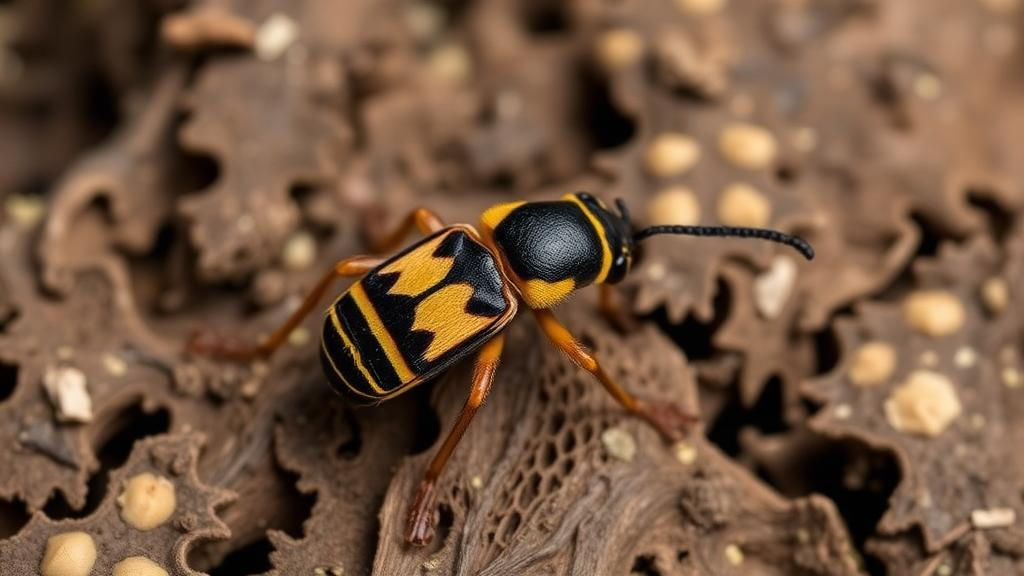
Deep in the mountain chains of northern Portugal, entomologists have uncovered a tiny beetle that had been hiding in plain sight for decades. The insect, a minute weevil measuring barely three millimetres long, has now been formally described as Anchonidium selvanum, a species new to science. The discovery, published in the journal Alpine Entomology, is remarkable not only for what it reveals about the hidden diversity of Iberian beetles, but also for what it says about the fragile forests the animal calls home.
The new species belongs to the weevil family Curculionidae, the largest family of animals on Earth, and more precisely to the subfamily Molytinae. The genus Anchonidium was established in 1884 and currently comprises five species, three of which belong to the group in the strict sense and occur in Western Europe. The other two, from the Caucasus region, differ so markedly in morphology that researchers now consider them likely members of a separate genus within the tribe Typoderini. Over the years, Anchonidium had also served as a kind of taxonomic wastebasket for superficially similar species from Africa, a confusion that recent work has begun to untangle, including the erection of the genus Oberprielerius in 2022 for a former Anchonidium species from South Africa.
The road to the new species began with a hunch. When Christoph Germann reviewed the genus in 2020, he already suspected that four specimens collected in the Serra do Marão in 1997 might represent something undescribed. Those specimens sat in museum collections for more than twenty-five years, waiting for someone to return to the misty Portuguese mountains and gather enough material to settle the question. A dedicated collecting excursion into the northern mountain chains finally provided the answer, yielding dozens of specimens from several localities and allowing researchers to assess the variability of the new species and map its range against that of its closest relative, Anchonidium spathiferum from the Serra da Estrela.
Morphologically, Anchonidium selvanum is most closely related to A. spathiferum, but the two can be reliably separated by a suite of characters. The new species is more slender in build, with elongate, parallel-sided wing cases that are widest shortly behind the middle and measure 1.5 to 1.6 times as long as wide. Its elytral striae carry 15 to 17 punctures from base to declivity, and the first abdominal ventrite bears coarse, roundish-oval punctures between the hind coxae that do not merge into the deep grooves seen in its relative A. unguiculare. The male genitalia offer the decisive evidence: the penis is tube-shaped with an apex that is only weakly rounded rather than spatula-shaped, while the female’s sclerotized bursal atrium is distinctly ear-shaped, quite unlike the frog-shaped structure of A. spathiferum.
The description was supported by high-resolution imaging. Photographs were taken with a Keyence VHX-6000 digital microscope system at the Natural History Museum Basel, with genitalia images captured from specimens embedded in glycerol. Body length was measured dorsally from the anterior margin of the pronotum to the tip of the elytra, giving a range of 2.1 to 3.3 millimetres. The type series is substantial: the holotype, a male collected on 31 May 2023 in the Serra do Alvão at 880 metres elevation, is joined by more than a hundred paratypes from the Serra do Alvão and the Serra do Marão, collected between 1997 and 2023 and distributed across museum collections in Basel, London, Bern, Prague and Müncheberg as well as private collections.
The species name itself carries an ecological message. Selvanum derives from the Portuguese word for forest, la selva, a nod to the primeval oak woodlands where the beetle lives. The choice is deliberate and pointed. These native forests, dominated by the indigenous oaks Quercus pyrenaica and Quercus cerris together with the heather Erica umbellata, are severely threatened. Intensive logging, the replacement of natural woodland with fast-growing plantations of Eucalyptus and Mimosa from Australia and of Aleppo pine, and increasingly frequent wildfires, many lit deliberately and tolerated or even enhanced by the fire-prone invaders, are steadily erasing one of the Iberian Peninsula’s most distinctive habitat types.
The fieldwork revealed just how tightly the beetle’s fortunes are bound to those ancient woods. At the type locality in the Serra do Alvão, near the village of Bobal, the researchers sifted 69 specimens from just two samples of deep, humid leaf litter beneath a small surviving fragment of old oak forest. Nearby sites where the forest had been cut years earlier still yielded 57 individuals, suggesting populations can persist for some time in degraded remnants. But at heavily altered localities in the Serra do Marão, close to Ansiães, where only small patches of replanted oak remain, the counts dropped to a handful of individuals. The deep and humid leaf litter layer, the authors note, is a reliable indicator of where the species thrives.
That pattern makes Anchonidium selvanum more than a curiosity; it is an excellent indicator species for ancient woodland. The researchers observed spectacular differences in the numbers of individuals collected when comparing disturbed habitats with more intact ones, and they argue that the relict character of both the forests and the beetle deserves explicit recognition. Even within the Parque Natural do Alvão, a protected area, only small remnants of the original forest type survive. Because of the constant loss of its characteristic habitat, the new species must be considered threatened, and its fate is effectively tied to the survival of habitat fragments that have persisted since ancient times, when such forests covered a considerable part of these mountain chains.
The discovery also sharpens the picture of how the four Western European Anchonidium species partition the landscape. Their distributions follow the mountain chains and river valleys: A. braunerti occupies the southernmost Serra de Monchique at around 890 metres, with the Rio Tajo forming its northern barrier; A. spathiferum lives in the Serra da Estrela at about 1290 metres; and the new species inhabits the Serra do Marão and Serra do Alvão between 750 and 1180 metres, separated from A. spathiferum by the Douro valley. The northernmost serras, meanwhile, belong to the widespread A. unguiculare, which the surveys showed extends beyond the Serras Peneda and Gerez into the Serra do Barroso and even across the Rio Tâmega valley.
Perhaps the most tantalizing finding concerns how close the two species now come to each other. In the northern edge of the Serra do Alvão, the team collected A. unguiculare from scrubland just four kilometres north of the type locality of the new species. The two were never found together at the same site, so no directly observed sympatric occurrence can be claimed, but the researchers consider it likely. The ecological demands of the species differ in telling ways: A. unguiculare tolerates a broad range of forests, from Mediterranean oak woods in southern Spain and Morocco to Atlantic deciduous forests in France and Great Britain, while A. selvanum appears strictly confined to the ancient oak forests of northern Portugal. As those woods continue to shrink under the combined pressure of logging, plantation forestry and fire, the beetle’s narrow world grows smaller with them, making this unassuming three-millimetre weevil an unlikely but powerful ambassador for the last primeval forests of the Portuguese mountains.
Subject of Research: Description of a new weevil species from ancient oak forests in northern Portugal
Article Title: Anchonidium selvanum sp. nov. ( Coleoptera , Curculionidae , Molytinae ) from northern Portugal
Article References: Germann, C., & Braunert, C. (2023). Anchonidium selvanum sp. nov. (Coleoptera, Curculionidae, Molytinae) from northern Portugal. Alpine Entomology, 7, 195-200. https://doi.org/10.3897/alpento.7.111490
Image Credits: AI Generated
Keywords: Anchonidium selvanum, weevil, Curculionidae, new species, Portugal, ancient oak forests, entomology, taxonomy, Serra do Alvão, Serra do Marão, habitat loss, Quercus
News Source: Margaret Porter. (October 18, 2026). New weevil species discovered in Portugal’s vanishing ancient oak forests. Scienmag.