Silkworm pupae, long discarded as a byproduct of silk manufacturing, are stepping into the spotlight of probiotic science. In a study published in Food Chemistry: X, researchers in China systematically dissected the peptides hidden within these protein-rich insects and discovered that the molecular architecture of specific peptide fractions can dramatically shape how well the probiotic bacterium Limosilactobacillus reuteri DSM 17938 grows and ferments. The work offers a striking example of how the fine details of peptide chemistry, not merely the bulk supply of nitrogen, govern the performance of beneficial microbes in fermentation.
L. reuteri is a commensal inhabitant of the gastrointestinal tract, prized for its ability to maintain intestinal microbial balance and to produce reuterin, a broad-spectrum antimicrobial metabolite. Like all probiotics, however, its survival and functional output depend heavily on the nutrients available in its culture environment. While carbohydrates have traditionally dominated the prebiotic conversation, protein hydrolysates are emerging as readily accessible nitrogen sources that can selectively fuel the growth and metabolic activity of lactic acid bacteria. Previous studies with soybean proteins and peptides had already shown that specific peptide fractions can enhance the growth and organic acid secretion of L. reuteri and related strains, hinting that the form and composition of supplied nitrogen may be as important as its quantity.
Silkworm pupae represent an underutilized protein-rich resource with considerable potential in the food industry. Beyond direct consumption, pupae powder has been tested as an alternative protein source in high-energy biscuits, and pupal protein hydrolysates have been explored as ingredients for protein-fortified and functional foods. Enzymatic hydrolysis improves the solubility and selected functional properties of silkworm pupal proteins, but the resulting hydrolysates contain peptides with diverse molecular weights, amino acid compositions, and sequences. These structural differences may affect how efficiently probiotics utilize them as nitrogen sources, ultimately influencing bacterial growth and metabolic output. Prior work had combined activity-guided fractionation with LC-MS/MS to identify bioactive peptides from silkworm pupal hydrolysates, but those investigations focused primarily on antioxidant, myogenic, and other bioactivities, leaving the growth-promoting effects on probiotic microorganisms largely unexplored.
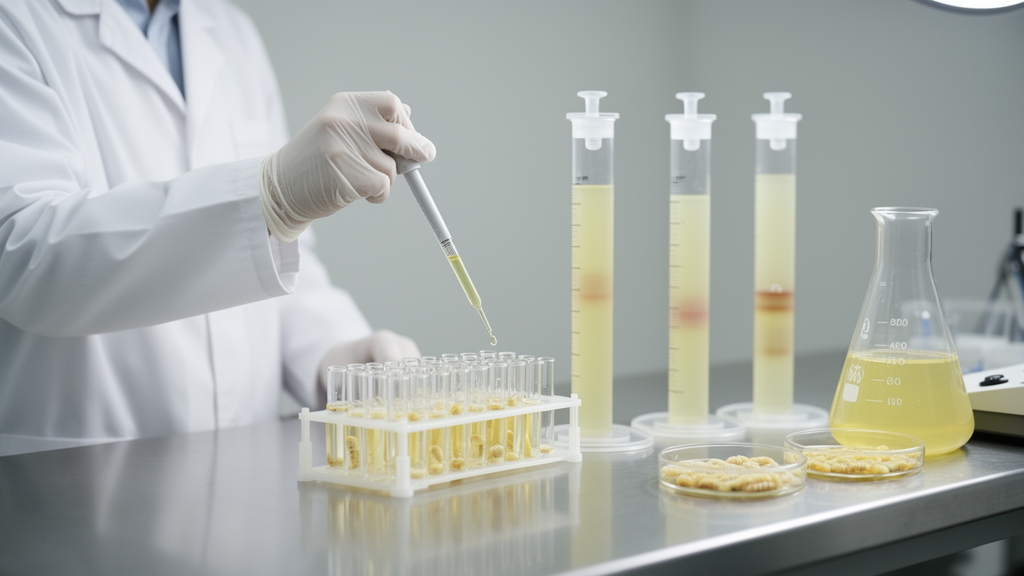
To fill this gap, the research team prepared silkworm pupal peptides using two food-grade enzymes, Alcalase and Flavourzyme, generating hydrolysates designated SPP-A and SPP-F respectively. Defatted pupae powder was suspended in water and hydrolyzed under enzyme-specific conditions of pH, temperature, and duration before the enzymes were heat-inactivated and the soluble peptide fractions freeze-dried. Molecular weight profiling by HPLC revealed that both hydrolysates were strikingly similar in size distribution: components above 5 kDa accounted for only 0.18 percent of each preparation, while more than 92 percent of the peptides fell below 3 kDa. The fraction under 500 Da was the largest, representing roughly 48 percent of SPP-A and 47 percent of SPP-F. Amino acid analysis confirmed that all amino acids detected in the original defatted powder were retained after hydrolysis, with aspartic acid and glutamic acid contents actually increasing in both hydrolysates compared with the untreated powder.
With these peptide-rich nitrogen sources in hand, the investigators evaluated their effects on L. reuteri DSM 17938 under nitrogen-limited conditions. Four culture media were compared: complete MRS medium as a positive control, nitrogen-limited MRS as a negative control, and the limited medium supplemented with an equivalent nitrogen amount from either SPP-A or SPP-F. Growth patterns were similar during the first 10 hours, but thereafter the optical density increased more rapidly in both peptide-supplemented groups than in the MRS and nitrogen-limited controls. Viable cell counts corroborated these observations. After 10 hours, the SPP-A group reached viable counts approximately 1.68-fold those of MRS and 1.78-fold those of the nitrogen-limited medium, and it remained the highest among all treatments at 14 hours. Although counts declined in every group by 18 hours, both peptide-supplemented cultures retained significantly greater viability than the controls.
Organic acid production told a parallel story. Lactic acid and acetic acid concentrations rose during fermentation, with no differences among groups at 6 hours but significantly higher accumulation in both peptide-supplemented cultures from 10 to 18 hours. The SPP-A group exhibited the highest levels of both acids after 14 and 18 hours. Because the peptide-supplemented cultures also harbored larger bacterial populations, the greater total acid accumulation may partly reflect a larger population rather than increased cell-specific metabolic activity. Nevertheless, the coincidence of enhanced growth and enhanced acid output underscores the potential of silkworm pupal peptides as functional nitrogen sources for probiotic fermentation, with SPP-A consistently outperforming SPP-F under these conditions.
The most intriguing discovery emerged when the researchers fractionated the hydrolysates by molecular size using ultrafiltration membranes. SPP-F yielded three fractions below 5 kDa, and the 1-3 kDa fraction, designated F2, proved the most potent, supporting viable counts approximately 1.19-fold those of MRS at 10 hours and maintaining the highest counts among all fractions at 18 hours. Remarkably, F2 outperformed even the original unfractionated SPP-F, demonstrating that the smallest molecular-weight fraction is not necessarily the most effective. For SPP-A, the picture was temporally complementary: the 1-3 kDa fraction A2 drove the strongest early response at 10 hours, yielding 8.70 g/L lactic acid and 2.98 g/L acetic acid compared with 8.00 and 2.67 g/L in MRS, whereas the 3-5 kDa fraction A3 better sustained late-stage viability and acid accumulation, reaching approximately 1.10-fold the MRS count at 14 hours and producing 4.07 and 3.89 g/L acetic acid at 14 and 18 hours respectively. This stage-dependent size effect suggests that tailored peptide blends could optimize fermentation performance across the entire cultivation cycle.
Further purification sharpened the picture. Sephadex G-50 gel filtration chromatography separated the active ultrafiltration fractions into narrower subfractions, revealing that the 1-2 kDa subfraction F2-1 from SPP-F and the 2-3 kDa subfraction A2-2 from SPP-A exhibited the strongest effects on growth and survival. Ion-exchange chromatography, which separates peptides according to charge, then identified FI-2 from SPP-F as the most consistently active fraction across all sampling times, with viable counts approximately 1.14-fold those of MRS at 10 hours and 1.10-fold at 14 hours. The differential activities of charge-separated fractions indicate that molecular size alone does not determine probiotic performance; charge-associated differences in peptide composition contribute meaningfully to the growth response.
LC-MS/MS profiling of the active fractions exposed the molecular features underlying these effects. In FI-2, 3013 peptide sequences were initially identified, of which 16 met high-confidence thresholds. Their masses ranged from 676 to 3621 Da and their lengths from 6 to 32 residues. Seven of the ten most abundant peptides were hydrophilic, and most had acidic-to-near-neutral isoelectric points, with eight exhibiting pI values below 5.0. The most abundant peptide, YPYEPTPKESEPF, contained polar and charged residues interspersed with aromatic and nonpolar ones. In F2-1, 4494 sequences were initially identified, of which 116 met confidence and abundance thresholds. These peptides ranged from 375 to 1882 Da, with 57.8 percent between 800 and 1400 Da, and 66.4 percent were classified as hydrophilic. Approximately 60 percent had predicted pI values below 6.0, consistent with frequent aspartic and glutamic acid residues. Nonpolar and aromatic residues represented about 56 percent of the amino acids in the top peptides, with proline the most abundant residue at 18.9 percent, a feature that may promote turn formation, disrupt extended secondary structures, and increase resistance to further proteolysis.
Sequence analysis revealed that peptide ordering was far from random. Leucine frequently occurred at the N-terminus, particularly as an LP motif, while proline, serine, phenylalanine, and tryptophan were common C-terminal residues. Recurrent motifs included LP, PD, DI, FP, and IF, and several overlapping peptide families were identified, suggesting stepwise N- or C-terminal trimming of common precursor proteins and preferential retention of relatively stable peptide cores. Notably, 17 of the top 20 peptides in F2-1 originated from lipoproteins and the remaining three from surface-layer proteins, indicating that these proteins were the principal precursors of the dominant peptides. The repeated occurrence of LPDIF-related and LPRGTEGGFP-derived fragments from different precursors suggests preferential cleavage of these regions during enzymatic hydrolysis, possibly linked to greater accessibility of these protein regions to proteolytic attack. While the study did not synthesize or independently test individual peptides, leaving their discrete functional roles and uptake mechanisms for future validation, the findings establish that the probiotic response to silkworm pupal peptides is not merely a function of total nitrogen content but is critically modulated by peptide size distribution and charge characteristics. This work provides a rational framework for designing insect-derived peptide ingredients with targeted growth-promoting functions while offering a sustainable strategy to valorize an underutilized protein resource in functional food and fermentation applications.
Subject of Research: Fractionation-guided profiling of silkworm pupae ( Bombyx mori ) peptides: molecular features governing stage-specific fermentative performance of Limosilactobacillus reuteri DSM 17938
Article Title: Fractionation-guided profiling of silkworm pupae ( Bombyx mori ) peptides: molecular features governing stage-specific fermentative performance of Limosilactobacillus reuteri DSM 17938
Article References: Liu, Y., Zhang, X., Chen, S., Chen, T., Liu, X., & Zhang, C. (2026). Fractionation-guided profiling of silkworm pupae (Bombyx mori) peptides: molecular features governing stage-specific fermentative performance of Limosilactobacillus reuteri DSM 17938. Food Chemistry: X, 40, Article 104639. https://doi.org/10.1016/j.fochx.2026.104639
Image Credits: AI Generated
DOI: 10.1016/j.fochx.2026.104639
Keywords: probiotics, silkworm pupae, peptides, fermentation, Limosilactobacillus reuteri, functional foods, Fractionation-guided, profiling, silkworm, pupae, Bombyx, mori
News Source: Morgan Morrow. (October 18, 2026). Fractionation-guided profiling of silkworm pupae ( Bombyx mori ) peptides: molecular features governing stage-specific fermentative performance of Limosilactobacillus reuteri DSM 17938. Scienmag.