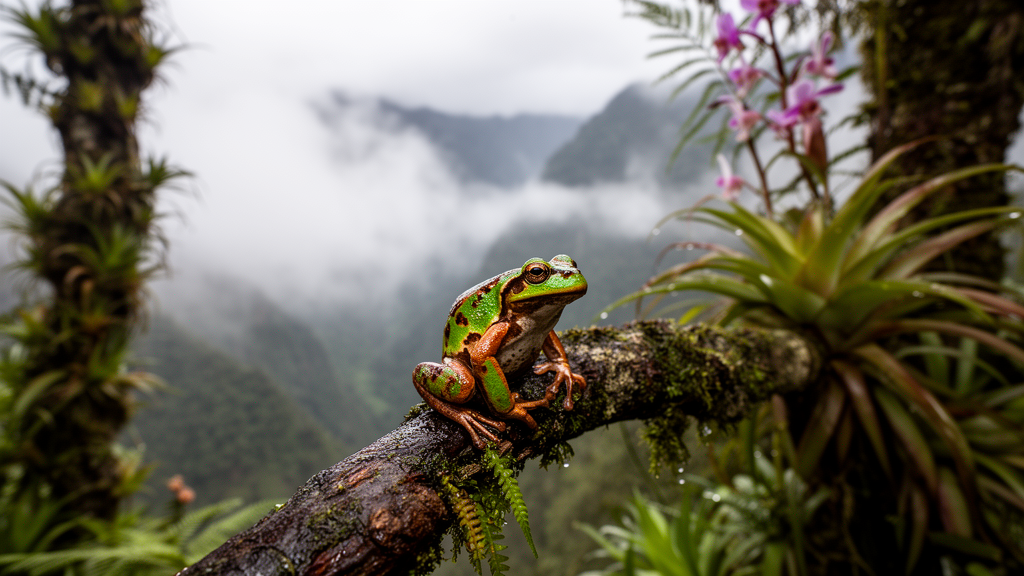
High in the cold, mist-shrouded ridges of northwestern Peru, scientists have identified three frog species entirely new to science, all belonging to the remarkably diverse genus Pristimantis. The discovery, published in the journal Evolutionary Systematics, emerged from a series of short expeditions into the rugged Cordillera de Huancabamba, a mountain range whose steep crests rarely exceed 4000 meters in elevation and whose loose, muddy soils and wildly changeable weather have discouraged all but a handful of herpetologists since the early 1990s. The three new species, named Pristimantis chinguelas, Pristimantis nunezcortezi, and Pristimantis yonke, were found in the páramos and adjacent elfin forests of mountain ridges north of Abra de Porcuya, the lowest east-west pass in the Peruvian Andes.
The frog genus Pristimantis, with 619 species described to date, is the most diverse group of amphibians on Earth, distributed across Central and South America and reaching its greatest richness in the tropical Andes of Colombia, Ecuador, and Peru. Its taxonomy is notoriously complex due to extensive diversity and high morphological variation, and recent studies indicate that the true species richness of the genus is significantly underestimated, with several cryptic species or species complexes likely hidden within taxa bearing wide geographic distributions. To untangle this complexity, the research team applied an integrative approach, combining detailed morphological examination with genetic analyses to propose well-supported taxonomic inferences about the three new frogs.
Fieldwork for the study took place at four sites across the Cordillera de Huancabamba during both rainy and dry seasons in 2021, 2023, and 2024. The researchers conducted nocturnal Visual Encounter Surveys, typically walking five to six hours per night, systematically scanning the ground, vegetation, and water edges using headlamps to detect amphibians. Each survey focused on multiple different microhabitats to ensure comprehensive coverage, with particular attention to riparian zones, streams, and moist areas within elfin forest patches and páramo ecosystems. From these surveys, the team obtained a small collection of Pristimantis frogs, and after morphological revisions and genetic analyses, concluded that three taxa in the collection represented new species to science.
Pristimantis chinguelas, a medium-sized frog, is distinguished by a combination of traits including enlarged dorsolateral tubercles running from the posterior edge of the upper eyelid to the groin, a prominent supratympanic fold extending from the upper eyelid to the level of the forelimb insertion, and a rounded head in profile. In life, its dorsum ranges from buff yellow to chestnut brown, with dark supratympanic and canthal stripes on the head, and a gold iris marked with fine black reticulations. The species is externally similar to Pristimantis wagteri but differs by having a longer supratympanic fold, a head rounded rather than inclined posteroventrally in profile, and different color patterns on the groins and posterior surfaces of the thighs. Notably, despite their external similarities, the phylogenetic analysis revealed that Pristimantis chinguelas and Pristimantis wagteri are not closely related at all, with the new species instead nested in a sister clade to one containing Pristimantis gloria and an undescribed species, both from Ecuador.
Pristimantis nunezcortezi, another medium-sized species, may be confused with Pristimantis cryptomelas but is differentiable by having heels bearing a single low conical tubercle, skin on the flanks that is areolate rather than shagreen, and by lacking the prominent postorbital ridges and large tubercles on the upper eyelids and heels that characterize its lookalike. In life, its dorsum is yellowish brown to reddish brown with minute red speckles, a light yellow trapezoidal mark on the occipital-scapular region, and orange-pink bordered black blotches on the groins and posterior surfaces of the thighs. Its venter is chrome orange, and its iris displays gold to orange-yellow on the upper half with copper to scarlet red on the lower half. The species was found on the eastern slope of Cerro Chinguelas in a small rocky stream crossing the Sapalache–El Carmen road at 2593 meters above sea level, where both known individuals were observed at night during the rainy season, perched on leaves about 1.8 to 2 meters from the ground.
Pristimantis yonke, the smallest of the three, is externally similar to Pristimantis morlaco from Ecuador but can be distinguished by being smaller, having an acuminate snout that protrudes and is inclined posteroventrally in profile, an oval rather than U-shaped palmar tubercle, and lacking dentigerous processes of the vomers. Adult males average just 19.6 millimeters in snout-vent length, while females reach about 30.6 millimeters. The species exhibits what researchers call the Bromeliad morph: a dorsoventrally compressed body with a broad, flattened head, an adaptation found in at least four separate clades of bromeliad-specialist Pristimantis frogs. Indeed, every individual of Pristimantis yonke was found inside bromeliads, one to three meters from the ground, in primary montane forests where trees of the genera Myrcianthes and Podocarpus reach up to 15 meters high. The species is known from two localities on the western slopes of the Cordillera de Huancabamba, Laguna Negra trail and Bosque de Ramos, which are 28.8 kilometers apart at elevations of 2949 and 3000 meters respectively.
The phylogenetic analysis was based on a 611-base-pair fragment of the mitochondrial 16S rRNA gene, the most commonly sequenced genetic marker for classifying frogs, and included 108 terminals with three outgroup taxa. Maximum Likelihood inference was conducted with IQ-TREE, using a substitution model determined by ModelFinder, which tested 88 models and selected TIM2+F+I+G4 as the best fit. Genetic distances, calculated as uncorrected p-distances, provided further support for species delimitation. Pristimantis chinguelas exceeds 3 percent genetic distance from all other Pristimantis in the analysis, with the lowest distance of 3.1 percent against an undescribed Ecuadorian species. Pristimantis nunezcortezi shows distances exceeding 4 percent from all sequenced congeners, with the smallest of 4.5 percent against Pristimantis cryptomelas. Pristimantis yonke exceeds 5 percent from all sequenced Pristimantis, with the lowest distances of 5.4 to 5.8 percent against Pristimantis morlaco. While a single mitochondrial gene is not optimal for phylogenetic reconstruction, 16S rRNA offers the best coverage among Pristimantis species in GenBank, and the researchers prioritized maximizing species overlap for their phylogeny.
The researchers also recorded the advertisement call of Pristimantis chinguelas, which consists of a single peep-like note averaging 0.10 seconds in duration, with a dominant frequency of approximately 2200 hertz and no frequency modulation. Recordings were made during night surveys at 13 degrees Celsius using a Marantz PMD660 digital recorder and a Sennheiser ME64 shotgun microphone at a distance of 0.5 meters from the calling male. Temporal call variables were measured on oscillograms using Raven Lite, while frequency data were analyzed with the warbleR package and spectrograms visualized with seewave in R. The acoustic files have been made publicly accessible through Zenodo, contributing to the growing bioacoustic library that helps distinguish morphologically similar frog species across the tropical Andes.
The Cordillera de Huancabamba is an area steeped in mythology, legends, and traditional beliefs in witchcraft, an atmosphere that, combined with its rough topography, has historically discouraged local people from invading the highlands for cattle pasture. Previous expeditions to the region resulted in the record of twenty-nine amphibian species, fourteen of which, nearly 50 percent, are endemic. Some of these species have not been spotted since their description, while others have been observed only recently after disappearing for many years. The Abra de Porculla pass, lying south of the Cordillera de Huancabamba at 2145 meters above sea level, provides a dispersal pathway for organisms moving between the Amazon region and the Pacific lowlands while simultaneously acting as a north-south distributional barrier due to the depression disrupting the continuity of the mountain range. Together, these features underscore that the Cordillera de Huancabamba is home to many unique amphibian species found nowhere else.
Despite habitat loss being evident in the area, the researchers do not have enough data to assess the conservation status of any of the three new species. Satellite imagery confirms that from 2001 to 2023, wildfires, agriculture, and cattle ranching caused the loss of nearly 5000 hectares of wild ecosystems in the Cordillera de Huancabamba, and large wildfires hit the area in November 2024, suggesting current habitat destruction may be even greater. The researchers estimate that the area of occupancy for each new species is less than 10 square kilometers, though adjacent unexplored areas might harbor additional populations. Following IUCN Red List guidelines, they suggest all three new species should be placed in the Data Deficient category, and they recommend further surveys, particularly after the next dry season when wildfire occurrence increases greatly, to collect additional data and confirm their conservation status before these cold-adapted frogs vanish from their mountain homes.
Subject of Research: New Pristimantis frog species from northwestern Peru
Article Title: Over the top: Three new species of terrestrial breeding frogs ( Anura , Terrarana , Pristimantis ) from the highlands of the Cordillera de Huancabamba, northwestern Peru
Article References: Chávez, G., Aznaran, W., Wong, I., Victoriano-Cigüeñas, K. Y., García-Ayachi, L. A., Valencia-Málaga, J. D., Ormeño, J. R., Gulman, M., Sumiano-Mejía, R., Thompson, M. E., & Catenazzi, A. (2025). Over the top: Three new species of terrestrial breeding frogs (Anura, Terrarana, Pristimantis) from the highlands of the Cordillera de Huancabamba, northwestern Peru. Evolutionary Systematics, 9(1), 145-166. https://doi.org/10.3897/evolsyst.9.148522
Image Credits: AI Generated
DOI: 10.3897/evolsyst.9.148522
Keywords: Pristimantis, new species, Peru, amphibians, Cordillera de Huancabamba, herpetology, taxonomy, biodiversity, Andes, Evolutionary Systematics, Over, Three
News Source: Gavin Prescott. (October 17, 2026). Three New Frog Species Emerge From Peru’s Cloud-Hidden Mountain Highlands. Scienmag.