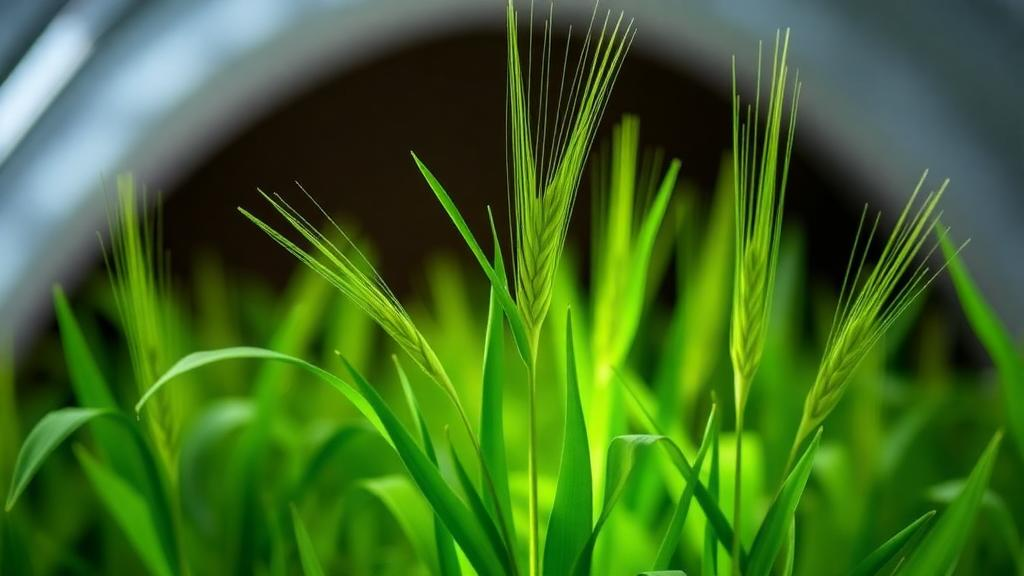
Barley, one of humanity’s oldest cultivated grains, may have just received a futuristic upgrade. In a new study published in Scientific Reports, researchers from the Laser and Plasma Research Institute at Shahid Beheshti University in Tehran discovered that blasting barley seeds with cold atmospheric plasma—a partially ionized gas generated at room temperature—can dramatically enhance seedling growth and biomass. Even more striking, the effects depend heavily on which gas is used to generate the plasma and on the specific barley cultivar being treated. The findings could open the door to a chemical-free, eco-friendly technology for boosting early crop development at a time when agriculture urgently needs sustainable alternatives to synthetic agrochemicals.
Cold atmospheric plasma, often abbreviated as CAP, is not the scorching, lightning-hot plasma found in stars or fusion reactors. Instead, it is produced under atmospheric pressure and remains close to ambient temperature, making it safe for delicate biological materials such as seeds. The research team used a dielectric barrier discharge, or DBD, device—a setup in which two electrodes are separated by an insulating dielectric layer that prevents arcing and produces a uniform, low-temperature plasma. When gases such as air, argon, nitrogen, or oxygen pass through this electrical field, they become ionized, generating a cocktail of reactive species including ozone, atomic oxygen, hydroxyl radicals, and excited nitrogen molecules. These reactive particles interact with the seed surface in ways that can fundamentally alter its chemistry and physics.
The study focused on two barley cultivars, Bahman and Novosadski, both of the species Hordeum vulgare L. The researchers began by exposing seeds to air plasma for durations of one, two, and three minutes to identify the optimal exposure time. What they found was remarkable: the ideal treatment time was not universal. Bahman seeds responded best to a full three minutes of air plasma exposure, while Novosadski seeds showed the strongest response at just one minute. This cultivar-dependent behavior suggests that the genetic background of a plant plays a significant role in how its seeds react to plasma treatment—a finding with major implications for how farmers and breeders might apply this technology in the future.
After determining optimal exposure times, the team compared the effects of different working gases: air, argon, nitrogen, oxygen, a nitrogen-oxygen mixture, and an argon-oxygen mixture. Across all treatments, final germination percentage remained unchanged at a perfect 100 percent, meaning plasma did not harm the seeds’ ability to sprout. However, plasma significantly affected seedling growth parameters in a cultivar-dependent manner. Air plasma produced the highest overall improvements in shoot length, root length, fresh weight, and dry weight in both cultivars. In contrast, nitrogen plasma generally showed inhibitory effects, suppressing seedling development rather than enhancing it. This distinction matters because it demonstrates that not all plasma treatments are created equal—the choice of gas can determine whether the treatment helps or hinders growth.
To understand why these effects occur, the researchers turned to sophisticated surface analysis techniques. Using Fourier-transform infrared spectroscopy, or FTIR, they examined the chemical functional groups on the seed surface before and after treatment. Scanning electron microscopy, or SEM, allowed them to visualize changes in the seed’s microscopic surface morphology. Water contact angle measurements revealed how hydrophilic—or water-attracting—the seed surface had become. Finally, water absorption tests measured how much water the treated seeds could take up. Together, these analyses indicated that plasma treatment modified seed surface properties and increased hydrophilicity, which likely enhanced water uptake and, in turn, seedling development.
The mechanism behind these improvements is rooted in plasma physics and surface chemistry. When reactive plasma species collide with the seed’s outer layers, they can break chemical bonds, introduce oxygen-containing functional groups such as hydroxyl and carboxyl groups, and etch away waxy surface coatings. These changes make the seed surface more polar and more water-attracting. A lower water contact angle means water droplets spread more easily across the seed, and increased hydrophilicity allows the seed to absorb water more rapidly during germination. Faster and more efficient water uptake triggers enzymatic activity, mobilizes stored nutrients, and accelerates the early stages of seedling growth. The result is longer shoots, longer roots, and greater fresh and dry biomass—all without a single drop of chemical fertilizer or pesticide.
What makes this research particularly exciting is its potential for real-world agricultural impact. Barley is the fourth largest cereal crop globally by production volume and is grown across a wide range of climates, from the Middle East to Northern Europe. It is used for animal feed, malt production, and human food. Enhancing seedling vigor and early biomass through a simple, non-chemical treatment could translate into stronger plants, better establishment in the field, and potentially higher yields. Because cold plasma treatment requires only electricity and a gas—both widely available—it could be implemented at seed-processing facilities without the environmental baggage associated with synthetic agrochemicals. The technology is also fast: treatment times of just one to three minutes mean large volumes of seeds could be processed efficiently.
The cultivar-specific nature of the findings adds an important layer of nuance. Bahman, an Iranian cultivar, and Novosadski, a Serbian cultivar, responded differently to identical plasma treatments. This suggests that plasma seed treatment protocols may need to be tailored to individual cultivars rather than applied as a one-size-fits-all solution. For breeders and agricultural scientists, this raises intriguing questions about the genetic basis of plasma sensitivity. Could certain cultivars possess seed coat compositions or surface chemistries that make them more receptive to plasma modification? Understanding these differences could allow researchers to predict which varieties will benefit most and to design plasma treatments optimized for specific crops and growing regions.
The inhibitory effects observed with nitrogen plasma also deserve attention. While nitrogen is an essential nutrient for plants, nitrogen plasma appears to have suppressed seedling growth in this study. This may be related to the specific reactive nitrogen species generated in the DBD discharge, which could interact differently with the seed surface than oxygen-containing species. Alternatively, nitrogen plasma may alter the seed surface in ways that reduce hydrophilicity or introduce compounds that inhibit enzymatic activity during germination. Whatever the mechanism, the finding reinforces the idea that plasma treatment is a double-edged sword: the same technology that can supercharge growth can also suppress it if the wrong gas or exposure time is chosen.
As the world grapples with climate change, soil degradation, and the need to feed a growing population, technologies like cold plasma seed treatment offer a glimpse of a more sustainable agricultural future. This study demonstrates that DBD cold plasma can improve early barley growth, although the effectiveness strongly depends on treatment conditions and cultivar type. The research team, including Mahdiyeh Martami, Mohamad Sajad Nikouei Fard, Shadi Sabzevari, and their colleagues, has provided a foundation for further exploration of plasma agriculture. Future studies will likely investigate the effects of plasma on field-grown plants, examine the technology’s application to other cereal crops, and explore the genetic and molecular mechanisms underlying plasma sensitivity. For now, the message is clear: a few minutes in an ionized gas cloud may be all it takes to give one of humanity’s oldest crops a powerful head start.
Subject of Research: Effects of dielectric barrier discharge cold plasma generated with different working gases on seedling growth and biomass traits in two barley cultivars
Article Title: Effects of dielectric barrier discharge cold plasma generated with different working gases on seedling growth and biomass traits in two barley cultivars (Bahman and Novosadski)
Article References: Martami, M., Fard, M. S. N., Sabzevari, S., Mohajer, M. H., Monfaredi, M., Hamidi, A., & Ghomi, H. R. (2026). Effects of dielectric barrier discharge cold plasma generated with different working gases on seedling growth and biomass traits in two barley cultivars (Bahman and Novosadski). Scientific Reports. https://doi.org/10.1038/s41598-026-74537-w
Image Credits: AI Generated
DOI: 10.1038/s41598-026-74537-w
Keywords: Effects, dielectric, barrier, discharge, cold, plasma, generated, different, working, gases, seedling, growth
News Source: Alan Morgan. (October 17, 2026). Cold Plasma Blast Supercharges Barley Seedlings, New Study Reveals. Scienmag.