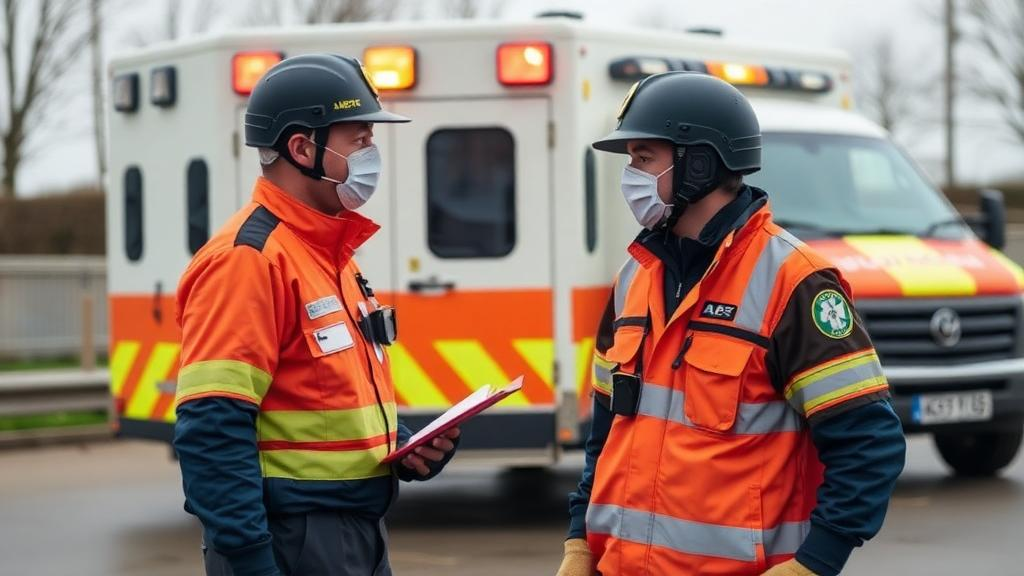
Every year, millions of people collapse with a cardiac arrest outside hospital, and their survival often depends on whether someone nearby starts chest compressions within minutes. Smartphone-based community first responder systems were built for exactly this moment: when an emergency call comes in, the dispatch center sends a mobile alert to trained volunteers within a few hundred meters of the victim, hoping a layperson will begin CPR and fetch an automated external defibrillator before the ambulance arrives. Yet a new scoping review published in BMC Health Services Research reveals a sobering pattern. Volunteer engagement does not simply fail or succeed; it leaks away at multiple stages along the emergency response timeline, from the moment the alert is dispatched to the moment the responder accepts it, navigates to the scene, and actually intervenes. The gap between the alert and the rescue, the authors show, is where the system’s promise quietly erodes.
The review, led by Sreejith Balachandran and David Schwartz of Bar-Ilan University’s Graduate School of Business Administration together with emergency medicine specialist Abdelouahab Bellou of the Guangdong Academy of Medical Sciences, followed Arksey and O’Malley’s scoping review framework and was reported in line with PRISMA-ScR, the reporting standard for this review type. In July 2025 the team searched PubMed, Scopus, IEEE Xplore, Ovid MEDLINE, Web of Science, Cochrane, and targeted Google Scholar screening, retrieving 1,941 records. After removing 651 duplicates, screening in the Rayyan platform against predefined criteria focusing on nonprofessional responders mobilized via smartphone-based alerting, the team assessed 90 full texts and included 23 studies. Thematic synthesis then mapped how challenges were expressed across the literature, producing 175 distinct manifestations grouped into 18 themes and 5 overarching clusters: technological, operational, psychological, organizational, and capability.
The most frequently reported challenges were personal constraints, navigational challenges, and emotional overload, and their prominence tells a story about the anatomy of a volunteer response. Personal constraints refer to the everyday circumstances that make it impossible to respond even when the alert arrives: a responder may be driving, at work, caring for children, or asleep. Navigational challenges describe the technical and cognitive burden of finding the patient, since GPS positioning can be imprecise in dense urban blocks, rural roads, or inside large buildings, and the alert may not provide enough contextual detail to locate a victim quickly. Emotional overload captures the psychological weight of the mission itself: a layperson who has never seen a cardiac arrest is suddenly asked to perform aggressive chest compressions on a dying stranger, often alone, with bystanders watching and the outcome uncertain.
The technological cluster reveals how much of the responder experience is shaped by software design decisions made long before any emergency. Alert acceptance rates depend on notification timing, sound salience, and whether the alert provides actionable information such as the patient’s condition, the nearest AED location, and clear routing. Poor GPS accuracy, unreliable network coverage, and ambiguous address data can turn a two-minute response into a ten-minute search, nullifying the survival advantage that early CPR is supposed to confer. The review maps how these technical manifestations interact with human behavior: a responder who once searched in vain for an address may hesitate the next time the phone buzzes, a feedback loop in which system failure erodes the trust that volunteer participation depends on.
Operationally, the review documents the friction of the mission itself. Responders face uncertainty about their role once on scene: bystanders may not recognize them as authorized helpers, family members may resist their intervention, and the responder may arrive to find CPR already underway or, conversely, no one willing to help. Handover to arriving EMS crews is another documented pressure point, as is the physical demand of sustained compressions, which most laypeople cannot maintain for the several minutes required for professional help to arrive. The operational cluster also includes challenges of coordination when multiple responders are alerted simultaneously, since duplicated alerts can create confusion about who is actually attending the scene.
The psychological cluster may be the most underappreciated dimension of volunteer emergency response. The review maps manifestations of acute stress, fear of harming the patient, and the emotional aftermath of unsuccessful resuscitation attempts. Some responders described intrusive memories after missions, while others reported reluctance to accept further alerts after a distressing experience. The authors position these findings within a sociotechnical framing: volunteer engagement is not a simple binary of willingness and refusal but a process shaped by system design, cultural context, and human behavior. A responder’s decision to accept an alert is influenced by prior experiences, perceived competence, social environment, and the emotional cost of previous missions.
Organizational and capability challenges complete the picture. Organizational manifestations include unclear legal protection for volunteers, inconsistent training standards across regions, and the absence of structured debriefing after missions. Capability challenges involve skill degradation over time, since CPR is a perishable skill and most volunteers rarely encounter a real arrest, and uncertainty about whether one’s training is sufficient for the situation encountered. The review maps how these challenges interact: a volunteer whose training has lapsed may feel less confident, which increases hesitation, which in turn reduces the likelihood of alert acceptance, creating a capability-engagement feedback loop that system designers rarely account for.
The review’s contribution is not merely cataloguing problems but providing a structured map that positions CFR engagement as a sociotechnical process. By mapping 175 manifestations across the emergency response timeline, the authors provide a foundation for technology-society research on how digital emergency response infrastructures can be designed to sustain volunteer participation across diverse settings. The framing matters because smartphone-based CFR systems are expanding globally, from dense metropolitan networks to rural systems where the nearest ambulance may be many minutes away, and the challenges documented in one cultural context may manifest differently in another. The review explicitly notes that cultural context shapes how challenges are expressed, meaning that a navigation problem in a rural area and an emotional overload problem in an urban setting may require entirely different design responses.
For the growing global community of smartphone-alerted volunteers, the review’s message is clear: the moments between the alert and the rescue are where survival is won or lost, and those moments are shaped by far more than willingness to help. Every design decision, from notification sound to address data quality to debriefing availability, influences whether a trained volunteer actually reaches a dying patient in time. The structured map of challenges provides researchers, system designers, and emergency medical services with a common vocabulary for understanding why engagement leaks away, and a starting point for building digital emergency response infrastructures that sustain the volunteer participation on which early CPR and defibrillation ultimately depend.
Subject of Research: Between the alert and the rescue: a scoping review of challenges faced by community first responders
Article Title: Between the alert and the rescue: a scoping review of challenges faced by community first responders
Article References: Balachandran, S., Bellou, A., & Schwartz, D. (2026). Between the alert and the rescue: a scoping review of challenges faced by community first responders. BMC Health Services Research. https://doi.org/10.1186/s12913-026-15664-y
Image Credits: AI Generated
DOI: 10.1186/s12913-026-15664-y
Keywords: Between, alert, rescue, scoping, review, challenges, faced, community, first, responders, scientific research
News Source: Ophelia Keating. (October 17, 2026). Why volunteer rescuers drop out between the alert and the ambulance. Scienmag.