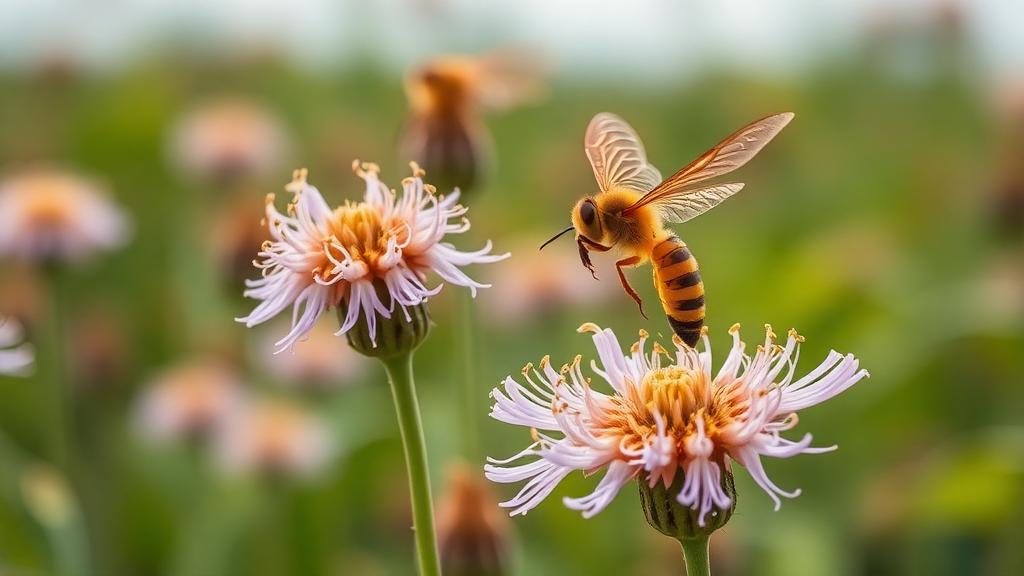
An invasive plant that has spread across Central Europe is turning out to be far more than an ecological problem. Common milkweed (Asclepias syriaca L.), a North American species that now dominates abandoned fields, vineyards, and sandy grasslands across Hungary and Serbia, produces nectar in quantities that swing dramatically from year to year and site to site, according to new research published in BMC Plant Biology. The findings reveal a plant caught in a tension between its role as an invader that degrades native ecosystems and its unexpected value as a nectar resource for honeybees and other pollinators.
Researchers led by Dragica Purger, Rita Filep, and Ágnes Farkas at the University of Pécs in Hungary measured nectar volumes and sugar concentrations of common milkweed across three consecutive years, from 2020 to 2022, at three sites in Hungary and a neighboring region of Serbia. Two of the sites were abandoned vineyards, while the third was a dry sandy grassland. The team wanted to understand how environmental factors such as soil moisture, relative humidity, and temperature shape nectar production in this invasive species, and whether the plant could contribute meaningfully to honey production in the region.
The results show that nectar volume per flower ranged from 0.5 to 2.7 microliters, while sugar concentration varied from 27 to 40 percent. These figures might sound narrow, but they represent a substantial range for a single species across different sites and years. The abandoned vineyard sites consistently produced higher nectar volumes and higher sugar concentrations than the dry sandy grassland site, suggesting that site characteristics play a decisive role in determining how much nectar this invasive plant can offer to pollinators.
What makes the study particularly striking is the degree of variability the researchers observed not just between sites and years, but also among individual shoots and among inflorescences within the same plant. This means that even within a single milkweed patch, some flowers are far richer nectar sources than others. Such fine-scale variation has important implications for how pollinators forage and how beekeepers might estimate the value of milkweed-dominated landscapes for honey production.
The environmental drivers behind these patterns are clear. Higher nectar volumes were recorded under conditions of higher soil moisture and higher relative humidity. Conversely, extreme heat, with temperatures reaching 35 to 40 degrees Celsius, combined with prolonged drought, substantially reduced nectar volumes. This finding underscores the vulnerability of nectar production to climatic stress and suggests that as heatwaves and droughts become more frequent in Central Europe, the nectar supply provided by this invasive species could decline sharply in some years.
The researchers also estimated potential honey yields based on their standing-crop measurements. Under favorable conditions, common milkweed stands could produce more than 100 kilograms of honey per hectare, a figure that would make the plant a genuinely valuable nectar resource for beekeepers. However, during periods of drought and heat stress, these estimated yields declined markedly, demonstrating that the apicultural value of this invasive species is far from guaranteed and depends heavily on climatic conditions in any given year.
Common milkweed is widely recognized as an invasive species in Central Europe, where it negatively affects native biodiversity and ecosystem processes, particularly soil moisture dynamics. Its dense stands can alter water availability in sandy soils and displace native plant communities. Yet the same plant simultaneously provides a valuable nectar resource for pollinators, including honeybees, at a time when many native nectar sources are declining. This duality complicates management decisions, as controlling the plant could reduce nectar availability for pollinators in landscapes where alternative floral resources are scarce.
The study contributes to a better understanding of the ecological and apicultural significance of common milkweed in Central Europe. It demonstrates that the plant can serve as a valuable nectar source for honeybees, although its nectar productivity is strongly influenced by site characteristics and climatic conditions. The researchers emphasize that any assessment of the plant’s role as a floral resource, or its potential contribution to honey production, must take into account environmental conditions and climatic variability rather than relying on single-year or single-site measurements.
As climate change continues to alter temperature and precipitation patterns across Europe, the interannual swings documented in this study are likely to become more pronounced. Years with favorable moisture and moderate temperatures could see milkweed stands producing nectar at levels that support substantial honey yields, while drought years could see production collapse. For beekeepers, conservationists, and land managers across Central Europe, the message is that this invasive species is neither purely a threat nor purely a resource, but a plant whose value shifts with the weather.
The research team, which also included Marianna Kocsis, Viktória L. Balázs, Lilla Radványi, and Viktória Biró, notes that their findings underscore the importance of considering environmental conditions when assessing the role of invasive plants as floral resources. The study was supported by the National Research Development and Innovation Office of Hungary and the Faculty of Pharmacy at the University of Pécs, and it offers a technical foundation for future work on how invasive species interact with pollinator communities under changing climatic conditions.
Subject of Research: Environmental variability and interannual changes in nectar production of common milkweed (Asclepias syriaca L.) in Central Europe
Article Title: Environmental variability and interannual changes in nectar production of common milkweed (Asclepias syriaca L.) in Central Europe
Article References: Purger, D., Filep, R., Kocsis, M., Balázs, V. L., Radványi, L., Biró, V., & Farkas, Á. (2026). Environmental variability and interannual changes in nectar production of common milkweed (Asclepias syriaca L.) in Central Europe. BMC Plant Biology. https://doi.org/10.1186/s12870-026-10119-2
Image Credits: AI Generated
DOI: 10.1186/s12870-026-10119-2
Keywords: common milkweed, Asclepias syriaca, nectar production, invasive species, pollinators, honeybees, Central Europe, climate variability, drought, BMC Plant Biology, Environmental, variability
News Source: Alan Morgan. (October 17, 2026). Invasive Milkweed Nectar Production Swings Wildly With Heat and Drought in Central Europe. Scienmag.