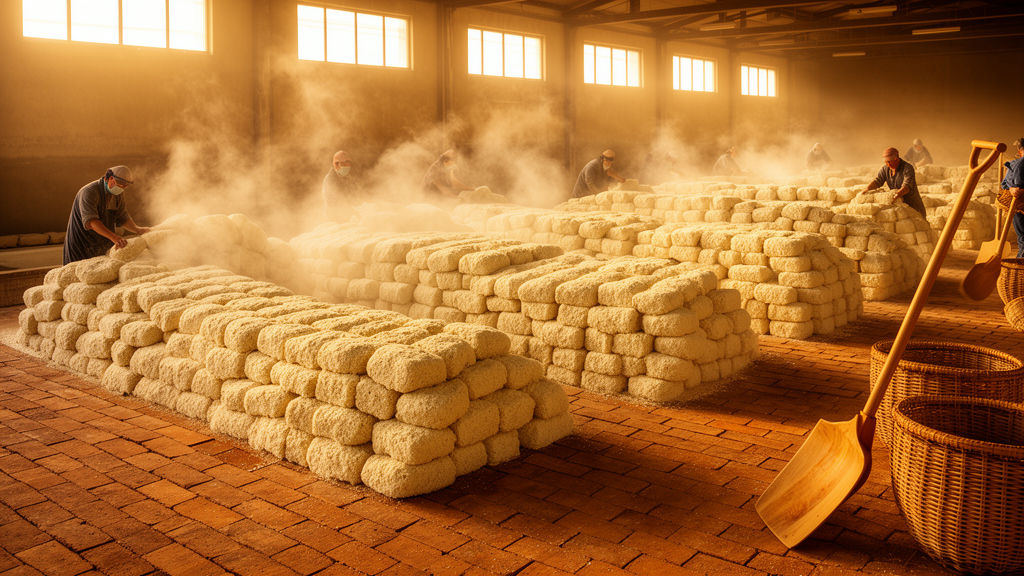
Deep in the wheat blocks of high-temperature Daqu, the fermentation starter that anchors the production of premium Moutai-flavor Baijiu, temperatures climb to a punishing 60 to 65 degrees Celsius. That heat is not an accident of insulation or ambient weather; it is generated by the microbes themselves as they oxidize carbohydrates, proteins, and lipids inside tightly stacked, straw-interleaved blocks. A new study published in Food Chemistry: X has now dissected, at the molecular level, how two bacterial genera, Bacillus and Pediococcus, cooperate to drive this thermogenesis, and it has identified a single metabolic branch point, chorismate, as the pivot on which the entire heat-generating program turns.
The research team, led by Huabin Tu, Guanyu Zhou, Yanfeng Liu, and Jian Chen, combined isothermal microcalorimetry, time-resolved transcriptomics, and untargeted metabolomics to systematically decipher the metabolic basis of interspecies cooperation under heat stress. Their work fills a critical mechanistic void: previous studies had established that a synergistic mutualism between Bacillus and Pediococcus is a key driver of heat generation in Daqu, with co-cultures producing significantly more metabolic heat than either monoculture, but the molecular underpinnings of that synergy remained entirely unresolved.
High-temperature Daqu is far more than a simple starter. It serves as a sophisticated carrier for microbial, enzymatic, and substrate systems that fundamentally determine the sensory characteristics, consistent quality, and economic value of the finished Baijiu. The signature high temperature drives a complex array of enzymatic and non-enzymatic reactions, most notably Maillard chemistry, which yields pyrazines, phenols, and furans that form the backbone of the sauce-like aroma profile. Precise regulation of the temperature trajectory during the critical early fermentation stage, before the first Daqu turning on day 9, is therefore paramount, as deviations disrupt microbial succession, enzyme kinetics, and flavor precursor formation.
The attainment of Daqu’s high-temperature environment emerges from the dynamic interplay between microbial metabolic heat generation and the thermal insulation properties of the solid-state substrate. Recent evidence indicates that thermogenesis is governed not by individual thermophilic taxa but by cooperative interactions within the microbial community. The point at which fermentation temperature rises to 45 degrees Celsius has been identified as the critical node at which temperature trajectories diverge: well-fermented batches attain the normal 60 to 65 degree range, whereas insufficiently fermented batches fail to reach it. A synergistic mutualism between Bacillus and Pediococcus, with an appropriate balance between the genera, is strongly associated with optimal thermal performance.
To probe this cooperation, the researchers worked with Bacillus velezensis YF83 and Pediococcus acidilactici YF45, both isolated from high-temperature Daqu at the first turning stage, where they were identified as the dominant Bacillus and Pediococcus species respectively. Using isothermal microcalorimetry on a solid wheat-flour substrate that simulates the Daqu environment, they measured heat production across different inoculation ratios at 25 and 45 degrees Celsius. At 25 degrees, heat capacity increased with the proportion of Bacillus, and the introduction of a small proportion of Pediococcus further enhanced heat generation during the mid-to-late cultivation stage. Under 45 degree conditions, all co-culture systems exhibited substantially higher cumulative heat output than their corresponding monocultures, regardless of inoculation ratio.
Population composition analysis revealed a dynamic coexistence pattern rather than a simple balance in abundance. At 45 degrees, Bacillus rapidly became dominant; in the 50:50 co-culture group, the relative abundance of Pediococcus and Bacillus at 6 hours was approximately 5.8:94.2, corresponding to a coexistence strength of 0.055. Yet by 12 hours, the ratio recovered to roughly 32.2:67.8, and coexistence strength rose to 0.218. Pediococcus was not eliminated under thermal stress but retained its ecological participation and interaction potential during the later thermogenic stage. Heat production in the mixed cultures at 12 hours was substantially higher than in the corresponding monocultures, indicating that this coexistence state positively contributed to thermogenesis.
Transcriptomic analysis of the 50:50 co-culture, comparing transcript abundances against biomass-weighted theoretical values calculated from the monocultures, revealed that co-culture-induced functional responses were strongly dependent on both time and temperature. Under 45 degree conditions, a large number of pathways exhibited positive transcriptional responses as early as 6 hours and remained highly active at 12 hours. These pathways were predominantly associated with nitrogen and amino acid metabolism and energy and redox metabolism. The most strongly enhanced functions included the tricarboxylic acid cycle, 2-oxocarboxylic acid metabolism, flagellar assembly, lipoic acid metabolism, and amino acid biosynthesis and degradation pathways, whereas only marginal changes were observed in glycolysis and gluconeogenesis. This pattern suggests that enhanced metabolic activity under thermal stress was not primarily driven by increased glycolytic flux but by intensified cellular turnover and biomass recycling.
Pediococcus predominantly contributed to aromatic amino acid biosynthesis and ubiquinone and other terpenoid-quinone biosynthesis pathways, both of which increased in parallel with the absolute biomass of Bacillus during co-cultivation. These pathways may provide nitrogen-containing metabolic intermediates or essential respiratory cofactors such as menaquinone. Although lactic acid bacteria generally do not rely on respiratory quinones for energy conservation, genomic analyses have demonstrated that Pediococcus and related lactic acid bacteria possess the genetic capacity for quinone precursor biosynthesis, and these compounds can function as shared metabolites supporting the growth and respiration of neighboring microorganisms.
Metabolomic analysis confirmed that the co-culture established a distinct metabolic state rather than a simple additive combination of the two monocultures. Several stress-protective compounds were elevated, including fraxetin, a potent antioxidant capable of scavenging heat-induced reactive oxygen species, and indolelactic acid, a characteristic tryptophan-derived metabolite produced by Pediococcus with potent antioxidant activity. Meanwhile, metabolites involved in amino acid biosynthesis, nitrogen metabolism, the tricarboxylic acid cycle, pyruvate metabolism, and fatty acid metabolism exhibited lower abundances in the co-culture than the weighted expectation, indicating that these intermediates were actively consumed and channeled into downstream reactions rather than accumulating, pointing to an elevated metabolic turnover rate.
Among the metabolites displaying striking temporal dynamics, chorismate stood out. Within the phenylalanine, tyrosine, and tryptophan biosynthesis pathway, quinic acid, shikimic acid, and anthranilic acid continuously decreased from 6 to 12 hours, while the corresponding pathway transcripts remained consistently upregulated. Chorismate accumulated 4.7-fold over the biomass-weighted expectation at 6 hours and then dropped to 0.5-fold at 12 hours, while L-tyrosine showed a reciprocal trend. This transition from accumulation to rapid depletion suggests that chorismate behaves as a key metabolic branch point underlying sustained heat production during the later stage of co-culture fermentation.
From a metabolic network perspective, chorismate occupies a central branching point between menaquinone biosynthesis and aromatic amino acid biosynthesis. Menaquinone functions as the principal lipid-soluble electron carrier in the respiratory chains of Gram-positive Firmicutes such as Bacillus, so the flux of chorismate toward menaquinone biosynthesis directly affects respiratory electron transport efficiency. On the other hand, chorismate is also a key precursor for tyrosine biosynthesis, whose conversion involves NAD(P)+-dependent oxidation reactions capable of generating reducing equivalents. Tyrosine catabolism produces fumarate and acetoacetate, with fumarate replenishing the tricarboxylic acid cycle and acetoacetate being further converted into acetyl-CoA for entry into central carbon metabolism.
The researchers integrated these findings into a mechanism model described as a cell turnover, nitrogen sharing, chorismate metabolic redirection framework. At 45 degrees, significant enrichment of the two-component system pathway indicated enhanced cellular capacity for sensing temperature, nutrient availability, and community status, reflecting elevated rates of cell damage and turnover. Cellular lysis continuously releases proteins, peptides, free amino acids, and other nitrogen-containing compounds, generating a renewable nitrogen reservoir for the microbial community. Concurrent upregulation of flagellar assembly and biofilm formation indicated extensive structural reorganization, imposing substantial energetic demands associated with respiration.
As carbohydrate-derived energy generation declined, the co-culture increasingly relied on the accumulated pool of free nitrogen compounds, with enhanced transcription of nitrogen metabolism and multiple amino acid metabolic pathways. The most strongly enriched pathways included lysine degradation, histidine metabolism, phenylalanine metabolism, and valine, leucine, and isoleucine degradation. Preferential utilization of branched-chain and aromatic amino acids is a common adaptive strategy in thermally stressed microorganisms, and their degradation products, including acetyl-CoA, succinyl-CoA, and pyruvate, can replenish central carbon metabolism through anaplerotic reactions, compensating for tricarboxylic acid cycle substrate depletion caused by heat-induced inactivation of pyruvate dehydrogenase and alpha-ketoglutarate dehydrogenase.
The custom chorismate biosynthesis pathway, defined as 28 aro-family genes catalysing the seven committed steps from DAHP synthase to chorismate synthase, was upregulated over the weighted expectation at both 6 hours (6.1-fold) and 12 hours (9.2-fold). Among the four major downstream routes of chorismate metabolism, three were upregulated at 12 hours, while biosynthesis of siderophore group nonribosomal peptides was significantly suppressed. This indicates that the co-culture preferentially allocated metabolic resources toward energy production, antioxidant defense, and cellular restructuring while temporarily restricting the energetically expensive and temperature-sensitive siderophore biosynthetic pathway.
Remarkably, the chorismate consumed through aromatic amino acid biosynthesis was not preferentially directed toward the energetically demanding tryptophan branch. Instead, metabolic flux was selectively redirected toward tyrosine biosynthesis. This redirection confers three interconnected physiological advantages. First, de novo tryptophan biosynthesis is among the most ATP-intensive amino acid biosynthetic processes, whereas the chorismate-to-tyrosine route is thermodynamically more economical and includes dehydrogenase-catalyzed reactions capable of generating NADH. Second, accumulated tyrosine possesses strong radical-scavenging activity owing to its phenolic hydroxyl group, enabling direct neutralization of heat-induced reactive oxygen species within the extracellular microenvironment. Third, tyrosine accumulation appears tightly coupled with maintenance of respiratory metabolism, as tyrosine degradation products replenish the tricarboxylic acid cycle, and tyrosine residues participate directly in quinone binding and electron transfer processes. All seven core Men genes were detected, and the re-grouped menaquinone biosynthesis pathway was strongly induced in the co-culture at 45 degrees, by 1.8-fold at 6 hours and 5.3-fold at 12 hours.
To evaluate the robustness of this mechanism under production-like conditions, the researchers employed a simulated high-temperature Daqu system in which wheat and rice straw from a Moutai-flavor Baijiu producer in Maotai Town, Guizhou Province, were used to reproduce the porosity and oxygen gradients of industrial Daqu. The co-inoculated system consistently exhibited the highest thermogenic performance. At the key temperature differentiation stage on day 4, neither single-species-inoculated group maintained dominance: in the Bacillus-inoculated group, Bacillus was substantially displaced by the background microbiota, whereas in the Pediococcus-inoculated group Pediococcus accounted for only about half of the community. In contrast, the co-inoculated group maintained both inoculated strains at appreciable proportions, supporting the robustness of the two-strain interaction.
At the transcriptomic level, the 50:50 co-inoculated group significantly enriched multiple key pathways, including the two-component system, nitrogen metabolism, aromatic amino acid biosynthesis, lipoic acid metabolism, and the tricarboxylic acid cycle, highly consistent with the microcalorimetric co-culture experiments. Furthermore, to verify that chorismate metabolic reprogramming promotes fermentative heat production, 3 micromolar D-tyrosine was introduced into the co-culture to inhibit the metabolic flux from chorismate to L-tyrosine. D-tyrosine binds to the allosteric regulatory site of prephenate dehydrogenase, mimicking L-tyrosine to trigger feedback inhibition, while remaining recalcitrant to degradation via the L-tyrosine catabolic pathway. The addition of D-tyrosine suppressed the thermogenic capacity of the co-culture fermentation, with inhibition primarily observed after the 6-hour time point of the previously identified chorismate redirection phase.
The researchers acknowledge that the model proposed is an inference from transcriptomic, metabolomic, and phenotypic signatures rather than a set of directly measured rates. Precisely quantifying the metabolic flux between Bacillus and Pediococcus will require isotope-resolved tracing combined with species-resolved labelling analysis, genetic validation through knockout, auxotrophic, or secretion mutants, and targeted quantification of chorismate, tyrosine, and menaquinone-7 against authentic standards. With flux partitioning finely quantified, the regulatory structure of the interaction can be resolved, the wider microbiome can be modulated in increasingly complex communities, and the framework can ultimately support the rational evaluation and refined design of microbial communities in industrial Daqu production.
These findings deepen understanding of microbial community thermogenesis and heat adaptation mechanisms in open solid-state fermentation systems. They also identify practical and actionable microbial targets for regulation, providing support for improving the stability and controllability of high-temperature Daqu production. By revealing how a thermally induced dynamic coexistence pattern, dominated by Bacillus with Pediococcus acting as a functional facilitator, establishes the ecological foundation for stable thermogenesis, and how chorismate partitioning acts as a central metabolic branch point channeling carbon preferentially toward tyrosine biosynthesis and menaquinone formation, the study offers a compelling molecular narrative for one of the most remarkable microbial heat-generating systems in traditional food fermentation.
Subject of Research: Interaction-driven chorismate metabolic reprogramming underlies Bacillus – Pediococcus synergistic thermogenesis in high-temperature Daqu
Article Title: Interaction-driven chorismate metabolic reprogramming underlies Bacillus – Pediococcus synergistic thermogenesis in high-temperature Daqu
Article References: Tu, H., Zhou, G., Tan, F., Yang, F., Chen, L., Lu, J., Li, J., Liu, Y., & Chen, J. (2026). Interaction-driven chorismate metabolic reprogramming underlies Bacillus–Pediococcus synergistic thermogenesis in high-temperature Daqu. Food Chemistry: X, Article 104599. https://doi.org/10.1016/j.fochx.2026.104599
Image Credits: AI Generated
DOI: 10.1016/j.fochx.2026.104599
Keywords: Bacillus, Pediococcus, Daqu, Baijiu, chorismate, thermogenesis, solid-state fermentation, microbial interactions, Interaction-driven, metabolic, reprogramming, underlies
News Source: Bethany Barker. (October 17, 2026). Bacterial teamwork and a single metabolite drive the fierce heat of Daqu fermentation. Scienmag.