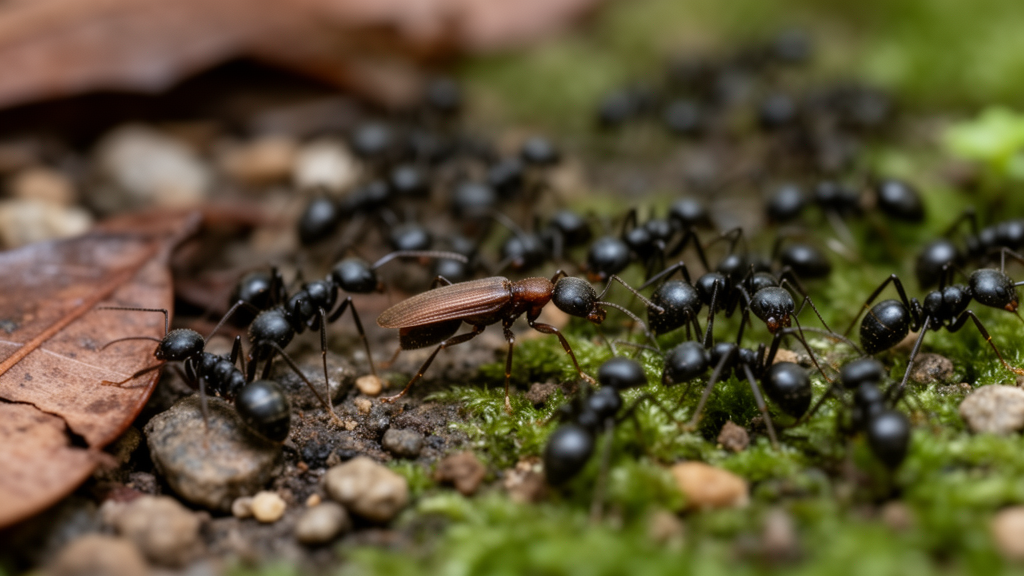
Deep in the forests of Japan, a group of tiny rove beetles has been quietly living one of biology’s most fascinating double lives. These beetles, members of the genus Homoeusa, spend their entire existence among ant colonies, walking alongside their hosts on foraging trails, begging for food, and even licking the bodies of worker ants to maintain their cover. For nearly 150 years, scientists have struggled to identify these beetles accurately, but a comprehensive new revision has finally brought order to this enigmatic group, revealing seven distinct species in Japan, including three entirely new to science.
The study, published in the Deutsche Entomologische Zeitschrift, represents the second installment of a series dedicated to revising the taxonomy of Homoeusa across the East Palearctic region. Led by Tsubasa Nozaki and Munetoshi Maruyama, the research combined extensive field collection efforts with the examination of historical specimens, some dating back to the pioneering collections of George Lewis in the 1870s. The result is a complete re-evaluation of the Japanese members of this myrmecophilous rove beetle genus, providing detailed descriptions, illustrations of genitalia, and ecological information for each species.
Homoeusa beetles are symbiotically associated with ants of the genus Lasius, and this relationship is characterized by a high degree of host specificity. Each beetle species tends to associate with a particular species group of Lasius ants, making them biologically intriguing subjects for studying myrmecophily and host-parasite interactions. The genus currently comprises twelve species distributed across the Holarctic region, and the new study brings the number known from Japan to seven.
The three newly described species are Homoeusa translucida, Homoeusa brevitarsis, and Homoeusa gigantea. Each was discovered through a combination of targeted field surveys and the careful re-examination of specimens that had been previously collected but never formally identified. H. translucida, named for its transparent pronotum, is a yellowish-orange beetle with a strongly transverse body shape that sets it apart from all other members of the genus. H. brevitarsis, found only on the Kii Peninsula of Honshu, is distinguished by its remarkably short hind tarsi. H. gigantea, the largest species in the genus, was found to be associated with Lasius umbratus group ants that forage mainly underground, a discovery made possible by an innovative baiting technique.
The identification of Homoeusa species has long been challenging because the diagnostic characteristics, particularly the genitalia, were poorly documented for many of the previously described species. The new study addresses this gap by providing detailed descriptions and illustrations of the male and female genitalia for all seven Japanese species. The researchers examined specimens using high-resolution stereomicroscopy, capturing stacked photographs to document morphological features with unprecedented clarity. They also constructed a distribution map using QGIS software to visualize the geographic ranges of each species.
Beyond taxonomy, the study provides rich ecological insights into the lives of these beetles. The researchers documented geographic distributions, host ant associations, seasonal activity patterns, and collection methods for each species. They also observed behaviors in the presence of host ant workers, both in the field and in laboratory settings. These observations revealed a fascinating spectrum of defensive strategies that vary according to body size and host species.
Smaller species, such as H. rufescens and H. ovata, simply stop moving when confronted by host ants, relying on their diminutive size to avoid detection. In contrast, larger species like H. japonica and H. longicornis raise the tips of their abdomens toward approaching workers, a behavior that resembles the appeasement strategy observed in other myrmecophilous insects. The researchers suggest that these larger beetles may release volatile chemicals from exocrine glands to reduce host aggression, as they cannot evade detection simply by remaining motionless.
Perhaps the most remarkable behavioral discovery involves H. laevigata, which was observed engaging in trophallaxis with its host ant Lasius nipponensis, begging for and receiving food from worker ants. The beetles were also seen licking the legs and bodies of workers as the ants groomed each other. The researchers propose that these behaviors may facilitate chemical mimicry, allowing the beetles to acquire the cuticular hydrocarbons that ants use for nestmate recognition. This mechanism, previously documented in ant crickets, represents a sophisticated form of social parasitism that has never before been observed in Homoeusa.
H. gigantea, the newly described largest species, exhibits yet another unique behavior: it proactively rubs its abdomen against the bodies of host ant workers. The function of this behavior remains unclear, but it may represent another means of acquiring chemical signatures from the hosts. The species was found to be associated with Lasius umbratus and L. meridionalis, both of which forage mainly underground, making them difficult to survey using conventional methods. The researchers found that setting bait along foraging trails under stones was an effective technique for collecting both the ants and their beetle guests, suggesting that H. gigantea may be more common than previously expected.
The study also raises intriguing questions about the life history of these beetles. Despite the large numbers of adults observed during their active season, no larvae have ever been recorded. The researchers suggest that larvae may reside deep inside ant nests, depending on host resources, and that they may pupate in cryptic places before emerging as adults. The dispersal behavior of adults also remains unknown, but the researchers note that species associated with underground-foraging ants were frequently collected in flight intercept traps, while those associated with surface-foraging ants were rarely caught by this method. These differences in flight activity may be influenced by habitat preferences, and they hint at the complex adaptations that have evolved in response to the myrmecophilous lifestyle of this remarkable group of beetles.
Subject of Research: Taxonomy of Homoeusa Kraatz, 1856 (Coleoptera, Staphylinidae, Aleocharinae) from the East Palearctic: II. Revision of Japanese species
Article Title: Taxonomy of Homoeusa Kraatz, 1856 ( Coleoptera , Staphylinidae , Aleocharinae ) from the East Palearctic: II. Revision of Japanese species
Article References: Nozaki, T., & Maruyama, M. (2025). Taxonomy of Homoeusa Kraatz, 1856 (Coleoptera, Staphylinidae, Aleocharinae) from the East Palearctic: II. Revision of Japanese species. Deutsche Entomologische Zeitschrift, 72(2), 525-555. https://doi.org/10.3897/dez.72.158689
Image Credits: AI Generated
Keywords: Taxonomy, Homoeusa, Kraatz, Coleoptera, Staphylinidae, Aleocharinae, East, Palearctic, Revision, Japanese, species, scientific research
News Source: Gavin Prescott. (October 17, 2026). Rove Beetles That Live Among Ants: Seven Japanese Species Revealed. Scienmag.