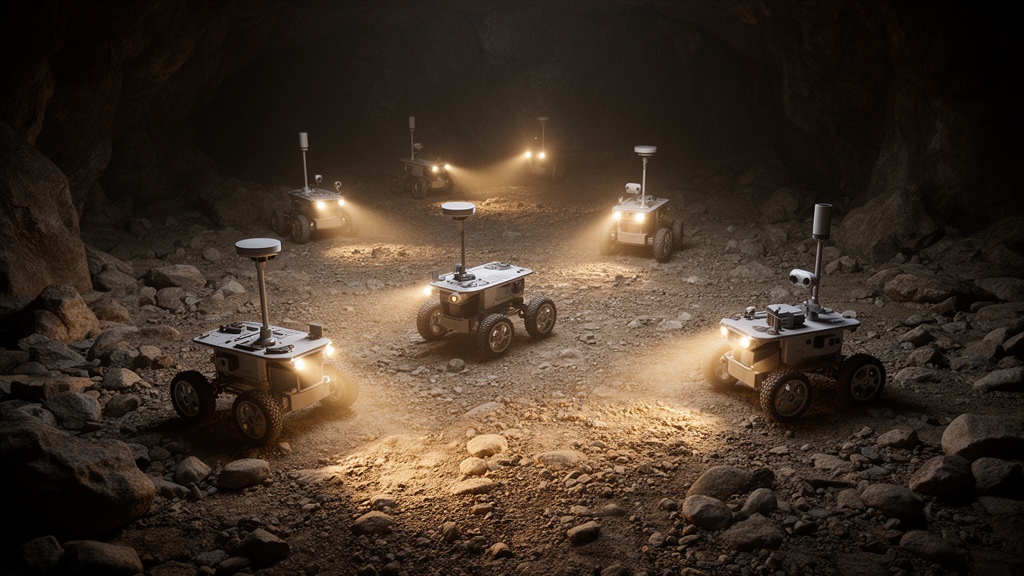
Robot teams that can rapidly map unfamiliar buildings, disaster zones, or extraterrestrial terrain have long been a holy grail of robotics, and a new study claims a surprising biological muse for the job: the crayfish. Researchers from Air University in Pakistan and the National Research Council of Italy have developed EMREL, short for Efficient Multi-Robot Exploration, a hybrid algorithm that pairs a deterministic coordination framework with a nature-inspired stochastic optimizer modeled on how crayfish forage, compete, and flee summer heat. Published in Frontiers in Robotics and AI, the work reports faster exploration rates, shorter runtimes, and zero failed simulation runs across a battery of test scenarios, outperforming five contemporary hybrid methods built around other metaheuristics.
The core problem the team tackled is deceptively simple to state but brutally hard to solve. When multiple robots explore an unknown environment, each must decide where to go next based on incomplete information, sensor noise, and the choices of its teammates. Poor coordination leads to redundant traversal, where several robots converge on the same frontier and waste mission time scanning already-covered ground. Current methodologies, the authors argue, suffer from inadequate exploration rates principally because of limited global coverage and infrequent decision-making, two deficiencies that compound as environments grow more cluttered and dynamic.
EMREL’s deterministic backbone is the Coordinated Multi-Robot Exploration formulation, a well-established framework originally developed by Burgard and colleagues in 2005. Under CME, the environment is represented as an occupancy grid map, a two-dimensional matrix in which each cell carries a probability of being free, occupied, or unknown. A frontier cell is formally defined as any free cell adjacent to at least one unknown cell, marking the demarcation between explored and uncharted territory. Advancing toward frontier cells is how robots gain new knowledge about their surroundings, and the CME framework evaluates each candidate frontier using two coupled quantities: a cost, reflecting the travel distance and occupancy probability, and a utility, which decreases as other robots claim nearby regions. This utility decay is what discourages the team from converging on spatially correlated targets and instead pushes robots to spread across the environment.
These cost and utility values are organized into a Frontier Information Structure, a shared data structure that maintains occupancy probabilities, utility values, and frontier flags across the entire robot team. The structure is incrementally updated with each new sensor observation, enabling real-time decisions by every robot without waiting for periodic global recomputations. Because the sensor’s coverage is limited, the occupancy grid is only populated for cells within range, typically the eight cells surrounding each robot, which keeps the computational footprint small while preserving the essential global structure needed for coordination.
Deterministic methods, however, have well-documented brittleness. They operate within known and predefined conditions and struggle when information is incomplete, terrain is unpredictable, sensors are noisy, or communication is delayed. In real missions such as search and rescue, hazardous site inspection, or underground exploration, these failures are critical. Metaheuristic algorithms, which embed randomness into their search process, offer greater flexibility and a better chance of escaping local optima, but they come with their own liabilities: non-unique solutions, fluctuating convergence rates, and a tendency to fall into local optima when applied naively. Until now, the authors note, most metaheuristics had been utilized for single-robot applications, and their impact on multi-robot configurations was yet to be ascertained.
EMREL’s answer is a two-stage hybrid. Robots first evaluate their environment using the deterministic CME method, which directs the prioritization of neighboring cells around each robot. Then the stochastic optimizer, the Crayfish Optimization Algorithm, takes over to enhance the search space by improving overall solutions. The COA, introduced by Jia and colleagues in 2023, is inspired by the foraging, rivalry, and summertime vacationing habits of crayfish. Its temperature-based model governs transitions between phases: when simulated temperatures exceed 30 degrees Celsius, crayfish exhibit heat avoidance behavior, searching for cooler caves, which corresponds to the algorithm’s exploration phase. Below 30 degrees, they forage, corresponding to exploitation. When food is considered excessively large, the crayfish fragments it and consumes it alternately with its second and third claws, a behavior translated into a mathematical step that refines solutions in small increments. This temperature-driven balance between global search and local refinement is what allows the algorithm to equilibrate exploration and exploitation in non-continuous, non-differentiable search spaces where gradient-based approaches fail.
A further innovation is the Intelligent Initial Configuration module. Rather than launching each run from scratch, EMREL maintains a database of previously determined optimal or nearly optimal solutions obtained from earlier iterations. To generate the initial population for a new run, the module selects a subset of these high-performing solutions at random, applies a mutation operator to each, and uses the perturbed results as the starting population. This method leverages information from past successful solutions to direct the search during its early stages while the mutation operator adds diversity, preventing the population from simply repeating previously solved problems and accelerating convergence.
The evaluation was conducted in MATLAB simulations on a 30 by 30 meter map with a 1.5 meter sensor ray length, testing each algorithm over 30 runs with 250 iterations. Four cases were designed to probe different aspects of performance: a baseline with uniformly distributed robots on a static map, a dynamic scenario with moving obstacles, a test of adaptability across strategic, random, and clustered starting positions, and a complex map layout featuring narrow passages and multiple obstacle clusters. EMREL was compared against five hybrids pairing CME with the Arithmetic Optimizer, Grey Wolf Optimizer, Whale Optimizer, Aquila Optimizer, and Reptile Search Optimizer. The results were emphatic. In the baseline case, EMREL achieved a mean exploration percentage of 98.07 with a standard deviation of just 1.25, compared with 78.95 for CME-AOA, 85.65 for CME-GWO, 85.90 for CME-WO, 87 for CME-AO, and 95.78 for CME-RSA. Under dynamic obstacles, EMREL still reached 92.87 percent exploration while others dropped as low as 71.35. Temporal performance showed the same pattern: EMREL completed the baseline in an average of 19.56 seconds versus 27.37 for CME-AOA and 34.65 for CME-AO. Failure analysis was perhaps the most striking, with EMREL recording zero failed runs in both baseline and dynamic cases while competitors logged between 1 and 8 failures out of 30.
Starting configurations mattered enormously. With strategic robot placements, EMREL attained a 98.54 percent exploration rate, the highest of all configurations evaluated. Clustered positions, where robots begin grouped together and risk overlapping exploration tracks, actually drove the best average at 99.19 percent, while random placements yielded 93.72. On complex map layouts, strategic positions led with 92.59 percent and clustered positions reached 93.93. Statistical significance was confirmed using the Wilcoxon rank-sum test, with p-values repeatedly falling below the 0.05 threshold, providing compelling evidence to reject the null hypothesis that EMREL performs no better than existing methods.
Beyond simulation, the team integrated EMREL with ROS2 and tested it in Gazebo using three TurtleBot3 robots, with MATLAB handling centralized coordination and RViz providing real-time visualization. The gmapping and AMCL packages ensured accurate mapping and localization, while movebase enabled dynamic path planning and obstacle avoidance. Across three environments, MATLAB-based exploration achieved 92 to 96 percent coverage in 9 to 15 minutes, while Gazebo coverage ranged from 77.34 to 87.13 percent, the gap attributable to command transmission delays and execution time. Successfully completing 100 iterations without aborting the objective underscores the system’s resilience. The authors acknowledge limitations: scalability to larger robot teams remains unvalidated, real-world environmental complexity poses hurdles like irregular terrain and fluctuating lighting, and computational demands may escalate in larger scenarios. Communication constraints and adaptability to different robot platforms also warrant further study. Still, the framework establishes a versatile foundation for multi-robot system design, with particular promise for rescue operations where human agents cannot modify obstacle locations or primary robot positions, and where the difference between a good algorithm and a brittle one may be measured in lives.
Subject of Research: Efficient multi-robot exploration using deterministic and metaheuristic methods
Article Title: Efficient multi-robot exploration using deterministic and metaheuristic methods
Article References: Gul, F., Mir, I., Abbas, M., & Forestiero, A. (2026). Efficient multi-robot exploration using deterministic and metaheuristic methods. Frontiers in Robotics and AI, 13, Article 1781310. https://doi.org/10.3389/frobt.2026.1781310
Image Credits: AI Generated
DOI: 10.3389/frobt.2026.1781310
Keywords: Efficient, multi-robot, exploration, deterministic, metaheuristic, methods, scientific research
News Source: Denise Maddox. (October 17, 2026). Crayfish-Inspired Algorithm Helps Robot Teams Map Unknown Terrain Faster. Scienmag.