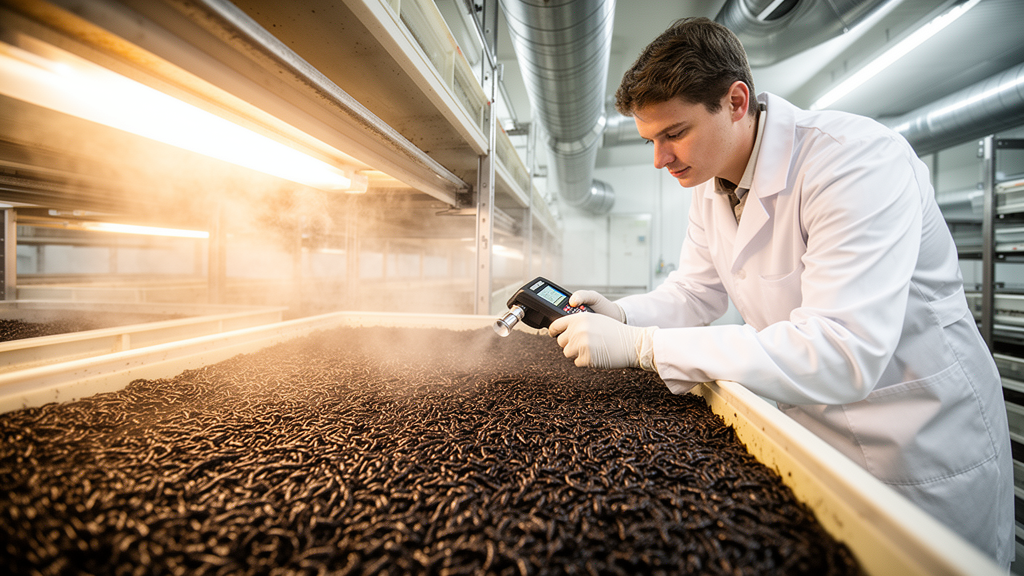
Black soldier fly larvae have become one of the most promising engines of the sustainable protein revolution. They devour organic waste streams with astonishing efficiency, converting food scraps and agricultural byproducts into protein-rich biomass that could one day replace conventional livestock feed. But a new study from South Korea has revealed an overlooked side effect of this green technology: the insect farms themselves are chemical factories, churning out a complex cocktail of volatile organic compounds that could shape everything from worker safety to the flavor of the final product.
Researchers at the National Institute of Animal Science and collaborating institutions set out to answer a deceptively simple question: what chemicals are actually floating in the air inside a black soldier fly rearing facility? The answer matters because insect farming is projected to expand dramatically as an alternative protein source, yet the volatile chemistry of these production systems has remained poorly characterized. Using thermal desorption coupled with gas chromatography–mass spectrometry, the team profiled the volatile emissions from rearing systems supplied with three different commercial animal feeds, tracking how the chemical atmosphere changed over a 15-day larval development period.
The experimental design was elegant in its precision. Four-day-old larvae were placed in rearing boxes containing dog, fish, or pig feed hydrated to 60 percent moisture, with each feed type maintained at 28 degrees Celsius under dark conditions. Crucially, the researchers ran parallel feed-only control boxes without larvae, allowing them to separate the chemical contribution of the larvae and their associated microorganisms from that of the substrate alone. Passive sorbent tubes were installed inside each container and retrieved every five days, capturing integrated snapshots of the volatile landscape at three consecutive stages of larval development.
The results were striking. The summed GC–MS peak area measured in rearing boxes containing larvae was 52-fold higher than that measured in boxes without larvae, suggesting that the detected volatile profile was closely associated with larval activity and their associated microorganisms rather than with microorganisms in the substrate alone. This finding challenges any assumption that the feed itself is the primary source of airborne chemicals in insect production facilities. Instead, the larvae and their gut microbiome appear to be the dominant chemical engines driving volatile formation.
Feed composition proved to be a powerful determinant of both larval growth and volatile chemistry. The fish feed was protein-rich at 44.78 percent protein, the dog feed was relatively lipid- and carbohydrate-rich, and the pig feed was predominantly carbohydrate-rich at 76.86 percent carbohydrates. By day 15, larvae reared on fish feed had achieved the highest mean dry weight at 52.47 milligrams, followed by those on dog feed at 40.93 milligrams and pig feed at 35.28 milligrams. This order corresponded directly to the initial protein contents of the feeds, suggesting that protein availability was a key driver of larval growth. The larvae consumed 64.91 grams of protein from the fish feed treatment over the 15-day period, compared to 40.69 grams from dog feed and 25.26 grams from pig feed.
The volatile profiles themselves shifted dramatically over time and varied among feed treatments. In the dog- and pig-feed treatments, the summed peak area was highest during the early rearing period and decreased rapidly thereafter. In contrast, the fish-feed treatment maintained high volatile signals until day 10 before declining. On day 5, compounds classified as carbohydrate-derived volatiles represented the largest class in all treatments, accounting for roughly 59 percent of the total signal in the dog and pig feeds and 42 percent in the fish feed. This pattern was consistent with the high carbohydrate contents of the feeds and may reflect the preferential utilization of readily degradable sugars during early rearing stages, since simple sugars can enter glycolysis directly while protein utilization requires slower proteolytic hydrolysis.
Among the carbohydrate-derived compounds, acetoin showed the highest relative abundance across all feed treatments. Following glycolysis, acetoin can be produced through the conversion of pyruvate to α-acetolactate and then to acetoin, and it can also be reversibly converted to 2,3-butanediol by acetoin reductase. The co-occurrence of acetoin and 2,3-butanediol in all three treatments was consistent with the involvement of glycolytic and fermentative pathways during early rearing, pathways that may involve both the larvae and their associated microorganisms. Protein-derived volatiles were most prominent in the fish-feed treatment, where they increased further by day 10 even as carbohydrate-derived signals declined, consistent with the slower pace of protein degradation relative to carbohydrate utilization.
Perhaps the most consequential finding relates to odor. The researchers identified 15 volatile compounds with reported odor characteristics, including methanethiol with its rotten cabbage and sewage notes, dimethyl disulfide with garlic-like and decaying fish odors, trimethylamine with its fishy smell, and indole with fecal and putrid characteristics at high concentrations. Thirteen odor-active compounds were tentatively identified in the fish-feed treatment compared with six in the pig-feed treatment, suggesting that the protein-rich substrate generated greater odorant diversity. Several odorants detected only in the fish-feed treatment, including dimethylamine, 3-methylbutanoic acid, and indole, can be formed through the biological degradation of amino acids and other nitrogen-containing compounds.
Remarkably, sulfur-containing odorants were detected in all treatments despite sulfur accounting for less than 1 percent of each feed by weight. These compounds produced strong chromatographic signals, likely reflecting the efficient microbial conversion of bioavailable sulfur-containing amino acids, particularly methionine, into low-molecular-weight volatiles such as methanethiol, dimethyl disulfide, and dimethyl trisulfide. Because various sulfur-containing volatiles have low odor detection thresholds and produce strong, unpleasant smells, their consistent formation may represent a substantial source of odor during insect rearing. Repeated or sustained exposure to these emissions could also impede indoor air quality in insect-rearing facilities and pose occupational health concerns depending on compound concentrations, exposure duration, and ventilation conditions.
From a food chemistry perspective, the findings carry implications for the sensory quality of insect-derived ingredients. Trimethylamine, acetic acid, and 3-methylbutanoic acid, all detected in the present rearing systems, have previously been identified by GC–olfactometry as key off-flavor compounds in black soldier fly larvae meal, contributing fishy, sour, and cheesy notes. The overlap between compounds detected in the rearing headspace and those previously reported in larvae meal provides relevant context, though the present measurements do not demonstrate transfer or retention of these compounds in harvested larvae. Post-harvest processing such as defatting and fermentation has been shown to reduce off-flavor intensity, but processing conditions must be carefully selected because they can also generate new volatile compounds. The researchers emphasize that paired characterization of volatiles in the rearing headspace, harvested biomass, and processed ingredients, together with olfactometric analysis, is needed to determine whether rearing-associated volatiles are retained or transformed during processing and whether they affect final product flavor.
Subject of Research: Volatile organic compound profiling during black soldier fly larvae protein production
Article Title: TD–GC–MS profiling of volatile organic compounds and potential odor relevance during insect protein production
Article References: Lee, D.-J., Kim, K. Y., Park, D., Oak, M.-H., Kim, P.-G., & Kim, J. Y. (2026). TD–GC–MS profiling of volatile organic compounds and potential odor relevance during insect protein production. Food Chemistry: X, 40, Article 104645. https://doi.org/10.1016/j.fochx.2026.104645
Image Credits: AI Generated
DOI: 10.1016/j.fochx.2026.104645
Keywords: black soldier fly larvae, volatile organic compounds, insect protein, odor compounds, sustainable protein, food chemistry, GC-MS, sulfur compounds, profiling, volatile, organic, compounds
News Source: Gavin Prescott. (October 17, 2026). Insect protein farms emit a surprising mix of odor compounds, study finds. Scienmag.