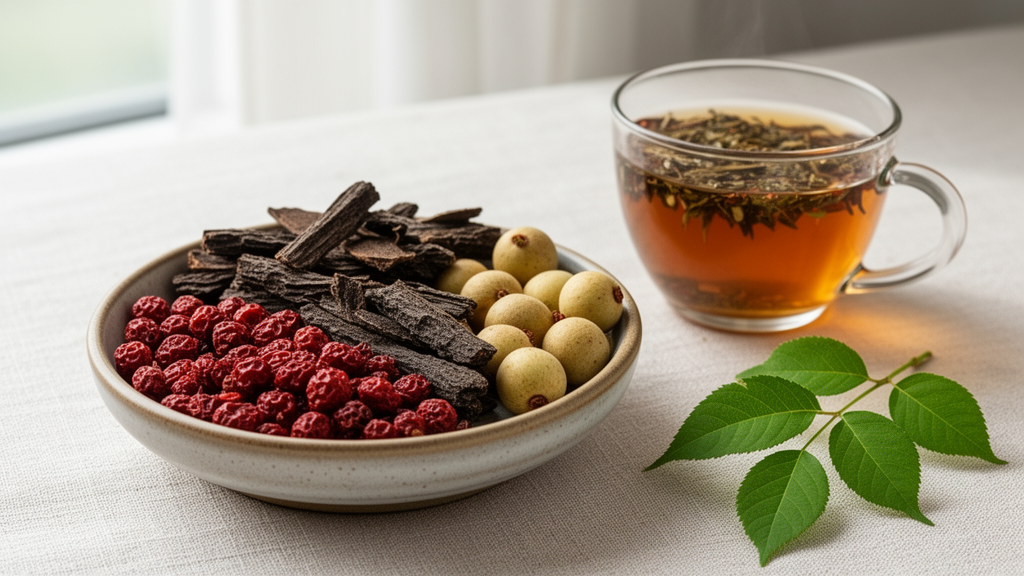
A carefully balanced trio of traditional medicinal herbs—Schisandra chinensis (magnolia vine fruit), Salvia miltiorrhiza (red sage), and hawthorn—may offer a new route to treating hyperlipidemia, the dangerous buildup of lipids in the blood that drives atherosclerosis, heart attack, and stroke. In a study published in Frontiers in Pharmacology, researchers showed that a standardized formulation of these three herbs lowered blood lipids, protected the liver, and calmed inflammatory signaling in animal models of the disease.
Hyperlipidemia is one of the most common metabolic disorders worldwide, and current first-line drugs such as statins, fibrates, and cholesterol-absorption inhibitors do not work for everyone and can cause side effects. Seeking alternatives, the team turned to herbs long used in traditional medicine. Schisandra chinensis is rich in lignans with documented liver-protective and anti-inflammatory actions. Salvia miltiorrhiza contains water-soluble phenolic acids such as salvianolic acid B alongside tanshinones, compounds shown to improve lipid profiles and protect blood vessels. Hawthorn contributes flavonoids and procyanidins linked to lowered cholesterol and better circulation.
To find the most effective blend, the researchers used a uniform design method, testing 32 different ratios of the three herbs. Each candidate formulation was evaluated in liver cells exposed to excess fatty acids, a laboratory model of lipid overload. The winning ratio—5 parts Schisandra, 3 parts Salvia, and 2 parts hawthorn—was then tested in mice fed a high-fat diet for eight weeks. Animals receiving the formulation showed significantly lower total cholesterol, triglycerides, and LDL cholesterol compared with untreated controls, while liver fat accumulation and liver enzyme levels also declined.
Delving into the mechanism, the team found that the formulation suppressed a key inflammatory pathway in liver tissue. Nuclear factor-kB (NF-kB), a protein complex that switches on genes driving inflammation, remained largely inactive in treated animals. Levels of inflammatory messengers such as tumor necrosis factor-alpha and interleukin-6 dropped in parallel. The researchers also observed reduced activity of acetyl-CoA carboxylase and other enzymes involved in fat synthesis, suggesting the herbs work through both anti-inflammatory and lipid-metabolism routes.
The study provides a scientific foundation for a formulation that has been used empirically for centuries, and the authors suggest it could be developed as a complementary therapy for patients whose hyperlipidemia is not fully controlled by conventional drugs. Further research, including clinical trials in humans, will be needed to confirm safety and efficacy before such a formulation reaches the clinic.
The experimental architecture behind the new findings reflects a deliberate two-tier strategy common in contemporary pharmacology research. By pairing a cell-based system with a whole-animal model, the investigators could first observe lipid-handling effects in a controlled setting and then verify whether those effects translate into systemic changes in living organisms. The HepG2 liver cell line, derived from human hepatocellular carcinoma tissue, is a widely accepted surrogate for studying hepatic lipid metabolism because these cells retain many of the enzymatic pathways that govern cholesterol and triglyceride synthesis, uptake, and export. When flooded with free fatty acids, HepG2 cells accumulate intracellular lipid droplets in a manner that mirrors the fatty change seen in liver tissue from patients and animals with dyslipidemia, making them a useful first screen for candidate lipid-lowering agents.
The choice of C57BL/6 mice for the in vivo arm is equally deliberate. This strain is notably susceptible to diet-induced obesity, hepatic steatosis, and the accompanying disturbances in plasma lipoproteins, which is why it has become the workhorse of nutritionally induced metabolic disease research. Eight weeks of high-fat feeding in these animals reliably produces the constellation of elevated total cholesterol, elevated triglycerides, and depressed high-density lipoprotein cholesterol that defines the human condition the researchers sought to model. The concordance between the cellular and animal results in this study—reduced lipid accumulation in both settings—strengthens the argument that the observed effects are not artifacts of a single experimental system.
Network pharmacology, the computational framework that guided the mechanistic arm of the investigation, represents a conceptual shift in how herbal medicines are studied. Rather than seeking a single active compound acting on a single molecular target, this approach acknowledges that multi-herb formulations exert their effects through constellations of constituents impinging on interconnected biological networks. By mapping the known chemical constituents of the three botanicals against disease-associated genes and proteins, the researchers identified seven molecular targets whose dysregulation appears central to hyperlipidemia: APOB, LDLR, OLR1, PPARG, PRKCA, RXRA, and NCF1. This target panel spans three functional clusters that together paint a coherent picture of how the formulation operates.
The first cluster concerns lipoprotein trafficking. Apolipoprotein B, encoded by APOB, is the structural protein scaffold of very-low-density and low-density lipoprotein particles, and its overproduction drives the delivery of cholesterol-rich particles into the arterial wall. The low-density lipoprotein receptor, encoded by LDLR, performs the opposite function, clearing LDL particles from the circulation by internalizing them into hepatocytes. The finding that the herbal formulation simultaneously suppressed APOB expression and enhanced LDLR expression suggests a coordinated dual action: less lipoprotein is assembled and secreted by the liver, while more is scavenged from the blood. This push-pull dynamic on lipoprotein metabolism is precisely the kind of balanced intervention that single-target drugs often struggle to achieve.
The second cluster links oxidative stress to inflammatory signaling. OLR1, the gene encoding the lectin-like oxidized low-density lipoprotein receptor-1, acts as a sentinel receptor on endothelial cells and macrophages that binds oxidized LDL particles and triggers inflammatory cascades. NCF1, a cytosolic subunit of the NADPH oxidase complex, is a principal generator of reactive oxygen species in phagocytic and vascular cells. PRKCA, the gene for protein kinase C alpha, sits upstream of both oxidative stress amplification and the activation of nuclear factor-kappa B, the transcription factor complex whose phosphorylation and nuclear translocation were directly monitored in this study. The demonstration that the formulation reduced reactive oxygen species production, dampened OLR1 and PRKCA protein levels, and prevented the phosphorylation and nuclear entry of the p65 subunit of NF-kappa B provides a mechanistic thread connecting lipid overload to the inflammatory consequences that make hyperlipidemia dangerous. Chronic activation of this axis is what transforms simple lipid accumulation into arterial wall damage, so interrupting it may confer benefits beyond lipid lowering alone.
The third cluster involves nuclear receptor biology. PPARG, the gene for peroxisome proliferator-activated receptor gamma, is a master transcriptional regulator of adipocyte differentiation, lipid storage, and insulin sensitivity, while RXRA, the retinoid X receptor alpha, serves as the obligatory heterodimerization partner for PPARG and several other nuclear receptors controlling lipid homeostasis. The observed downregulation of both genes in the treated animals suggests the formulation may modulate the transcriptional programs governing fat storage and lipid partitioning, though the precise functional consequences of this suppression in the context of hyperlipidemia remain an area for further dissection.
Methodologically, the study employed a battery of complementary readouts that lend confidence to the conclusions. Oil Red O staining, which selectively labels neutral lipids, provided direct visual and quantitative evidence of reduced hepatic fat deposition, while hematoxylin and eosin staining revealed improvements in liver architecture and diminished signs of cellular injury. Enzyme-linked immunosorbent assays quantified the drop in circulating tumor necrosis factor-alpha and interleukin-6, two cytokines whose elevation is a hallmark of the low-grade systemic inflammation that accompanies dyslipidemia and contributes to atherosclerotic progression. Quantitative reverse transcription polymerase chain reaction and Western blotting confirmed that the changes in target gene expression occurred at both the messenger RNA and protein levels, ruling out purely post-transcriptional artifacts. The dichlorofluorescein-based fluorescence assay for reactive oxygen species and the immunofluorescent tracking of p65 subcellular localization added functional validation to the molecular measurements.
It is worth noting that the formulation was prepared as a water-based decoction, the traditional method of herbal preparation in Chinese medicine, involving sequential reflux extractions of powdered plant material. This approach captures the water-soluble constituents of each herb, including the phenolic acids of Salvia miltiorrhiza and the polar fractions of hawthorn flavonoids, though it may leave behind some lipophilic compounds such as tanshinones that require organic solvents for efficient extraction. The pharmacological profile of the final preparation therefore reflects the collective activity of the water-extractable fraction, and future work may explore whether standardized enrichment of specific constituent classes enhances potency further.
The uniform design methodology used to optimize the three-herb ratio deserves mention as an efficient alternative to full factorial experimentation. By sampling a structured subset of the possible proportion combinations across seven dosage levels for each herb, the researchers could identify an optimal blend with a fraction of the experimental burden that exhaustive testing would require. This statistical approach, originally developed for industrial process optimization, has found increasing application in traditional medicine research where multi-herb formulations present combinatorial challenges that conventional dose-finding designs handle poorly.
Several caveats temper the enthusiasm warranted by these results. The mechanistic targets were identified through computational prediction and validated at the expression level, but direct binding studies demonstrating that specific constituents of the formulation engage these molecular targets remain to be performed. The duration of treatment in the animal model, while sufficient to establish efficacy, does not address the long-term safety profile that any therapeutic candidate must demonstrate. Furthermore, the metabolic context of laboratory mice differs from human hyperlipidemia in important respects, including lipoprotein metabolism and gut microbiome composition, both of which can profoundly influence herbal pharmacology. Clinical translation will require carefully designed human trials with standardized preparations, defined dosing, and rigorous monitoring of both lipid outcomes and adverse events. Nevertheless, the convergence of lipid-lowering, anti-inflammatory, and antioxidant effects observed across multiple experimental readouts positions this three-herb formulation as a scientifically grounded candidate worthy of continued investigation.
Subject of Research: The Schisandra-Salvia-Hawthorn herbal formulation demonstrates therapeutic efficacy in ameliorating hyperlipidemia
Article Title: The Schisandra-Salvia-Hawthorn herbal formulation demonstrates therapeutic efficacy in ameliorating hyperlipidemia
Article References: Xing, N., Qu, H., Jiang, Y., Ge, P., & Ma, W. (2026). The Schisandra-Salvia-Hawthorn herbal formulation demonstrates therapeutic efficacy in ameliorating hyperlipidemia. Frontiers in Pharmacology, 17, Article 1893568. https://doi.org/10.3389/fphar.2026.1893568
Image Credits: AI Generated
DOI: 10.3389/fphar.2026.1893568
Keywords: Schisandra chinensis, Salvia miltiorrhiza, hawthorn, hyperlipidemia, herbal formulation, NF-kB, inflammation, lipid metabolism, Schisandra-Salvia-Hawthorn, herbal, formulation, demonstrates
News Source: Ophelia Keating. (October 17, 2026). The Schisandra-Salvia-Hawthorn herbal formulation demonstrates therapeutic efficacy in ameliorating hyperlipidemia. Scienmag.