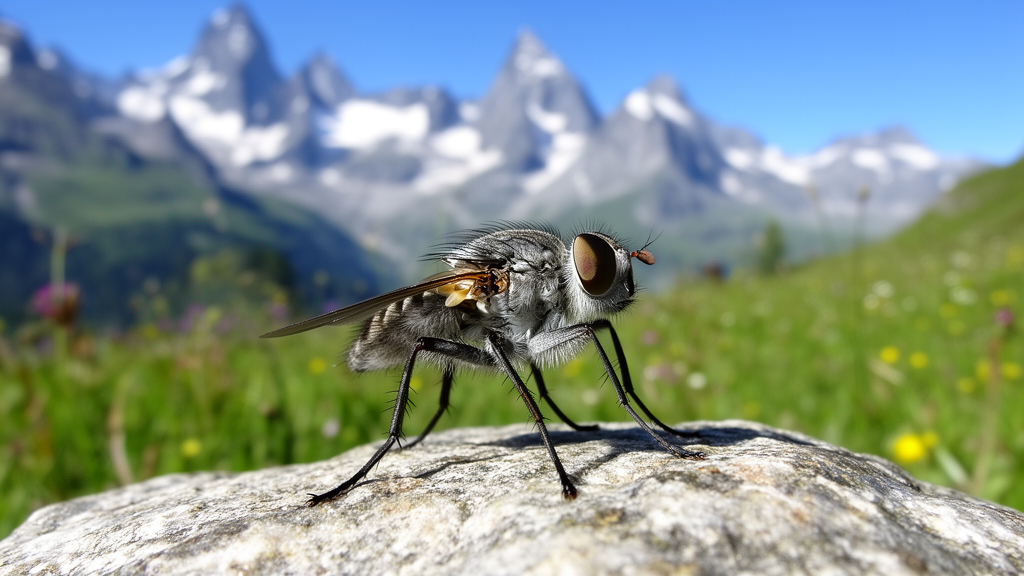
In the sun-baked pine and oak forests of the Swiss Alps, a predatory fly that had eluded entomologists for nearly four decades has finally reappeared. Choerades mouchai, a robber fly described in 1985 from the Carpathian Mountains and never recorded again in the scientific literature, has now been found at three localities in Switzerland. The discovery, published in the journal Alpine Entomology, extends the species’ known range hundreds of kilometres westward and provides the first detailed modern description of an insect so poorly characterized that it never made it into any European identification key.
Robber flies, the family Asilidae, comprise roughly 600 species in Europe and rank among the most formidable aerial predators of the insect world. Adults ambush other insects in flight, impaling them with a stout, bristly proboscis and injecting paralyzing saliva before draining their prey. The genus Choerades belongs to the subfamily Laphriinae and is represented by at least ten species in central Europe. Its larvae are equally specialized: they develop inside the wood of old trees, where they hunt the larvae of saproxylic insects, those dependent on dead or decaying timber. Some Choerades species develop in deciduous trees such as elm, beech and oak, while others, including the well-known Ch. marginata, Ch. gilva and Ch. ignea, develop in conifers such as pine and spruce.
The original description of Ch. mouchai rested on male specimens collected more than 60 years ago in Slovakia, in the north-western Carpathians, and Romania, in the south-eastern Carpathians. After 1985, no published records of the species followed. Part of the problem, the authors of the new study explain, lies in the brevity and ambiguity of Milan Hradský’s original description and its accompanying figures, which were insufficient to confirm identifications. Combined with the species’ omission from every key dealing with the European fauna, this obscurity effectively rendered Ch. mouchai invisible to field entomologists, even those actively surveying asilid flies.
The rediscovery unfolded in stages across the Swiss Alps. During surveys of selected fly families in the central Alps, G. Pétremand collected an unfamiliar male Choerades in a dry forest of Scots pine, Pinus sylvestris, mixed with pubescent oak, Quercus pubescens. The specimen was first identified as Ch. femorata, a common and morphologically similar species, but its highly distinctive terminalia prompted a deeper search of the literature and consultation with specialist expertise. That inquiry led J. Bosák to uncover a second Swiss male, collected in 2011 in the eastern Alps by M. Kadlecová and traced through an insect exchange in Prague. A third male then surfaced in the private collection of Christian Monnerat in Neuchâtel, among material gathered by an interception trap set up for saproxylic beetles within an old beech slope forest in the central Alps.
Because Hradský’s description only partially matched the Swiss males, the researchers compared them directly with the holotype and paratypes held in Hradský’s collection, and photographs of a paratype from the Carpathian Mountains were taken at the museum in Prague. The match was confirmed, and the new paper presents an illustrated redescription of the male, accompanied by photographs of diagnostic features including the terminalia and images of the entire insect. Ch. mouchai proves to be a black, white and golden-haired species measuring 12 to 14 millimetres, with black antennae whose first segment is about three times longer than the second, a mystax of long black hairs mixed with shorter white bristles, and a shiny black abdomen covered with dense golden hairs.
The most decisive characters lie in the male terminalia, the structures entomologists rely on most heavily for species-level identification in this group. In Ch. mouchai, the gonopod is black at the base and brown to yellow towards the tip, the epandrium is almost entirely black and terminates in two or three prominent black hairs curved at the tip, and the black pointed projection ending the hypopygium is covered only in yellowish-white hairs. The mesoscutum, the dorsal plate of the thorax, bears three longitudinal stripes of dusting connected at its posterior margin, a feature that separates it at a glance from the uniformly bright mesoscutum of both Ch. marginata and Ch. femorata, though the authors caution that this striping can become invisible in specimens preserved in alcohol.
To prevent future misidentifications, the study includes a table of morphological differences between the males of Ch. mouchai, Ch. femorata and Ch. marginata, three species that could easily be confused with one another. The distinctions span the coloration of coarse hairs on the face, the relative lengths of the first and second antennal segments, the hair colour on the abdominal tergites, the pilosity on the hind femur, and the hair colour on the posterior anepisternum. In Ch. mouchai, some hairs on the ventral and dorsal surfaces of the hind femur are almost as long as the femur’s maximum depth, whereas in the two similar species they reach at most half that length. The closely related Ch. castellanii, whose last tergite is bifid posteriorly, was excluded from the comparison because its unique character makes it readily separable.
The ecological picture emerging from the Swiss records is as intriguing as the taxonomic one. In the Carpathians, Hradský reported the species from Pinus mugo forest. The new Alpine records extend its known habitats to dry Scots pine forest mixed with pubescent oak, belonging to the Ononido-pinion association, and to old, dry beech slope forest. One male was found sitting on a dead oak log lying on the forest floor. It remains unknown whether the larva of Ch. mouchai develops in conifers such as pine or in deciduous trees such as oak and beech, but the species appears to favour thermophilic, old-growth forest situations where both coniferous and deciduous trees coexist, a habitat type that has become scarce across much of Europe.
The rediscovery also reshapes the known Choerades fauna of the Alps. Weinberg and Bächli listed eight species for Switzerland in 1995, including the taxonomically problematic Ch. dioctriaeformis and Ch. fulva. The frequently encountered Ch. femorata, long confused with Ch. marginata and omitted from that earlier list, must now be added, and with Ch. mouchai the Alpine Choerades fauna stands at ten species. Two further species recently found in Germany, Ch. castellanii and Ch. amurensis, can reasonably be expected to occur in the Alps as well.
Only nine specimens of Ch. mouchai are currently known worldwide, from Romania, Slovakia and now Switzerland, making it one of the rarest robber flies in European collections. Curiously, no evidence of the species has emerged from the countries lying between the Carpathians and the Alps, such as the Czech Republic and Austria, despite their intensively studied asilid faunas, leaving a puzzling gap in the species’ apparent distribution. The authors hope that the detailed redescription will prompt entomologists to re-examine existing collections for overlooked material, clarify the species’ ecology and distribution, and ultimately enable the long-awaited development of a key to the Choerades species of central Europe. A precise diagnosis of the male also raises the prospect of recognizing the still-unknown female, whose description would mark the next milestone in the story of this once-lost Alpine predator.
Subject of Research: Taxonomy and biodiversity of Alpine insects
Article Title: The enigmatic robber fly Choerades mouchai Hradský, 1985 redescribed and recorded from the Alps ( Diptera , Asilidae )
Article References: Pétremand, G., & Bosák, J. (2024). The enigmatic robber fly Choerades mouchai Hradský, 1985 redescribed and recorded from the Alps (Diptera, Asilidae). Alpine Entomology, 8, 81-86. https://doi.org/10.3897/alpento.8.117862
Image Credits: AI Generated
Keywords: enigmatic, robber, Choerades, mouchai, Hradsk, redescribed, recorded, Alps, Diptera, Asilidae, scientific research
News Source: Gavin Prescott. (October 17, 2026). Enigmatic robber fly lost for decades rediscovered in the Swiss Alps. Scienmag.