Deep inside a cave near Liangshan Temple in Shanggao County, Jiangxi Province, China, a small brownish fish with irregular black speckles has just rewritten part of the evolutionary history of southern Chinese freshwater life. The animal, formally described as Oreonectes weii sp. nov. in the journal Zoosystematics and Evolution, is the first species of its genus ever recorded from the Yangtze River Basin, a drainage that until now lay entirely outside the known range of these tiny karst-dwelling loaches. Its discovery, announced by a research team led by Tao Luo of Jiangxi Agricultural University, is more than a routine taxonomic addition. Behind this single new species stands a sweeping biogeographic story in which the rise of the East Asian monsoon, intensified erosion, and the slow uplift of mountains conspired to carry ancestral fish populations across watersheds and then strand them in isolation long enough to become new species.
The genus Oreonectes, established in 1868 from a specimen collected in Hong Kong, belongs to the family Nemacheilidae, a group of small bottom-dwelling fishes often called stone loaches. For nearly two centuries its members were known almost exclusively from the Pearl River Basin of southern China, including Guangdong, Guangxi and Hong Kong, and from northern Vietnam. Eight of the thirteen previously recognized species were described within just the past three years, a clear signal that the true diversity of the genus has been substantially underestimated. The new find from western Jiangxi, made during a biodiversity survey in October and November 2025 in Yichun and Xinyu cities, pushes the recognized species count to fourteen and dramatically expands the genus’ geographic footprint northward into the Yangtze system.
Morphologically, the new loach is a masterclass in subtle diagnostic characters. The team measured 34 morphological traits on ten adult specimens, converting each measurement into a ratio relative to standard length and applying logarithmic transformation to correct for allometric growth, the distortion that arises when body parts scale disproportionately with body size. A one-way analysis of variance revealed significant differences from its closest relatives, O. guidongensis and O. polystigmus, across 15 morphometric characters, concentrated in features of the head, eye and fin rays. Principal component analysis then separated the new species from O. polystigmus along the second principal component, driven largely by upper jaw length, lower jaw length, eye diameter, pectoral-fin length and the distance between pectoral and anal fins. A canonical discriminant analysis achieved complete separation of all three species, with every specimen correctly assigned, a statistical confirmation that the cave fish from Shanggao County is something genuinely distinct.
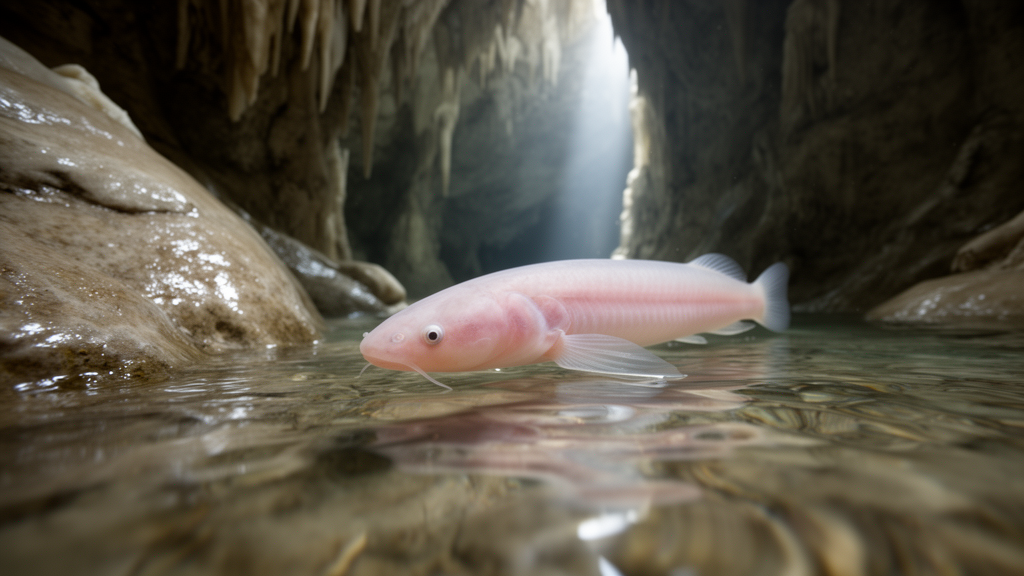
The diagnosis relies on a combination of meristic and morphological characters rather than any single feature. Oreonectes weii carries irregular black spots on its lateral body surface and caudal fin, has normal eyes rather than the degenerated eyes seen in some cave-adapted congeners, and possesses a well-developed posterior chamber of the air bladder. Its cephalic lateral-line system shows 4 + 10 infraorbital canal pores and six preoperculo-mandibular canal pores, counts that differ from every congener. It has 9 to 10 branched pectoral-fin rays, a truncated caudal fin with 14 bran rays, 10 inner gill rakers on the first gill arch, and 10 to 12 lateral-line pores. Compared with its sister species O. polystigmus, the new species has longer pectoral fins, a longer trunk, more lateral-line pores, and pelvic-fin tips that fall short of the anus. In life the fish is light yellowish-brown with conspicuous speckles above the lateral line, a dark brown stripe running from the eye to the outer rostral barbel, and a golden iris that does not form a continuous ring around the black pupil.
Genetic evidence clinched the species’ independence. The team sequenced the mitochondrial cytochrome b gene, a 1,140-base-pair matrix containing 409 variable sites and 333 parsimony-informative sites, and reconstructed phylogenies using both maximum likelihood and Bayesian inference. The new specimens formed an independent evolutionary lineage clustering with O. guidongensis, an undescribed Oreonectes from Guilin, and O. polystigmus, sitting as sister to O. polystigmus with moderate support. A tree-based species delimitation method called the Multi-rate Poisson Tree Processor, which models branching rates across a phylogeny to identify independently evolving lineages, supported the new species as distinct. Its uncorrected p-distance from congeners ranged from 5.8 to 10.0 percent, exceeding the divergence observed between some currently recognized species pairs, such as the 4.9 percent between O. guananensis and O. luochengensis. The 6.3 percent distance from O. polystigmus alone would justify species status under most modern standards.
The specific epithet weii honors Academician Fu-Wen Wei, one of China’s most distinguished conservation biologists, recognized for his pioneering contributions to biodiversity research and conservation. The team suggests the English common name Wei’s Mountain Loach. All type specimens, including the holotype collected on November 25, 2025, are deposited at the Jiangxi Provincial Key Laboratory of Conservation Biology at Jiangxi Agricultural University in Nanchang. So far the species is known only from its type locality and from Dong Village in Fenyi County, both tributaries of the Ganjiang River within the Yangtze Basin. It inhabits natural caves and has never been found in open rivers outside them, and numerous juveniles at the type locality suggest a relatively large population there, though only a single specimen from the second site hints at a potentially vulnerable status.
What elevates this description from routine taxonomy to evolutionary drama is the molecular clock analysis. Because no fossils exist for the group, the team calibrated divergence times using three points from a recent phylogenomic study, including a root age of roughly 28.78 million years and the divergence between Oreonectes and its closest genera at 27.21 million years. Running a Bayesian molecular dating analysis in BEAST, they estimated that Oreonectes originated in the Late Oligocene around 27.06 million years ago, with the most recent common ancestor of extant species appearing around 13.91 million years ago. Strikingly, the new species’ own divergence, at about 6.78 million years ago during the Late Miocene, predates that of several currently recognized congeners, meaning this Yangtze pioneer is evolutionarily older than some of its Pearl River cousins.
Biogeographic reconstruction using the BioGeoBEARS framework, which models dispersal, extinction and cladogenesis across a phylogeny, identified the DEC+J model as the best fit, a model that explicitly incorporates founder-event speciation, the process by which a small population crosses a barrier and founds a new lineage. The results point to the Guijiang-Hejiang River Basin as the likely source area for the genus’ dispersal into adjacent drainages. Around 6.78 million years ago, an ancestral population apparently made a long-distance jump from the Pearl River system northward into the Ganjiang tributary of the Yangtze, where isolation and speciation gave rise to the new species. The team proposes two possible routes: one crossing the Xiangjiang River and its continuous karst landscape into the Ganjiang, the other winding through the Xijiang, Beijiang and Dongjiang drainages. Phylogenetic relationships favor the first pathway, since the new species is not closest to downstream Pearl River congeners such as O. platycephalus and O. yuedongensis.
The timing of these events dovetails with paleoclimate history in a way the authors find compelling. Lineage-divergence dynamics, quantified through a metric called maximal number of divergence events per million years, show cladogenesis beginning around 28 million years ago, accelerating markedly at roughly 18 million years, peaking at about 6 million years, and then declining gradually. This curve broadly coincides with periods of intensified Asian monsoons, including the so-called super-monsoon interval from roughly 12 to 4 million years ago, though it postdates the main phase of rapid Qinghai-Xizang Plateau uplift between 25 and 15 million years ago. Geological evidence indicates the Pearl River system itself was established in the Late Oligocene and attained its modern configuration during the Miocene, a framework that aligns neatly with both the origin of Oreonectes and its diversification peak. Similar monsoon-driven diversification has been documented in other nemacheilid loaches, East Asian cyprinids and Asian warty newts, suggesting a region-wide evolutionary pulse.
The authors propose a two-stage mechanism. Enhanced monsoonal precipitation intensified surface erosion, which may have facilitated the initial dispersal of ancestral Oreonectes populations from the Guijiang-Hejiang River Basin across watershed boundaries. Subsequent erosional fragmentation of habitats then promoted geographic isolation, accelerating speciation within the genus. Meanwhile, the uplifted Nanling Mountains, which rose by roughly 300 to 2000 meters through multiple uplift events, likely acted as a natural barrier isolating lineages between the Pearl and Yangtze basins, a pattern mirrored in other low-dispersal taxa such as Chinese ranid frogs, whose southern and northern lineages diverged around 6.97 million years ago. In this view, the diversification of Oreonectes is indirectly driven by the orogenic history of the Qinghai-Xizang Plateau, transmitted through monsoon-mediated ecological and geomorphological processes. The discovery also carries a conservation warning: the cave habitat faces frequent anthropogenic disturbance, and seasonal reductions in water volume during winter may threaten populations already confined to a handful of subterranean sites. The authors call for phylogenomic approaches and expanded sampling to clarify the genus’ evolutionary history, population dynamics and genetic diversity, work that would ultimately support the conservation of these remarkable freshwater fishes.
Subject of Research: A new endemic species Oreonectes weii sp. nov. (Cypriniformes, Nemacheilidae) within the Yangtze River Basin and its monsoon-driven evolutionary diversification
Article Title: A new endemic species Oreonectes weii sp. nov. ( Cypriniformes , Nemacheilidae ) within the Yangtze River Basin and its monsoon-driven evolutionary diversification
Article References: Luo, T., Ling, W.-Q., Cao, H.-L., Zhou, J., & Huang, G.-P. (2026). A new endemic species Oreonectes weii sp. nov. (Cypriniformes, Nemacheilidae) within the Yangtze River Basin and its monsoon-driven evolutionary diversification. Zoosystematics and Evolution, 102(3), 751-765. https://doi.org/10.3897/zse.102.186155
Image Credits: AI Generated
Keywords: endemic, species, Oreonectes, weii, Cypriniformes, Nemacheilidae, within, Yangtze, River, Basin, monsoon-driven, evolutionary
News Source: Gavin Prescott. (October 17, 2026). New cave loach species reveals how Asian monsoons sculpted freshwater life. Scienmag.