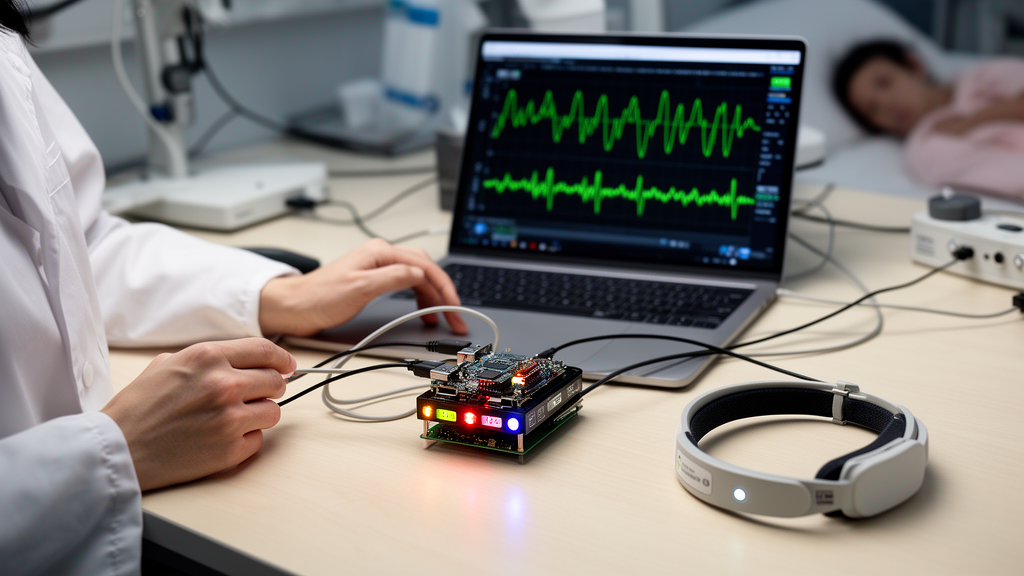
Sleep apnea is one of the most underdiagnosed disorders in modern medicine, a condition in which breathing repeatedly stops and restarts during the night, straining the heart and brain while the sleeper remains oblivious. Left undetected, it raises the risk of hypertension, arrhythmia, stroke, and daytime accidents, yet millions of people never receive a diagnosis because the gold-standard test, overnight polysomnography in a sleep laboratory, is expensive, uncomfortable, and often unavailable. Now a team of researchers in India has reported a framework that could bring apnea screening out of the clinic and onto a tiny computer the size of a credit card, running entirely at the bedside with no cloud connection required.
The study, published in Neural Computing and Applications by Mohebbanaaz and Pasuluri Binduswetha of Ravindra College of Engineering for Women in Kurnool and Srilaxmi Dasari of VNR Vignana Jyothi Institute of Engineering and Technology in Hyderabad, describes a Deep Bidirectional Long Short-Term Memory framework, or DeepBiLSTM, that detects sleep apnea from a single-lead electrocardiogram. The work is notable not only for its reported accuracy but for where the trained model ultimately runs: an NVIDIA Jetson Nano, a low-power edge computing board designed for embedded artificial intelligence. The researchers evaluated the deployment quantitatively, measuring inference latency, memory usage, and power consumption to demonstrate that the framework is feasible for real-time applications rather than remaining a laboratory curiosity.
The technical formulation is a window-based multi-class classification problem. Rather than asking a binary question, apnea or no apnea, the model categorizes fixed-length segments of ECG signal into three classes: Wake, Obstructive Apnea, and Central Apnea. The distinction matters clinically. Obstructive apnea occurs when the airway physically collapses despite ongoing respiratory effort, while central apnea arises when the brain simply fails to send the signals that drive breathing. Both produce characteristic signatures in the ECG, because each apnea event perturbs the heart rate through autonomic reflexes, but they differ in timing and pattern, and a classifier that can separate them offers richer diagnostic information than one that cannot.
To train and test the framework, the team drew on the MIT-BIH Polysomnographic Database, a widely used public collection of overnight recordings in which ECG signals are paired with expert annotations of sleep stages and respiratory events. The recordings were segmented into fixed-length windows, and each window was labeled according to the annotation intervals it overlapped. Crucially, the researchers employed a record-wise data split strategy, ensuring that data from each subject appears exclusively in either the training set or the testing set, never both. This detail is more important than it may sound. Many machine learning studies in this field shuffle segments from the same patient into both sets, which allows the model to memorize individual cardiac fingerprints rather than learn generalizable apnea patterns, inflating reported accuracy. By enforcing subject-level separation, the evaluation avoids this bias and provides a more honest estimate of how the model would perform on a stranger.
The architecture itself combines two complementary ideas. The first is a wavelet-sequence preprocessing layer based on the discrete wavelet transform, or DWT. Wavelet transforms decompose a signal into components that capture both frequency content and the time at which that content occurs, a technique well suited to ECG because apnea events manifest as transient changes in heart rate dynamics rather than stationary rhythms. The second is the bidirectional LSTM network. Long Short-Term Memory units are recurrent neurons designed to remember information across long sequences, solving the vanishing gradient problem that plagued earlier recurrent networks. The bidirectional variant processes the sequence in both forward and reverse directions, so at every time step the model has access to context from both the past and the future of the signal. Stacking these layers into a deep framework allows the model to capture bidirectional temporal dependencies that a unidirectional network would miss, such as the recovery pattern that follows an apnea event and the autonomic buildup that precedes it.
Under these controlled evaluation settings, the proposed model achieved an overall accuracy of 98.51 percent, which the authors describe as competitive performance compared to existing methods. The comparison context is a crowded field. Prior approaches to single-lead ECG apnea detection have spanned modified convolutional networks such as a LeNet-5 variant with automatic feature extraction, deep neural networks paired with hidden Markov models, multiscale networks operating on RR intervals, CNN-transformer hybrids, deep belief networks, and algorithms built on smoothed Gabor spectrograms or singular spectrum analysis. Many of these achieve strong results on the same database, but few have been examined through the lens of edge deployment, which is where the present study differentiates itself. Accuracy alone does not make a screening tool; the model must also fit within the memory, latency, and power envelope of a device that a patient can actually own.
That device is the NVIDIA Jetson Nano, an edge platform built around a quad-core ARM processor and a 128-core GPU, designed to run neural networks locally on embedded hardware. Deploying the trained DeepBiLSTM on this board required the researchers to confront the practical constraints of edge inference. The quantitative metrics they report, including inference latency, memory usage, and power consumption, address the three questions that determine whether a bedside monitor is viable: how quickly the model can classify each incoming window of ECG, how much of the board’s limited memory the framework occupies, and how much energy it draws. The results indicate that the proposed framework provides an effective and practical solution for automated sleep apnea detection using ECG signals, and the deployment demonstrates feasibility for real-time applications.
The implications extend beyond sleep medicine. The same research group has previously applied deep learning frameworks to cardiac arrhythmia detection, seizure detection in EEG signals using conditional generative adversarial networks, and lightweight CNN-LSTM models for diabetic retinopathy on edge platforms, building a body of work unified by a common theme: pushing sophisticated neural architectures onto inexpensive, low-power hardware. The pattern suggests a broader shift in biomedical engineering, in which the question is no longer only whether a model can detect a disease but whether it can do so on a device that costs a few hundred dollars, plugs into a wall, and never sends a patient’s data to a remote server. For conditions like sleep apnea, where diagnosis depends on observing the body over an entire night in a natural setting, that shift could be decisive.
There are, of course, caveats. The 98.51 percent figure was obtained under controlled evaluation settings on a specific public database, and performance on diverse populations, different ECG hardware, and noisy home environments remains to be established through clinical validation. The framework classifies ECG segments rather than measuring airflow directly, so it infers apnea from the heart’s response to disrupted breathing rather than observing the disruption itself. Real-world screening tools would need to handle motion artifacts, electrode detachment, and the variability of individual cardiac physiology across age and health status. Nevertheless, the study demonstrates that the full pipeline, from wavelet preprocessing through bidirectional temporal modeling to embedded inference, can run on hardware small enough to sit on a nightstand. If subsequent validation confirms the edge metrics in clinical settings, the work points toward a future in which apnea screening happens quietly at home, one ECG window at a time, with the diagnosis arriving before the disorder has done its damage.
Subject of Research: Employing novel DeepBiLSTM framework on NVIDIA Jetson Nano edge platform for sleep apnea detection
Article Title: Employing novel DeepBiLSTM framework on NVIDIA Jetson Nano edge platform for sleep apnea detection
Article References: Mohebbanaaz, Dasari, S., & Binduswetha, P. (2026). Employing novel DeepBiLSTM framework on NVIDIA Jetson Nano edge platform for sleep apnea detection. Neural Computing and Applications, 38(20), Article 814. https://doi.org/10.1007/s00521-026-12604-z
Image Credits: AI Generated
DOI: 10.1007/s00521-026-12604-z
Keywords: Employing, novel, DeepBiLSTM, framework, NVIDIA, Jetson, Nano, edge, platform, sleep, apnea, detection
News Source: Ophelia Keating. (October 17, 2026). DeepBiLSTM model spots sleep apnea on Jetson Nano edge device. Scienmag.