Hidden on the submerged, decaying wood of streams and ponds in two of China’s most intensively forested provinces lies a fungal world that scientists have barely begun to catalogue. A new survey of freshwater habitats in Jiangxi and Zhejiang provinces has now delivered one of the largest single additions to the region’s aquatic mycological record: thirteen lignicolous freshwater fungi, of which ten are new to science, two are new records for the region, and one is a new collection from an unexpected habitat. The findings, published in IMA Fungus, combine classical microscopy with six-gene phylogenetics to redraw parts of the fungal tree of life and to argue that East China deserves recognition as a genuine hotspot of freshwater fungal biodiversity.
Freshwater fungi occupy a peculiar ecological niche. Defined broadly as fungi that rely on freshwater for all or part of their life cycle, or that exploit aquatic or semi-aquatic substrata, they are the principal engines of decomposition in streams, lakes, ponds and even artificial water bodies such as reservoirs and drainage ditches. Their most celebrated role is the breakdown of lignocellulose in woody litter: by degrading cellulose, hemicellulose and lignin, they soften submerged wood, release bioavailable nutrients, and make the substrate more palatable to detritus-feeding invertebrates. Many aquatic hyphomycetes have evolved strikingly shaped spores that aid dispersal and adherence in flowing water, a morphological signature of their adaptation to life between land and water. Molecular studies suggest most of these aquatic lineages descend from terrestrial ancestors, making freshwater fungi a mosaic of ancient endemics and more recent immigrants.
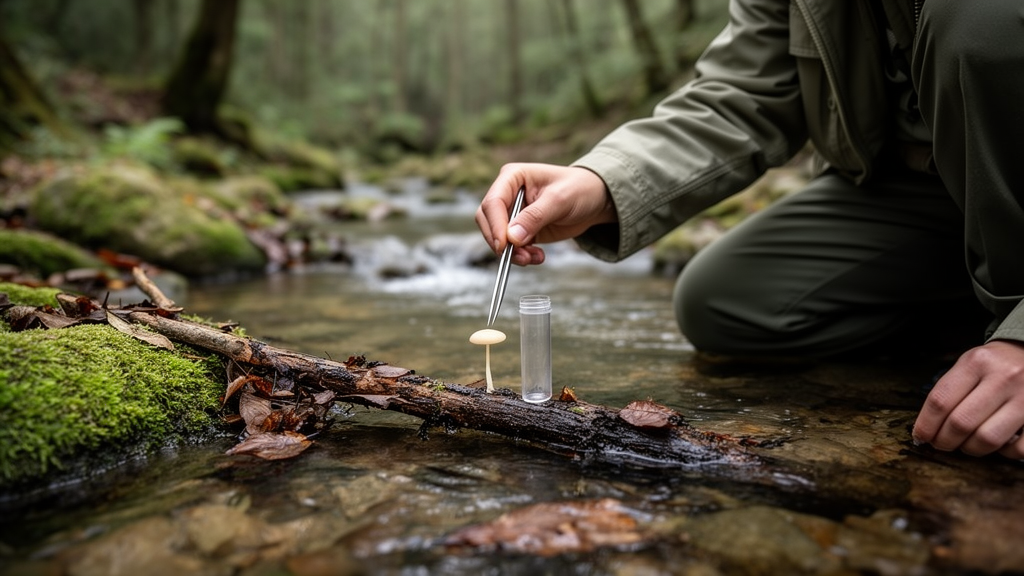
Taxonomically, freshwater fungi span thirteen phyla, but the class Dothideomycetes and the class Sordariomycetes within the Ascomycota dominate the literature, and it is precisely these groups that the new study targets. The research team collected submerged decaying wood from freshwater sites across Jiangxi and Zhejiang between 2023 and 2025, recording precise locality data before transporting samples to the laboratory. There, colonies growing on the wood surface were examined under stereomicroscopes, and microscopic structures such as conidia, conidiogenous cells, conidiophores and asci were photographed with compound microscopes. Pure cultures were established through single-spore isolation, with two independent isolates obtained per specimen to guard against contamination and to confirm conspecificity.
The molecular backbone of the study is a multi-locus approach. Genomic DNA was extracted from fresh mycelium using a modified CTAB protocol optimized to remove secondary metabolites, and six genetic markers were amplified and sequenced: the internal transcribed spacer (ITS), the large and small nuclear ribosomal subunits (LSU and SSU), translation elongation factor 1-alpha (TEF1-α), beta-tubulin 2 (TUB2), and RNA polymerase II subunit 2 (RPB2). Alignments were concatenated and refined, then analysed under both maximum likelihood, using RAxML with 1,000 bootstrap replicates, and Bayesian inference, using MrBayes with Markov chain Monte Carlo runs of two million generations. Only nodes supported by bootstrap values of at least 70 percent or Bayesian posterior probabilities of at least 0.90 were considered robust, and every new species was placed within an updated genus-level phylogeny.
Among the standout discoveries are two new species found on the same submerged lotus stem in Jiangxi. Dendryphiella loti, named for its host Nelumbo nucifera, is only the second species of its genus ever reported from an aquatic habitat. It is distinguished by conidiophores swollen at the nodes and smooth-walled, one- to three-septate conidia bearing thickened, darkened scars, features that separate it from relatives whose conidia carry a warty surface texture. Sharing the same lotus stem, Neodendryphiella loti represents an even more significant first: no species of Neodendryphiella had previously been recorded from any aquatic environment. The new fungus differs from its closest relative, N. michoacanensis, by smaller conidiogenous cells and conidia that are smooth-walled with dense central contents rather than verrucose.
The Sordariomycetes yielded equally notable finds. Hilberina jiangxiensis, collected from submerged wood near Nanchang, is the first valid record of the genus Hilberina from an aquatic habitat; an earlier report from Lake Dianchi in Yunnan lacked descriptions and molecular data. The new species is set apart by fusiform ascospores with distinct granules, in contrast to the oval, smaller spores of its sister species H. hongheensis, from which it also diverges by 3.6 percent in LSU sequence. Further new species include Sporidesmiella saprophytica, Wongia lignicola and Wongia saprophytica, Paracremonium jiangxiense, Pleurothecium saprophyticum, Rhamphoriopsis jiangxiensis and Distoseptispora quzhouensis, each diagnosed through a combination of spore and conidiophore morphology and statistically supported phylogenetic separation from named relatives.
Perhaps the most consequential part of the work concerns the genus Distoseptispora, a group of dark-spored, distoseptate fungi that has exploded from nothing to 117 accepted species in just a decade. That rapid growth has produced considerable ambiguity in species boundaries, with many new taxa proposed on the basis of spore size alone. The new study updates the genus-wide phylogeny to include all known species and proposes four synonymies. Distoseptispora longispora and D. zhejiangensis are merged into D. aquatica, and D. nabanheensis into D. clematidis, while D. thailandica falls within D. phangngaensis and five further names, including D. submersa and D. sinensis, are subsumed into D. tectonae. In several cases the merged species differ by less than one percent across sequenced loci, and the authors note that conidial size alone is an unreliable criterion at species level, since isolates of the same species from different habitats or seasons can vary dramatically in spore dimensions.
The survey also documented range extensions that matter for biogeography. Distoseptispora dinghuensis, previously known only from a terrestrial collection in Guangdong, was recovered from submerged wood in Jiangxi with identical ITS, LSU and TEF1-α sequences to the type strain. Sporidesmiella xishuangbannaensis, first described from Yunnan, turned up on rotting Phragmites stems in Jiangxi, and Xylolentia oblongispora, originally described from terrestrial wood in Guizhou, was found on submerged wood with 100 percent sequence similarity, though the aquatic collection showed slightly different conidial shapes that the authors attribute to morphological plasticity under different habitat conditions.
Behind these individual discoveries lies a stark geographic imbalance. China’s freshwater fungal research has concentrated overwhelmingly on Yunnan Province, which boasts 2,136 recorded fungal species, whereas Jiangxi and Zhejiang have mustered only 169 and 141 respectively, and most of those were isolated from terrestrial habitats. The new study records six genera, Dendryphiella, Hilberina, Neodendryphiella, Paracremonium, Rhamphoriopsis and Wongia, from Jiangxi for the first time, suggesting that the apparent poverty of East China’s aquatic mycota is an artefact of undersampling rather than biology. The concentration of rarely recorded genera in southwestern China, the authors argue, reflects historical research bias rather than genuine biogeographical constraint.
The study also candidly maps the taxonomic challenges ahead. Many genera, including Dendryphiella, Hilberina and Sporidesmiella, contain numerous species described before the molecular era that lack sequence data entirely, and some, such as Hilberina and Pleurothecium, appear polyphyletic, with generic boundaries blurring into neighbouring lineages. Resolving these problems will require recollecting type material, sequencing fresh collections across multiple loci, and applying integrative taxonomy that weighs morphology alongside DNA. As the authors emphasize, systematic nationwide surveys of aquatic fungal diversity would not only enrich the global catalogue of fungal life but also provide a scientific foundation for conserving the freshwater ecosystems these invisible decomposers quietly sustain.
Subject of Research: Taxonomy and multi-locus phylogeny of saprobic freshwater fungi in East China
Article Title: Multi-locus phylogenetic analyses and morphology reveal new species, new records, and taxonomic updates of saprobic Dothideomycetes and Sordariomycetes from freshwater habitats in China
Article References: Lu, L., Zheng, S.-P., Zhai, Z.-J., Xiong, Y.-R., Karunarathna, S. C., Tibpromma, S., Hu, D.-M., & Song, H.-Y. (2026). Multi-locus phylogenetic analyses and morphology reveal new species, new records, and taxonomic updates of saprobic Dothideomycetes and Sordariomycetes from freshwater habitats in China. IMA Fungus, 17, Article e188546. https://doi.org/10.3897/imafungus.17.188546
Image Credits: AI Generated
DOI: 10.3897/imafungus.17.188546
Keywords: freshwater fungi, Dothideomycetes, Sordariomycetes, Distoseptispora, new species, phylogenetics, Jiangxi, Zhejiang, taxonomy, lignicolous fungi, biodiversity, China
News Source: Roger Howard. (October 17, 2026). Freshwater fungi of East China yield ten new species and a taxonomic shake-up. Scienmag.