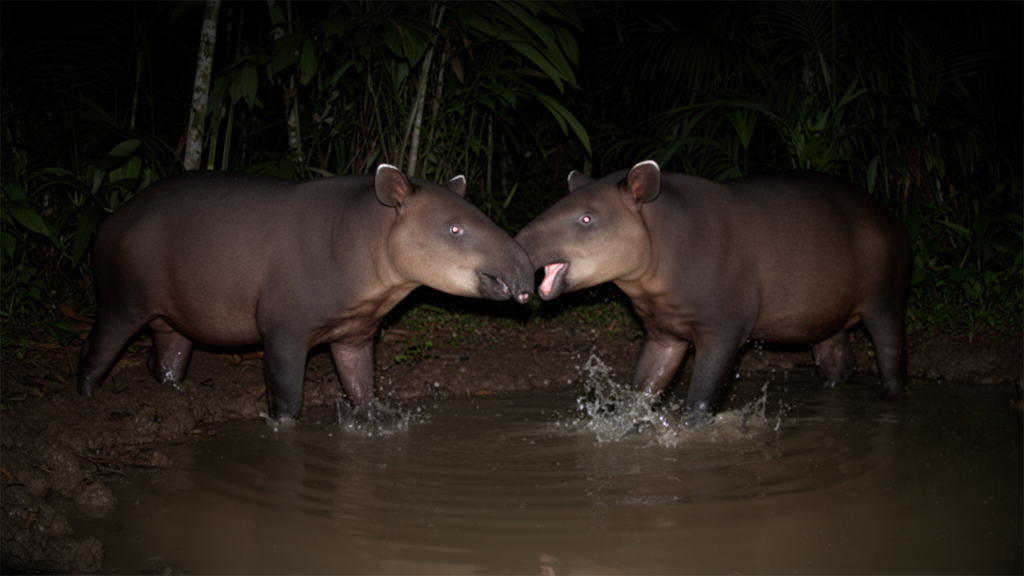
Deep in the Calakmul Biosphere Reserve of southern Mexico, camera traps have captured something scientists had never before documented in the wild: Baird’s tapirs, long considered shy and gentle giants of the Neotropical forest, engaged in violent, hours-long fights and producing a surprising repertoire of whistles. The footage, gathered over 17 days in late April and early May 2024 at a pond known locally as an aguada, reveals a hidden social world of one of the Americas’ most elusive mammals and may finally explain the mysterious scars that riddle the bodies of many adults.
Baird’s tapir (Tapirus bairdii) is the largest terrestrial mammal in the Neotropics, roaming well-preserved humid forests from southern Mexico to Colombia. The species is naturally rare, living at low densities because of slow reproductive rates, and its shy, mostly nocturnal habits make direct observation in the wild extraordinarily difficult. Over the past two decades its range has shrunk considerably under pressure from deforestation and hunting, and the animal is classified as endangered. To study such a cryptic creature, researchers have long relied on non-invasive tools, chief among them camera traps.
The new observations come from a decade-long monitoring programme led by researchers working across 18 aguadas in the Calakmul Biosphere Reserve, a 7,289-square-kilometre protected area decreed in 1989 and part of the Maya Forest shared with Guatemala and Belize. The reserve’s landscape is dotted with ephemeral ponds that fill with rainwater and become lifelines for wildlife during the punishing dry season, when temperatures can climb to 43 degrees Celsius. Since 2014, motion-triggered cameras installed roughly 50 centimetres above the ground have recorded more than 13,000 tapir photographs representing some 600 visits, revealing that individual tapirs show site fidelity to particular ponds for more than ten years and move across home ranges of 40 to 70 square kilometres.
Previous work had already hinted that these ponds are more than watering holes. Tapirs were found to socialise about 13 percent of the time they spent at aguadas, with male-female interactions the most common associations, leading researchers to describe the ponds as social arenas: places where animals gather information about one another, strengthen social networks and interact. What the cameras captured at one aguada named Naranjal between 26 April and 13 May 2024, however, went far beyond casual mingling. Ninety-seven videos documented at least three individuals, two males and one female, with the possibility of a second female, engaged in behaviour never before described in such detail for this species in the wild.
The drama unfolded in stages. From 26 April to 5 May, the two males and the female visited the pond at different times, with the males sniffing tree trunks around the water’s edge. On the night of 5 May the female was seen with one of the males, but the following day the male appeared alone and the female, also alone, emitted two long whistles lasting 1.13 and 3.24 seconds, with frequencies ranging from about 1,009 to 6,105 hertz. The researchers interpreted these calls as searching behaviour, the female apparently broadcasting her location. From 5 to 9 May the males returned, one marking a tree trunk with urine, while the female continued to visit alone.
Then came the fight. On 9 May, from 7:48 in the morning until at least 11:16, ten videos recorded two tapirs, one certainly male and the other suspected to be male as well, locked in combat that lasted a minimum of four hours. The animals chased each other violently around the pond, each trying to bite the other on the lower hind legs. Both fell to the ground and rose again repeatedly, and the footage shows the heavy animals bending their bodies and executing sharp, high turns in ways the researchers found astonishing given their bulk. When it was over, both tapirs were visibly injured, particularly on the lower back legs and rump, and one was limping.
The following day, one tapir chased another away from the aguada five separate times, with the same male returning to the pond after each pursuit. During one of these chases, a burst of short, high-pitched whistles was recorded, averaging 0.74 seconds in duration with frequencies between roughly 1,613 and 5,024 hertz, possibly serving as advertisement calls. On 11 May a male and female were seen together, the male following the female at a distance of less than a metre while emitting another set of short whistles. Similar courtship calls, lasting 0.72 to 0.85 seconds with frequencies from about 1,235 to 5,521 hertz, were recorded again in the early hours of 13 May before the camera’s memory card filled and recording stopped.
Analysing the sounds with acoustic software, the team concluded that tapirs vocalise in at least three distinct contexts: long whistles when searching for another individual, short whistles during courtship when a male closely follows a female, and a different pitch again during stressful chases. This suggests the animals are far more vocal than previously believed, with calls woven into courtship, searching and fighting or fleeing behaviour. Related vocal signalling, including pair-bonding calls, has been documented in the mountain tapir, hinting that acoustic communication may be more widespread across the tapir family than once thought.
The fights carry important implications for interpreting tapir injuries. Scars on the backs and rumps of adult tapirs have traditionally been attributed to escaped attacks by jaguars or pumas, the animals’ thick hides and large size allowing them to survive predation attempts. The new footage shows that conspecifics themselves can inflict severe wounds during mating-season combat, meaning many of the scars seen on wild tapirs may be the record of battles with rivals rather than near-misses with big cats. The researchers also note an unresolved puzzle: the female, seen paired with the victorious male, later displayed wounds on her left leg, raising unanswered questions about whether she joined the fight, fought the rival male herself, or whether females clash with their partners before mating.
The findings also reshape understanding of tapir temperament and conservation. In captivity, aggression between males and females before copulation has been observed when females reject suitors, but such behaviour had not been documented under natural conditions where multiple males may compete around a receptive female. The researchers believe these intense episodes probably occur every time a female enters oestrus and may last from days to weeks. Because the battles unfolded at an aguada, the results reinforce the idea that these ponds are critical social arenas, not merely sources of water, and underline their conservation value. The team hopes that future tools such as audio recorders and radiotelemetry, combined with the continued protection of Calakmul’s forests, will reveal more of the hidden lives of this endangered ungulate and help secure its future.
Subject of Research: Fighting and vocalisation behaviour of Baird's tapirs recorded at waterholes in southern Mexico
Article Title: Extreme fighting and vocalisations in Tapirus bairdii : observations from aguadas of Calakmul, social arenas for the species
Article References: Reyna-Hurtado, R., Huerta-Rodríguez, J. O., & Rojas-Flores, E. (2025). Extreme fighting and vocalisations in Tapirus bairdii: observations from aguadas of Calakmul, social arenas for the species. Neotropical Biology and Conservation, 20(1), 67-78. https://doi.org/10.3897/neotropical.20.e143760
Image Credits: AI Generated
DOI: 10.3897/neotropical.20.e143760
Keywords: Baird's tapir, Tapirus bairdii, Calakmul Biosphere Reserve, camera traps, aguadas, animal behaviour, fighting, vocalisations, courtship, endangered species, Neotropical mammals, conservation
News Source: Margaret Porter. (October 17, 2026). Baird’s Tapirs Caught on Camera in Brutal Fights and Secret Whistles at Mexican Watering Holes. Scienmag.