The Atlantic blue crab, Callinectes sapidus, is one of the most successful marine invaders in the Mediterranean Sea, and a new study reports the first targeted environmental DNA assay designed specifically to detect it. Writing in Ecology and Evolution, researchers led by Valeria Specchia and Maurizio Pinna of the University of Salento describe a pair of species-specific primers that amplify a 464-base-pair segment of the crab’s mitochondrial COI gene, validated in silico, in vitro and in situ, and applied to water samples from five pilot areas spanning both coasts of the Adriatic Sea. The assay detected blue crab DNA at every sampling site, demonstrating a sensitivity that conventional metabarcoding with universal primers failed to achieve in the same waters.
The blue crab is native to the western Atlantic Ocean and most likely entered the Mediterranean during the 1940s through ballast water discharge from transoceanic shipping. Since then its populations have expanded across a wide range of coastal habitats, with a marked acceleration since approximately 2017. The species is an opportunistic predator with broad trophic flexibility, exploiting fish, invertebrates, polychaetes, macrophytes and especially bivalves, and documented declines in native bivalve stocks have followed its arrival, from oysters in Spain’s Ebro Delta to the aquaculture of the Manila clam in Italy’s Po Delta. Females can produce up to four million eggs per spawning event, and the crab is euryhaline, tolerating wide ranges of salinity and temperature, which allows it to colonize coastal waters, estuaries and lagoons with equal ease.
These traits combine to make early detection both difficult and urgent. Under Regulation (EU) No 1143/2014, early detection means confirming an invasive alien species before it becomes widely established, yet conventional surveys based on trapping and visual census frequently miss low-density invasions. In the Ebro Delta, roughly five years elapsed between the first detection of the blue crab and the onset of exponential population growth. Notably, the species is not currently listed among the invasive alien species of Union concern, and recent analyses suggest its Adriatic expansion is being facilitated by rising sea surface temperatures, adding urgency to calls for harmonized surveillance and coordinated management across Member States.
Environmental DNA metabarcoding offers a molecular alternative. By extracting DNA directly from water or sediment, amplifying universal genetic markers such as COI with degenerate primers, and applying high-throughput sequencing, researchers can identify entire biological communities from a single sample. But the approach has well-known constraints. Incomplete reference databases limit taxonomic resolution in marine and transitional ecosystems, and because universal primers amplify DNA from many taxa simultaneously, DNA from a rare target species competes with DNA from all co-occurring organisms during PCR. Low-abundance species may therefore be underrepresented in sequencing output or excluded during bioinformatic filtering, undermining the very sensitivity needed for early detection of invaders.
Targeted eDNA assays sidestep this competition by using highly specific primers that selectively amplify DNA from a single species. The Salento team began by downloading five COI sequences representative of Mediterranean blue crab populations from NCBI GenBank and establishing the forward primer position with Primer-BLAST. To minimize cross-reactivity, they compiled a list of roughly 1300 aquatic animal species co-occurring with the crab in Mediterranean coastal and transitional ecosystems, retrieving Folmer-region COI sequences for about 600 of them and testing the candidate primer in silico against this panel. The reverse primer was designed manually outside the Folmer region, about 500 base pairs downstream, to yield an amplicon optimal for both Sanger sequencing and next-generation sequencing while ensuring reliable species-level identification.
Only the primer pair predicted to amplify exclusively Callinectes sapidus was retained. The final primers, named CSapFor and CSapRev, were then validated experimentally. Genomic DNA extracted from blue crab muscle tissue produced a single amplicon of the expected 464 base pairs, while DNA from two non-target control species, the brown shrimp Penaeus aztecus and the Mediterranean mussel Mytilus galloprovincialis, generated no visible bands under the tested PCR conditions. Sanger sequencing of the crab amplicon returned a BLAST match exclusively with Callinectes sapidus sequences, with 100% sequence identity, confirming that the amplified fragment corresponds to the intended target region.
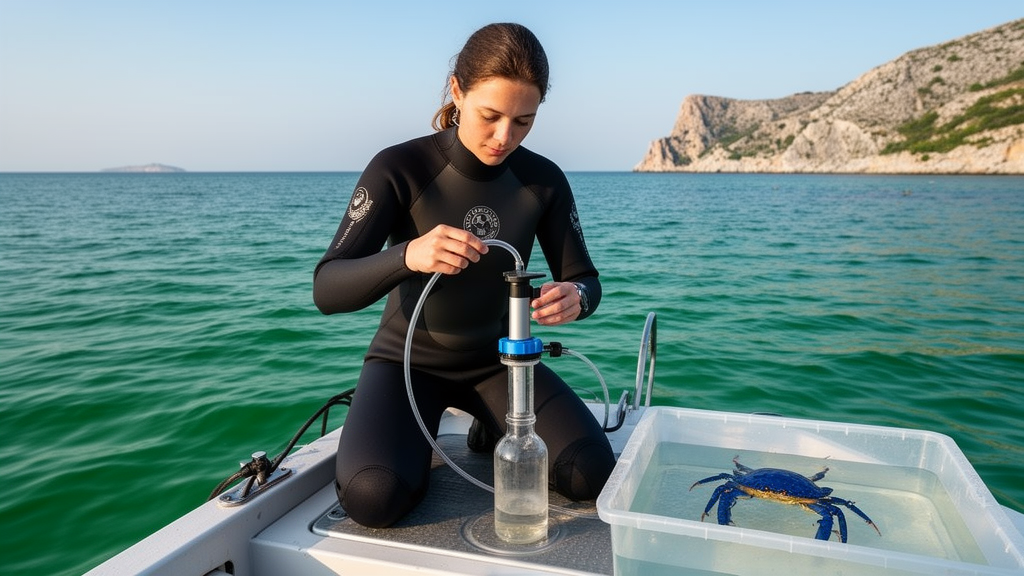
The researchers then applied the assay to environmental samples. One-liter surface water samples were collected from the Aquatina di Frigole lagoon in southeastern Italy, the Neretva River Delta in Croatia, the San Benedetto del Tronto coast and Tronto River Delta in central Italy, and the Venice Lagoon, yielding 22 eDNA samples in total. Each replicate was pre-filtered through a 0.5-millimeter mesh to remove particulates and PCR inhibitors, then filtered through 0.45-micrometer cellulose filters from which DNA was extracted. High-throughput sequencing of the COI amplicons on an AVITI platform generated 10,773,406 raw reads, averaging about 500,000 reads per sample. Every operational taxonomic unit assigned at the species level was identified as Callinectes sapidus, and the most abundant OTU was detected across all pilot areas, demonstrating the assay’s ability to identify the species even at low DNA concentrations.
Because similarity-based classification alone cannot assess the evolutionary coherence of identified sequences, the team added independent phylogenetic validation. They built a maximum-likelihood tree from 96 blue crab amplicon sequence variants together with reference COI sequences representing the diversity of the genus Callinectes and a mud crab sequence as an outgroup. The topology resolved two well-supported lineages among the reference taxa, consistent with previously published molecular phylogenies of the genus, and all metabarcoding-derived variants clustered coherently within the Callinectes sapidus lineage, clearly separated from congeneric species. The researchers caution that the more than 2500 variants should not be read as extensive evolutionary diversification; amplicon sequence variants preserve even single-base polymorphisms, so many represent closely related mitochondrial haplotypes differing by only one or a few nucleotides, as reflected in the short branch lengths within the crab clade.
A haplotype network analysis added a phylogeographic dimension. The network resolved a star-like topology anchored by a predominant central hub spanning all Adriatic pilot areas and Mediterranean reference sites, with single-mutation tip haplotypes radiating outward. The dominant Mediterranean hub appears directly connected to reference sequences from Mexico, supporting the hypothesis that the species was introduced from the Gulf of Mexico via ballast water transport, with the broad distribution of the primary haplotype across all Adriatic locations reflecting high gene flow driven by prolonged pelagic larval drift and the strong oceanographic connectivity of the Adriatic Sea. Distinct spatial partitioning emerged, with high haplotype richness in the Neretva River Delta and Aquatina di Frigole Lagoon and a subset of variants apparently localized in the Venice Lagoon, hinting at localized demographic processes and ongoing in situ microdiversification after settlement.
The study represents one of the few experimental demonstrations confirming the feasibility of detecting an invasive species through targeted eDNA analysis, complementing earlier probe-based qPCR methods for the blue crab. Previous analyses of the same Adriatic pilot areas using the widely adopted degenerate primer pair mCOIintF/dgHCO2198 did not consistently detect the species, whereas the species-specific primers succeeded across all sites, underscoring the sensitivity gain that targeted design delivers. Beyond early detection, the approach yields genetic data that can reconstruct invasion dynamics at the molecular level, identifying haplotypes originating in the native range or following introduction into the Mediterranean. As rising temperatures continue to favor the establishment and spread of this invader, the researchers argue that integrating molecular detection methods into invasive species management offers a powerful means to detect and track invaders even in the absence of physical specimens, ultimately informing the targeted control measures needed to protect native Mediterranean coastal ecosystems.
Subject of Research: Development and validation of a targeted environmental DNA assay for early detection of the invasive blue crab Callinectes sapidus in Adriatic coastal-marine ecosystems
Article Title: Targeted eDNA Survey Enables Consistent Detection of the Invasive Blue Crab in Trans‐Border Adriatic Coastal‐Marine Ecosystems
Article References: De Donno, M. D., Zangaro, F., Arnosti, P., Bergamin, S., Boban, J., Bozzetti, M. P., Cazzetta, A., De Pittà, C., Dessanai, D., Drigo, F., Julius, O. T., Ključe, L., Lušić, J., Marcucci, F., Massaro, R., Morelli, V., Moro, I., Nazlić, N., Pellizzato, M., … Pinna, M. (2026). Targeted eDNA Survey Enables Consistent Detection of the Invasive Blue Crab in Trans‐Border Adriatic Coastal‐Marine Ecosystems. Ecology and Evolution, 16(10), Article e74462. https://doi.org/10.1002/ece3.74462
Image Credits: AI Generated
DOI: 10.1002/ece3.74462
Keywords: Targeted, eDNA, Survey, Enables, Consistent, Detection, Invasive, Blue, Crab, Trans, Border, Adriatic
News Source: Drew Townsend. (October 17, 2026). eDNA Test Spots Invasive Blue Crab Early Across Adriatic Waters. Scienmag.