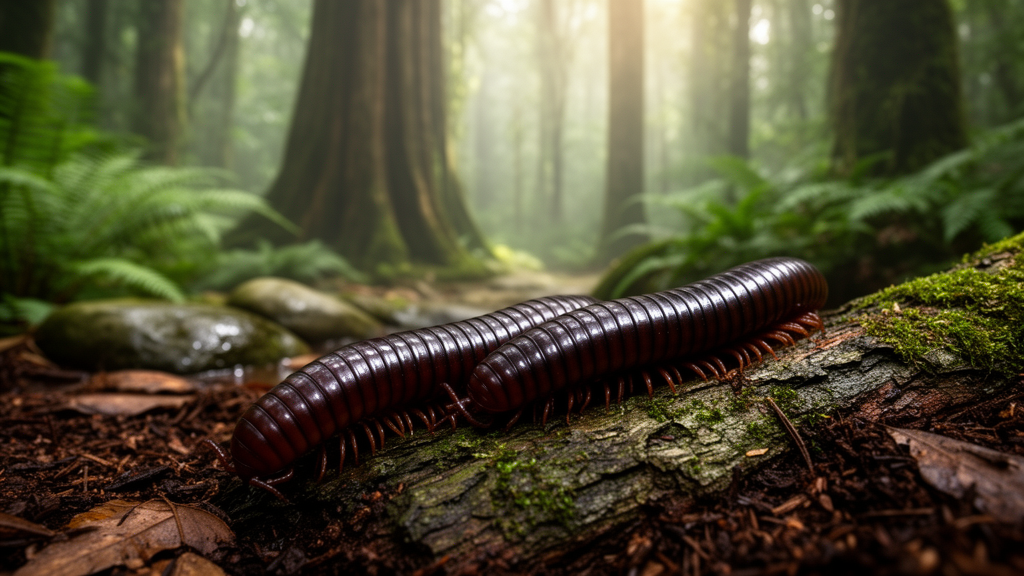
Deep in the red sandstone ravines of southwestern China, where the “living fossil” tree fern Alsophila spinulosa crowds humid gullies and 99.6 percent of the landscape is cloaked in subtropical moist evergreen broad-leaved forest, scientists have completed the first systematic survey of one of the planet’s most overlooked groups of animals: millipedes. The results, published in Zoosystematics and Evolution, document eight species belonging to five families and four orders within the Chishui Alsophila National Nature Reserve in Guizhou Province. Two of them are entirely new to science, and several others have never before been recorded in Guizhou, dramatically updating the known distribution of millipede biodiversity in Southwest China.
The Chishui Alsophila National Nature Reserve, spanning 30,000 hectares in northwestern Guizhou Province near the borders of Sichuan Province and Chongqing Municipality, is a globally significant conservation area. Elevations range from 330 to 1,730 meters above sea level within a mid-subtropical humid monsoon climate zone, where annual mean temperatures sit between 12.7 and 17.7 degrees Celsius, annual precipitation reaches 1,200 to 1,300 millimeters, and average relative humidity hovers around 90 percent. More than half of the reserve, 56.3 percent, consists of well-preserved primary forest. Its striking Danxia landforms, characterized by vivid red sandstone cliffs and deep, humid ravines, form a critical reservoir of genetic resources for flora and fauna, serving as both refuge and habitat for numerous endangered and endemic species.
Despite this biological richness, the millipede fauna of the reserve had never been documented. In 2024, a field survey was conducted to investigate diplopod diversity, with specimens collected by tweezers from several sites between roughly 496 and 1,278 meters in elevation and preserved in 75 percent ethanol. All specimens are deposited in the Guizhou Institute of Biology, Guizhou Academy of Sciences, Guiyang, China. Millipedes are a vital component of soil macrofauna, playing a significant role in nutrient cycling and organic matter decomposition in terrestrial ecosystems, and they are most diverse and abundant in humid temperate, subtropical, and tropical forest environments. While China is recognized as a major reservoir of biodiversity, its millipede fauna remains substantially understudied, making focused local-level surveys increasingly essential for uncovering hidden diversity in previously underexplored habitats.
The first of the two new species, Hyleoglomeris erecta, belongs to the family Glomeridae, the pill millipedes capable of rolling into a ball. Males of this species can be easily distinguished from its congeners by the telopods, the specialized male reproductive legs, being erect and not curved basally. The species is morphologically similar to Hyleoglomeris bicolor from Hong Kong and Hyleoglomeris tiani from Hunan, as they share relatively erect telopods, but the new species can be distinguished from H. tiani by male legs 17 having four podomeres rather than three, a stout rather than slender femoral trichostele, a digitiform rather than broad femoral process, and a short, small tibial process. It differs from H. bicolor by having a slightly concave syncoxial notch on male legs 18, a mesally directed prefemoral trichostele, a femoral trichostele slightly larger than the femoral process, a distally directed tibial process, and by lacking a small microsetose tubercle on the tibia.
The holotype of H. erecta measures approximately 15.9 millimeters in length with a thoracic shield width of about 7.1 millimeters, while paratypes range from 14.9 to 20.0 millimeters in males and 15.7 to 27.4 millimeters in females. The head is brownish-black with a yellow labrum, the thoracic shield is yellow with a central X-shaped brownish-black pattern, and the remaining terga are brownish-black with a yellow central dorsal line and irregular yellow patterns on the lateral sides. The specific epithet means “erect,” referring to the distal segment of the telopod being erect, unlike other species in the genus where it typically curves inwards in a pincer-like shape. The species is known only from the type locality. To date, 36 species of Hyleoglomeris have been recorded from China, and the new species represents the 37th species recorded in the country and the 11th known from Guizhou Province.
The second new species, Sellanucheza tumida, belongs to the family Paradoxosomatidae and is distinguished by the conspicuously swollen femorite of the gonopod, the short and slightly bifid solenophore, the shapes of the gonopodal processes, and the swollen male leg 10 femora. The species closely resembles Sellanucheza hoffmani from Vietnam in its external characteristics and the general arrangement of gonopodal processes, but it differs in possessing a swollen gonopodal femorite, an erect and spine-like process b rather than a slightly curved one, and process a being broad and laminate at the tip rather than spine-like. Among species recorded from China, it can be distinguished from S. jaegeri from Shaanxi and Chongqing by its swollen femorite and very shortly bifid solenophore tip, and from S. tenebra and S. typica from Sichuan by its relatively shorter solenophore, which is extremely long and coiled into a circular shape in the latter two species.
The holotype of S. tumida measures 26.5 millimeters in length and 3.0 millimeters in width, with paratypes ranging from 27.9 to 30.8 millimeters in males and 30.9 to 38.9 millimeters in females. The head is brown with pale yellow labrum and antennal sockets, the metaterga bear a wide pale transverse band extending laterally across the paraterga, and the legs are yellow. The specific epithet derives from the Latin tumidus, meaning “swollen,” referring to the swollen femorite of the gonopod. This genus belongs to the tribe Sulciferini and currently comprises six species known from China and Vietnam, with three species recorded in China distributed in Shaanxi, Chongqing, and Sichuan. The new species represents the first record of this genus from Guizhou Province.
Beyond the two new species, the survey yielded several significant new provincial records. The order Julida and the family Julidae are recorded from Guizhou for the first time through the discovery of Nepalmatoiulus sichuanensis, whose type locality in Mianning, Sichuan sits at 3,360 meters above sea level while the current collection site in Chishui lies at roughly 930 meters. The morphological consistency between these populations confirms the taxonomic identification and reveals a remarkable elevational plasticity, aligning with the general patterns of the genus Nepalmatoiulus, which exhibits a distinct montane predilection. Four genera, Niponia, Sellanucheza, Tylopus, and Nepalmatoiulus, and four species, Niponia nodulosa, Kronopolites biagrilectus, Tylopus nigromarginatus, and Nepalmatoiulus sichuanensis, are recorded from Guizhou Province for the first time. The greenhouse millipede Oxidus gracilis, a cosmopolitan species attaining worldwide distribution through human-mediated dispersal, was likewise collected from habitats in close proximity to human settlements.
Notably, specimens of Kronopolites biagrilectus from Chishui exhibit a certain degree of morphological variation among different populations, particularly in the length and curvature of gonopodal processes, suggesting that future molecular investigations are required to ascertain the possible existence of cryptic diversity. Similarly, specimens of Tylopus nigromarginatus agree morphologically with the original description except for their coloration, with the Chishui specimens possessing a dark brown head and collum and wing-shaped brown patches along the anterior margins of the metaterga. The findings demonstrate strong biogeographical affinities between the millipede fauna of Chishui and those of the adjacent Sichuan and Chongqing areas, filling a significant lacuna in the provincial faunal list.
However, the survey should be considered preliminary, and the actual millipede diversity within the reserve is likely far greater than reported. During fieldwork, several specimens were collected that could not be identified to the species level because they were juveniles, including representatives from the orders Chordeumatida, Spirobolida, and Polydesmida. The presence of these additional taxa indicates that the taxonomic richness of the reserve extends well beyond the eight species formally identified. Given the complex terrain and the seasonal activity of millipedes, many species with cryptic lifestyles or narrow phenological windows were likely overlooked. The current work provides only a snapshot of the reserve’s soil biodiversity, and future investigations utilizing more intensive, multi-seasonal sampling are essential to achieve a comprehensive understanding of the diplopod community in this unique Danxia ecosystem.
Subject of Research: First faunistic survey of millipedes in Chishui Alsophila National Nature Reserve, China, describing two new species and new provincial records.
Article Title: Millipedes ( Diplopoda ) from the Chishui Alsophila National Nature Reserve, China, with description of two new species
Article References: Jiang, X., Liu, B., & Chen, H. (2026). Millipedes (Diplopoda) from the Chishui Alsophila National Nature Reserve, China, with description of two new species. Zoosystematics and Evolution, 102(3), 767-782. https://doi.org/10.3897/zse.102.185791
Image Credits: AI Generated
Keywords: millipedes, Diplopoda, new species, taxonomy, biodiversity, China, Guizhou, Chishui Alsophila National Nature Reserve, Zoosystematics and Evolution, invertebrates, Chishui, Alsophila
News Source: Gavin Prescott. (October 17, 2026). Two New Millipede Species Uncovered in China’s Living Fossil Forest Reserve. Scienmag.