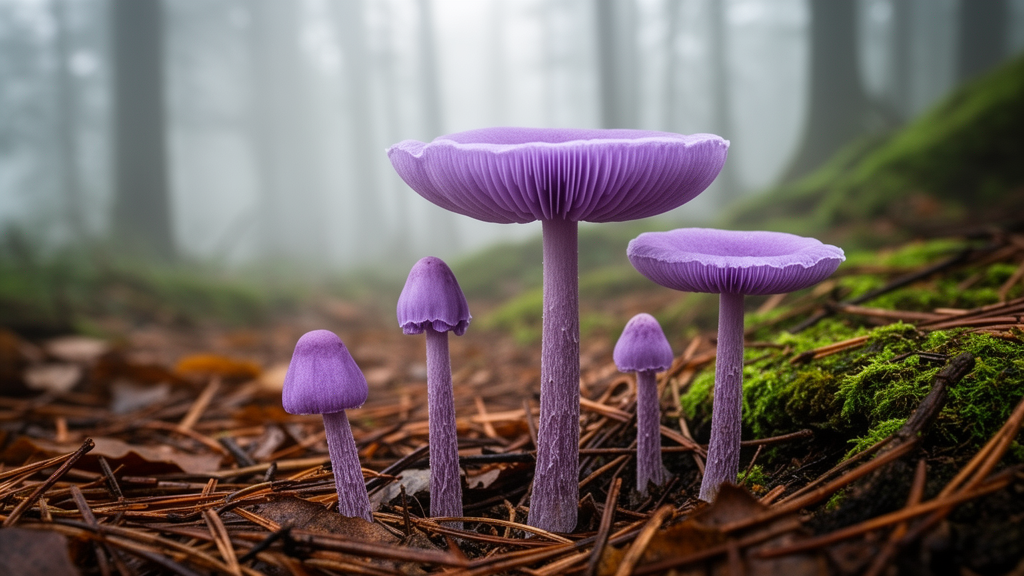
Deep in the mountain forests of southwestern China, two mushrooms previously lumped in with known species have now been shown to be entirely new to science. The fungi belong to the genus Laccaria, a group of edible, tree-symbiotic mushrooms prized by foragers across Asia, and their discovery brings the number of formally recognized Laccaria species in China to 47. The finding, published in MycoKeys, also highlights how modern DNA sequencing is transforming a genus whose species have long confounded even expert mycologists.
Laccaria is no obscure lineage. Established in 1883 with the deceiver mushroom, Laccaria laccata, as its type species, the genus now includes more than 100 recorded species worldwide. All currently known members are considered edible, and several larger Asian species, such as Laccaria yunnanensis and L. moshuijun, are highly valued for their culinary qualities. The genus is also ecologically significant: every Laccaria species is ectomycorrhizal, forming intimate symbioses with the roots of trees, exchanging soil minerals for plant sugars. Yet despite this economic and ecological importance, identifying individual Laccaria species has been notoriously difficult.
The problem lies in the mushrooms’ appearance. Key diagnostic traits, especially cap color, are highly plastic and strongly influenced by environmental humidity. When moist, different species display their distinct diagnostic hues; when dry, the fruiting bodies dehydrate and turn a uniform grayish brown to earth brown, erasing the very characters taxonomists rely on. As a result, while a handful of species can be recognized by distinctive morphology, accurate delimitation of most species now demands molecular evidence.
To untangle the diversity of Laccaria in northwestern Yunnan Province, a research team led by Guo Zhao, Song-Ming Tang, and Zhu-Liang Luo collected nine specimens from field sites across southwestern China, documenting each collection with in situ photographs, habitat data, elevations, and geographic coordinates. The specimens were dried at 50 degrees Celsius, deposited in the Herbarium of Cryptogams at the Kunming Institute of Botany and at Dali University, and then subjected to both detailed microscopic examination and multigene sequencing.
On the molecular side, the team extracted genomic DNA from the dried material and amplified four genetic markers: the nuclear ribosomal internal transcribed spacer region (nrITS), the large subunit nuclear ribosomal RNA gene (nrLSU), RNA polymerase II subunit 2 (rpb2), and translation elongation factor 1-alpha (tef1-alpha). These four loci were chosen because, together, they provide a far more robust phylogenetic signal than nrITS alone, which previous studies had shown can underestimate or misdelimit species diversity. The final combined alignment comprised 166 specimens and 3,570 characters, including gaps.
Phylogenetic analyses were then performed using both maximum likelihood, via RAxML with 1,000 bootstrap replicates, and Bayesian inference, via MrBayes with 10 million generations of Markov chain Monte Carlo. The two approaches yielded generally congruent topologies, and the nine new specimens resolved into four strongly supported clades. Two of those clades represented species new to science; the other two corresponded to known species, L. acanthospora and L. pumila, both of which are also edible.
The first new species, Laccaria daliensis, was collected on Shibao Mountain in Dali Autonomous Prefecture at 2,500 meters elevation, growing in Quercus forest. It is characterized by pale orange to light grayish orange caps measuring 10 to 30 millimeters across, distant waxy gills, and subglobose to globose basidiospores averaging 7.8 by 7.7 micrometers, covered in crowded spines 2 to 5 micrometers long. Microscopically, it produces both narrowly utriform cheilocystidia and pleurocystidia, sterile cells on the gill edges and faces that prove crucial for species discrimination. Phylogenetically, L. daliensis is sister to L. salmonicolor, but that species has reddish-brown fruiting bodies and lacks pleurocystidia, making the two easy to separate once both morphology and molecules are considered.
The second new species, Laccaria violaceonana, was found in Ailao Mountain in Puer City at 2,300 meters, growing scattered or gregarious on sandy soils and ditch edges. Its name refers both to the deep purple coloration of its fruiting bodies and to their smaller stature compared with the well-known amethyst deceiver, L. amethystina. The species has convex caps of 10 to 36 millimeters, deep purple gills, and globose to subglobose spores averaging 7.5 by 7.3 micrometers with spines 1 to 4 micrometers long. It is one of only a few Laccaria species with purple basidiomata, a trait that has arisen in multiple independent lineages across the genus, including L. amethystina, L. japonica, L. moshuijun, and L. violaceotincta, suggesting the character may have evolved convergently more than once, a pattern of significant interest for evolutionary biology.
Distinguishing L. violaceonana from its purple relatives required careful micromorphological comparison. Unlike L. amethystina and L. amethysteo-occidentalis, it possesses abundant pleurocystidia, structures absent in both. Its spores are smaller than those of L. amethystina, its basidia smaller than those of L. amethysteo-occidentalis, and its narrowly utriform cheilocystidia differ in shape from those of both species. Its hyphal structure, with appressed parallel hyphae in the pileipellis and stipitipellis, contrasts with the interwoven radiating hyphae with intracellular pigmentation found in L. japonica and L. moshuijun. Phylogenetically, it is sister to L. fulvogrisea, from which it differs by its deep purple rather than gray to brownish pileus, smaller stipe, and smaller basidia, with an ITS sequence divergence of 2.03 percent between the two species.
Beyond the two new species, the study also produced new distribution records. L. acanthospora, originally described from Xizang, was newly recorded from Dali in Yunnan, and L. pumila, originally described from France, was newly recorded from Linzhi in Xizang at 3,700 meters elevation. The Xizang collections of L. pumila match the original description morphologically but display larger fruiting bodies and basidia than previously documented, and phylogenetic analysis placed them firmly within the L. pumila clade. All four species investigated are edible, and their formal recognition enriches the documented edible fungal resources of the genus, providing new germplasm materials for future development and utilization.
The findings underscore both the richness and the under-sampling of Laccaria diversity in Asia. Yunnan and Xizang are biodiversity hotspots for the genus, with 22 and 11 species reported respectively, thanks to complex vertical climate zones and diverse vegetation types that provide rich ecological niches for ectomycorrhizal fungi. Yet the current sampling scope remains limited and fails to fully cover the potential distribution areas of Laccaria across southwestern China and the broader Asian region. As field surveys expand to cover more under-investigated forest ecosystem types, and as multilocus sequence analyses become standard practice, the species diversity records of this genus in Asia are likely to increase further, revealing more cryptic species and novel biogeographic patterns in one of the world’s most ecologically important groups of edible mushrooms.
Subject of Research: Species diversity of edible mushrooms III: new species of Laccaria (Agaricales, Basidiomycota) from southwestern China based on morphology and multilocus phylogeny
Article Title: Species diversity of edible mushrooms III: new species of Laccaria ( Agaricales , Basidiomycota ) from southwestern China based on morphology and multilocus phylogeny
Article References: Zhao, G., Qu, Y.-H., Tang, L.-Y., Zhang, J., Suo, H.-N., Niu, K.-Y., Luo, Z.-L., Song, H.-B., & Tang, S.-M. (2026). Species diversity of edible mushrooms III: new species of Laccaria (Agaricales, Basidiomycota) from southwestern China based on morphology and multilocus phylogeny. MycoKeys, 139, 213-249. https://doi.org/10.3897/mycokeys.139.175697
Image Credits: AI Generated
DOI: 10.3897/mycokeys.139.175697
Keywords: Species, diversity, edible, mushrooms, Laccaria, Agaricales, Basidiomycota, southwestern, China, based, morphology, multilocus
News Source: Roger Howard. (October 17, 2026). Species diversity of edible mushrooms III: new species of Laccaria (Agaricales, Basidiomycota) from southwestern China based on morphology and multilocus phylogeny. Scienmag.