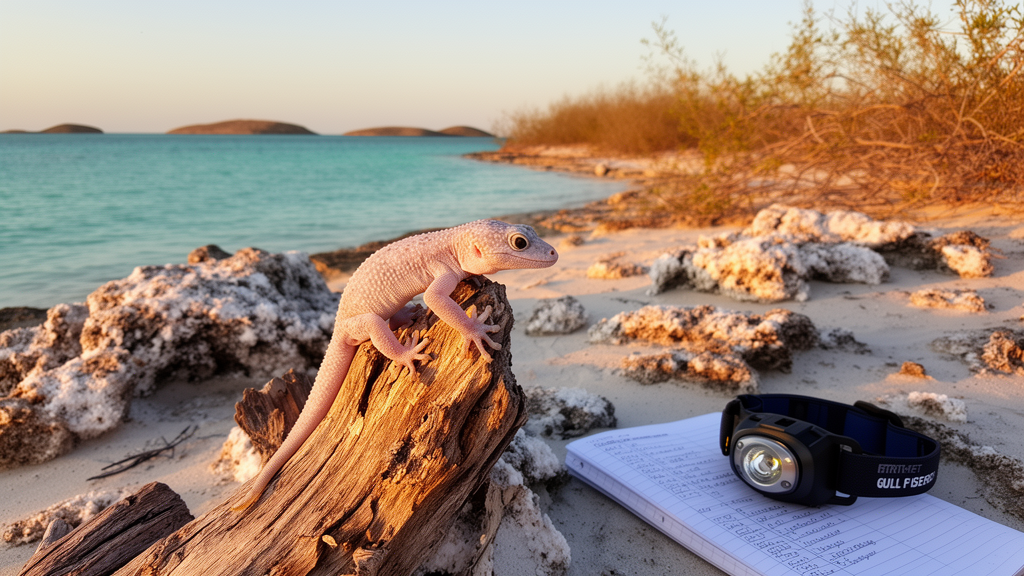
The flat, low-lying islands scattered along Saudi Arabia’s coast in the Arabian Gulf have long been biological blank spots. Roughly 130 islands belong to the Kingdom, yet only 29 are of considerable size, ranging from about 59 square kilometers on Abu Ali Island down to barely 0.01 square kilometers on Al Haiza. Most rise no more than 13 meters above the sea. Until now, the reptiles of these islands had been documented from just two localities in a single 1996 survey, and nothing at all was known about their amphibians. A new study, published in the journal Herpetozoa, has changed that picture with the first comprehensive field survey of the islands’ herpetofauna, and the results reveal an unexpected story of ancient land bridges, human hitchhikers, and thriving sea turtle nurseries.
Between August 2024 and May 2025, a research team made 13 field visits to nine Saudi islands, logging approximately 51 hours of daytime and nighttime survey effort by two observers. The islands spanned a remarkable gradient of sizes and isolation: Abu Ali, the largest at 59.3 square kilometers and just 8.33 kilometers from the mainland, down to tiny Kareen and Al-Huwaylat, each barely 0.1 square kilometers, with Karan Island lying a full 57.41 kilometers offshore. Specimens that were collected were examined, identified, and mostly released at the site of capture, with voucher material deposited at Taibah University under the Islands Reptiles Collection. The team also examined reptile specimens held at the King Fahd University of Petroleum and Minerals and incorporated records and photographs submitted by local residents.
The survey yielded a total of 20 species of amphibians and reptiles across 12 families, including ranid frogs, geoemydid and cheloniid turtles, seven genera of geckos, lacertid lizards, skinks, a worm lizard, boas, colubrids, psammophiids, and vipers. Species richness varied dramatically among the islands, from a single species on four islands to 11 species on Tarout Island, with a mean of 3.44 species per island. The statistical patterns were clear and, in places, counterintuitive. Species richness correlated positively with island area, with a Pearson’s correlation coefficient of 0.52, but it correlated negatively with distance from the mainland, at r = −0.55. In other words, bigger islands held more reptiles, but islands closer to the shore also did better, a signature of ongoing dispersal rather than deep evolutionary isolation.
Diversity analysis told a similar story. Using the Simpson Diversity Index, where larger values indicate lower diversity, Tarout Island scored highest at 0.152, followed by Abu Ali at 0.274 and Az-Zakhnuniyyah at 0.31. Four islands, Al Fanateer, Al-Juraid, Karan, and Kareen, each hosted a single reptile species, yielding zero diversity by this measure. Cluster analysis based on species presence and absence data, using the Bray-Curtis similarity measure and the UPGMA algorithm, grouped the islands according to their geographical location, size, and human use. The three largest islands, Abu Ali, Tarout, and Az-Zakhnuniyyah, were the least similar to the rest, a separation the authors attribute to their size and long histories of development and agriculture.
The single most species-rich locality was also the most humanized. Tarout Island, the third largest Saudi Gulf island at 20.3 square kilometers, sits a mere 0.10 kilometers from the Qatif mainland coast and is linked to it by three causeways. It has been inhabited for roughly 5,000 years and is now densely populated, with palm farms and irrigation canals threading the landscape. All 11 of its species, from the marsh frog Pelophylax ridibundus and the Caspian turtle Mauremys caspica in the farm canals to the fan-footed gecko Ptyodactylus cf hasselquistii on farm walls, are known from the nearby coastal mainland around Al Qatif. The drainage canals that shelter frogs and freshwater turtles are currently being reclaimed, a change the researchers flag as a significant threat to these animals.
Geckos emerged as the study’s most striking finding, because so many of them appear to owe their island presence entirely to people. The Rough Bent-toed Gecko Cyrtopodion scabrum, believed to have been introduced to the Arabian Peninsula by human activity, turned up on six of the nine islands. The Yellow-bellied Gecko Hemidactylus flaviviridis, native to central India and spread to Africa and Arabia through human commerce, was recorded from Tarout farms. Hemidactylus persicus, Bunopus tuberculatus, Stenodactylus slevini, and Trigonodactylus arabicus rounded out the gecko fauna. The authors conclude that the colonization of most recorded species, particularly the geckos and lizards, represents human introduction, carried in construction materials, infrastructure projects, and the transport of trees from the mainland, echoing earlier findings from the United Arab Emirates islands.
Not every species fits the hitchhiker narrative, however. Records of the Arabian Horned Viper Cerastes gasperettii on Az-Zakhnuniyyah Island and Zarudnyi’s Worm Lizard Diplometopon zarudnyi on Tarout Island may represent a previous physical connection of these islands with the mainland. Both islands lie very close to the shore, and both species are common in the Eastern Province. The Arabian Gulf itself was formed only 8,000 to 12,000 years ago and underwent repeated episodes of filling and emptying during Quaternary glacial cycles, when sea levels fell and rose. The Gulf is believed to have served as a dispersal center for Iranian and Arabian reptiles some 20,000 to 30,000 years ago, and these ancient land bridges likely explain the presence of snakes and large lizards on islands that are now separated by open water.
The islands also play a outsized role for marine turtles, and the survey confirmed viable populations on at least three of them. Abu Ali Island hosts Green Turtles Chelonia mydas, though the team found seven dead specimens there in October 2024 and another in May 2025, a worrying signal on an island suffering from road fragmentation and widespread solid waste pollution. Al-Juraid and Az-Zakhnuniyyah islands support Hawksbill Turtles Eretmochelys imbricata, with three individuals observed swimming off Al-Juraid in May 2025. Jana Island is considered the most important Saudi Gulf island for the Green Turtle, and Karan, Jana, and Al-Juraid are major nesting sites for both species. The small coral island of Karan additionally hosts the largest breeding population of the Lesser Crested Tern in the region. The researchers call for continued monitoring of turtle breeding on these islands and the implementation of conservation measures to protect them.
Compared with neighboring Gulf states, the Saudi islands emerge as surprisingly rich. The Saudi islands’ 19 reptile species and one amphibian exceed the 10 species recorded from five Kuwaiti islands, the 10 species from Qeshm Island in Iran, and the 13 species from Sir Bani Yas Island in the UAE. Yet each national island group harbors species the others lack. The UAE islands add Hemidactylus robustus, Pristurus rupestris, Stenodactylus arabicus, Chalcides ocellatus, and Scincus conirostris, while Kuwaiti islands contribute the Olive Ridley Sea Turtle, the Toad-headed Agama Phrynocephalus longicaudatus, and the pelagic Hydrophis platurus. Iranian Qeshm Island hosts seven species absent from the Saudi islands, including the skink Scincus mitranus and the gecko Tropiocolotes hormozganensis, considered endemic to southwestern Iran.
Perhaps the most biologically significant negative result is what the Saudi Gulf islands lack: endemism. No endemic species have ever been reported from any Arabian Gulf island, in sharp contrast to the Red Sea’s Farasan Archipelago, where raised fossil coral reefs, greater isolation of roughly 50 kilometers, and a longer evolutionary window have produced two endemic reptiles, the Farasan Fan-footed Gecko and the Sarso Racer. The Socotra Archipelago, formed during the Eocene about 40 million years ago and lying 370 kilometers from Yemen, takes the regional record with 29 of its 31 reptile species considered endemic. Masirah Island in Oman has two endemics of its own. The young, flat, and frequently connected Saudi Gulf islands simply have not had the time or isolation for speciation. Even so, the new dataset provides a key resource for biogeographical analysis and conservation planning, and the authors urge follow-up studies to compare the taxonomic identity of island populations with mainland relatives, noting that recent revisions of the Mesalina guttulata complex suggest that records previously assigned to Mesalina brevirostris may in fact represent the newly described Mesalina cryptica. Understanding the interplay between natural dispersal and human-driven colonization on these islands, they conclude, is now the central question for the herpetology of the Arabian Gulf.
Subject of Research: Reptiles and amphibians of the Saudi islands in the Arabian Gulf
Article Title: Reptiles and amphibians of the Saudi islands in the Arabian Gulf
Article References: Aloufi, A., Al Zayer, M., Abu Baker, M. A., & Amr, Z. S. (2025). Reptiles and amphibians of the Saudi islands in the Arabian Gulf. Herpetozoa, 38, 379-391. https://doi.org/10.3897/herpetozoa.38.e172180
Image Credits: AI Generated
DOI: 10.3897/herpetozoa.38.e172180
Keywords: Reptiles, amphibians, Saudi, islands, Arabian, Gulf, scientific research
News Source: Drew Townsend. (October 17, 2026). Hidden gecko hitchhikers: First full survey reveals the secret reptile life of Saudi Arabia’s Gulf islands. Scienmag.