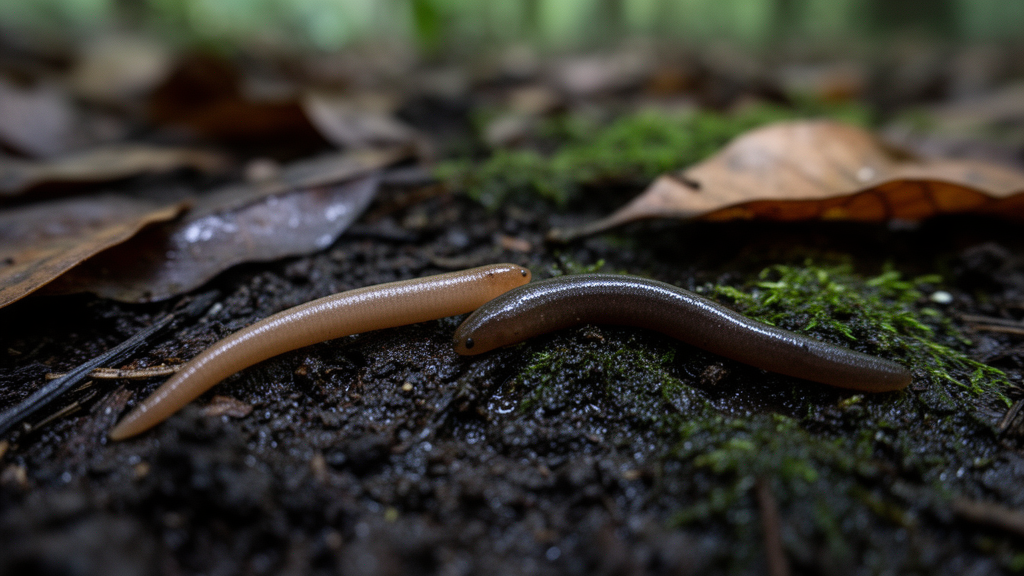
Beneath the clear, cold streams of China’s Taihang and Funiu Mountains lives a group of animals so inconspicuous that most people will never notice them: free-living freshwater flatworms of the genus Dugesia. Yet these humble planarians are now at the center of a discovery that is rewriting what scientists know about biodiversity in northern China. In a study published in the journal Zoosystematics and Evolution, researchers Guang-Wen Chen, Zi-Mei Dong and colleagues describe two new species of Dugesia from these mountain ranges, one of which turns out to be a sibling species so similar to a previously known flatworm that only a painstaking integrative analysis could tell them apart.
The genus Dugesia is one of the most extensively studied groups of free-living freshwater flatworms, with approximately 117 species reported across the Old World and Australia, from Africa and Europe to the Middle East, South Asia, and Australasia. Molecular studies suggest that the genus is ancient, originating in southern Gondwana and reaching its present distribution through a complex history of dispersal and vicariant events. China, however, was long overlooked as a potential distribution hotspot for the genus. Only recently have taxonomic studies begun to unveil its rich biodiversity there: seventeen species have been described from China’s Oriental Realm, while the Palearctic Realm, which covers much of northern China, had yielded just one new Dugesia species before this study.
The two mountain ranges where the new flatworms were found are geologically dramatic settings. The Funiu Mountains are an extension of the Qinling Mountains, forming the watershed between the Huaihe and Han River basins, and were shaped by the collision of the Northern China and Yangtze tectonic blocks as part of China’s Central Orogenic Belt. The Taihang Mountains, located at the eastern margin of the Loess Plateau, experienced several tectonic upheavals, including the Yanshanian, Himalayan, and Lüliangshian orogenic processes. Both ranges combine unique landforms with abundant water resources and a temperate monsoon climate, creating a mosaic of stable freshwater habitats that have facilitated both speciation and dispersal of freshwater planarians.
Collecting the worms required patience and a delicate touch. Specimens were gathered from under stones in streams with the help of a paintbrush and transported to the laboratory in plastic bottles of spring water packed in coolers with ice bags. More than 70 asexual worms and 20 sexual worms of the first new species, Dugesia cylindrica, were sampled from a small pool formed by a stream in the southern Taihang Mountains at an altitude of 350 meters, with additional specimens collected between 2018 and 2023 from localities in Linzhou City and Weihui City in Henan Province and Huairou village near Beijing. For the second new species, Dugesia elongata, over 70 asexual worms and seven sexual worms were collected from a small pool in Baiyun National Forest Park in the Funiu Mountains at 1100 meters, with further specimens from Yangcheng village in Shanxi Province. In the laboratory, the worms were cultured in autoclaved tap water at 16 degrees Celsius and fed fresh beef liver once per week, then starved for at least seven days before histological studies and DNA extraction.
The team applied an integrative taxonomic approach, combining morphological, karyological, histological, and molecular information. DNA was extracted and fragments of four genes were amplified: the cytochrome c oxidase subunit I (COI), internal transcribed spacer 1 (ITS-1), the 18S ribosomal gene, and the 28S ribosomal gene. Phylogenetic analyses were based on the two new species and available sequences of 52 other Dugesia species spanning the genus’s geographic range, with Schmidtea mediterranea, S. polychroa, and Recurva postrema serving as outgroup taxa. The concatenated dataset totaled 4298 base pairs. Maximum likelihood analysis was conducted with IQ-TREE using 10,000 standard bootstrap repetitions, while Bayesian inference was performed with MrBayes under the same substitution models, running two replicate Markov chain Monte Carlo calculations for 5,000,000 generations until the runs reached stationarity.
The phylogenetic trees revealed that all Chinese species fall into a group comprising Eastern Palearctic, Oriental, and Australasian species, a clade consisting of two main branches. Dugesia cylindrica and D. elongata belong to two different subclades that form sister taxa. D. cylindrica shares a robust sister-group relationship with a small clade comprising D. patula and D. postica, two species recently described from the Hengduan Mountains in southern China. D. elongata is sister to D. constrictiva from the Taihang Mountains, and together they are sister to D. verrucula from Guangxi Province. This close phylogenetic affinity between northern and southern Chinese species suggests a historical connection between the biotas, with present-day disjunct distributions potentially reflecting past biogeographical events across the significant geographical barriers formed by the Qinling Mountains and the vast lowlands of the North China Plain.
Genetic distances provided further evidence for the distinct status of the new species. The lowest COI distance values were 4.93 to 5.56 percent between D. cylindrica and D. patula and 12.02 percent between D. elongata and D. constrictiva, while the two new species differ from each other by 17.40 to 17.93 percent in COI. For ITS-1, the lowest values were 1.29 to 1.47 percent for D. cylindrica with D. patula and 1.66 percent for D. elongata with D. verrucula, with a 7.75 percent difference between the two new species. The team then applied four molecular species delimitation methods: Automatic Barcode Gap Discovery (ABGD), Assemble Species by Automatic Partitioning (ASAP), the Poisson tree process (PTP), and the Bayesian implementation of the Poisson Tree Processes (bPTP) model. The ABGD analysis partitioned the sequences into 22 operational taxonomic units, the optimal ASAP partition also identified 22 OTUs with complete congruence with ABGD, and the PTP method resulted in a slightly higher number of splits. Importantly, all analyses consistently recognized the populations of each new species as distinct OTUs, confirming their status regardless of which partition was preferred.
Anatomically, D. cylindrica is characterized by a sac-shaped copulatory bursa located immediately posterior to the pharyngeal pocket, a stubby cylindrical penis papilla with a blunt tip, a relatively large and pointed diaphragm, a long connecting duct between the seminal vesicle and diaphragm, and a slightly ventrally displaced ejaculatory duct with a terminal opening. Its karyotype is diploid with 16 metacentric chromosomes, examined across 168 metaphase plates of which 160 exhibited the diploid complement. D. elongata, in contrast, possesses a plump barrel-shaped penis papilla, an elongated dumb-bell-shaped seminal vesicle, a long connecting duct communicating with a low-conical diaphragm, a ventrally displaced ejaculatory duct opening at the ventral portion of the papilla tip, and asymmetrical openings of the oviducts. Remarkably, its karyotype is mixoploid, with diploid metacentric complements of 2n = 16 and triploid complements of 3n = 24 observed across 185 metaphase plates, 83 diploid and 102 triploid.
The case of D. cylindrica and D. patula is a textbook example of cryptic diversity. The two species are anatomically almost identical, differing only in the position of the copulatory bursa, which lies at a distance of approximately 400 to 600 micrometers behind the pharyngeal pocket in D. patula but immediately behind it in D. cylindrica. Their relatively low genetic distance means DNA barcoding alone fails to separate them cleanly, echoing earlier examples in the genus such as the Mediterranean species complex around D. benazzii, where detailed studies revealed multiple species that are not well separated by COI distance but can be differentiated by molecular species delimitation. Similar situations occur with D. aethiopica from Ethiopia and D. arabica from Yemen, which cannot be separated by COI genetic distance. These results indicate that DNA barcoding fails in special cases such as cryptic species and closely related species, and that only an integrative approach using both anatomical and molecular species delimitation can resolve such complicated species boundaries.
The discovery of two new species in a region previously thought to harbor limited Dugesia diversity strongly supports the hypothesis that the Palearctic Realm of China is a potential hotspot for the genus and that its species richness has been underestimated. The mixoploid karyotype of D. elongata adds another dimension to this picture, since polyploidy and mixoploidy are particularly prevalent in asexually reproducing populations and have been proposed as adaptive mechanisms to withstand harsh environmental conditions. Notably, D. elongata was collected at a water temperature of 6 degrees Celsius, the lowest documented temperature for any Chinese Dugesia species to date, reflecting the constant cool conditions of its spring-fed habitat. Because temperature regulates the switch between asexual and sexual reproduction in planarians, with low temperatures promoting sexual reproduction, water temperature may be a key factor shaping the diversity and composition of Dugesia species in Chinese mountains. The distribution records of the two new species underscore the rich diversity of freshwater planarians in northern China, and the discovery of the sibling species highlights the efficacy of integrative taxonomy in delimiting cryptic species that would otherwise remain hidden in plain sight.
Subject of Research: Freshwater planarian biodiversity and integrative taxonomy in northern China
Article Title: Unveiling cryptic diversity: two new species of Dugesia from northern China, including one sibling species ( Platyhelminthes , Tricladida , Dugesiidae )
Article References: Su, Y.-F., Yu, F.-Y., Wu, F., Wang, J.-Y., Sluys, R., Liu, D.-Z., Wang, L., Dong, Z.-M., & Chen, G.-W. (2026). Unveiling cryptic diversity: two new species of Dugesia from northern China, including one sibling species (Platyhelminthes, Tricladida, Dugesiidae). Zoosystematics and Evolution, 102(3), 783-805. https://doi.org/10.3897/zse.102.181547
Image Credits: AI Generated
Keywords: Dugesia, flatworms, planarians, cryptic species, integrative taxonomy, China, new species, phylogenetics, Unveiling, cryptic, diversity, species
News Source: Drew Townsend. (October 17, 2026). Two New Flatworm Species Unveiled in Northern China, Including a Hidden Sibling Species. Scienmag.